0 Car Service Italy 2026: Compare & Book Transfers
- Travel Tips
- by Tara Malone
- 21-04-2026
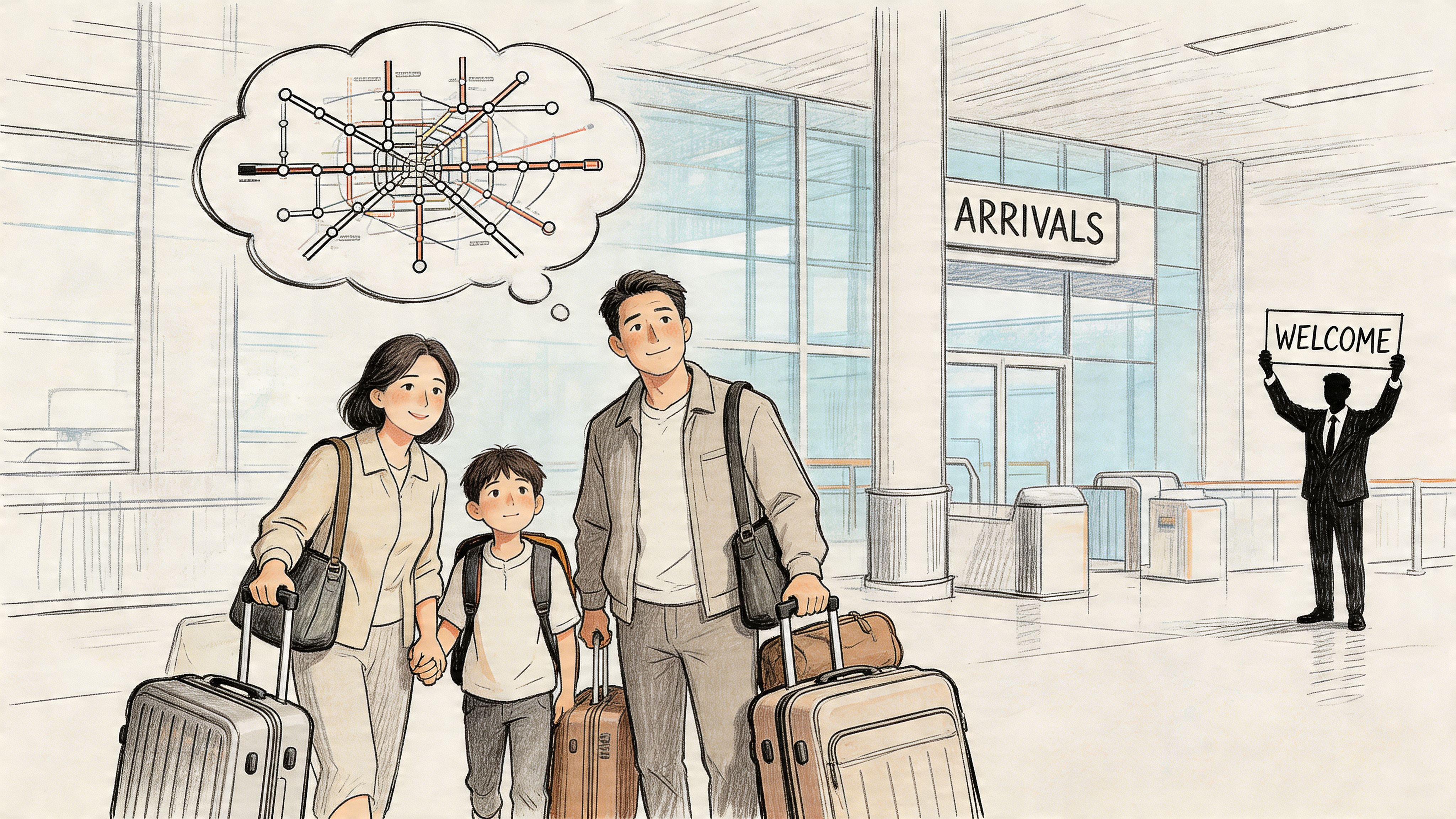
You land at Malpensa tired, slightly dehydrated, and already doing mental arithmetic. How many bags. How far to the train. Whether the children will hold up. Whether your hotel is inside a restricted traffic area. Whether the taxi line is moving or not.
That’s the moment when transport in Italy stops being an abstract planning task and becomes part of the trip itself.
For many visitors, car service italy isn’t about luxury in the glossy sense. It’s about removing friction. A pre-booked car, legal pickup, fixed pricing, and a driver who knows where your hotel entrance is can save a surprising amount of stress, especially in northern Italy where airport traffic, business schedules, lake destinations, outlet shopping, and cross-border routes all collide.
Table of Contents
- Arriving in Italy Your Guide to Seamless Travel
- Understanding Italy's Official Car Service (NCC)
- Comparing Your Transport Options in Italy
- Navigating Popular Northern Italy Routes
- What Should a Private Car Service in Italy Cost
- How to Book a Reliable Car Service and Avoid Scams
- Your Car Service Italy Questions Answered
Arriving in Italy Your Guide to Seamless Travel
At the big northern airports, the first challenge usually isn’t the journey itself. It’s the transition. You’ve gone from aircraft to passport control to baggage claim, and suddenly you need to choose between a queue, a ticket machine, a platform change, or a curbside negotiation.
That’s one reason chauffeured transport has become such a large part of the travel mix. The Italy car rental market, including chauffeur services, is projected to reach USD 5.01 billion by 2032, and northern Italy holds a 44% market share, driven by major gateways such as Milan Malpensa, which handled 25 million passengers in 2025 according to Credence Research on the Italy car rental market.
 For the traveler, that market data shows something simple. This isn’t a niche service anymore. It’s part of how people move through Milan, the lakes, trade fairs, wedding venues, and Alpine resorts.
The airport reality most visitors discover late
A train works well when all the pieces line up. One suitcase. One destination near a station. No child seat needed. No delayed arrival. No villa on a hillside road. No apartment host waiting with keys.
A pre-booked car works better when the trip has any complexity at all. Airport pickup is clear. Luggage is handled. The destination doesn’t need to be “near enough” to a rail line. If you’re still deciding how to combine airport transfer with city sightseeing, this guide to Milan tourist places public transport options and airport transfers is a useful planning reference.
A smooth arrival in Italy usually comes down to one question. Do you want to manage connections after landing, or do you want the transfer already solved before wheels touch down?
When a private car is the practical choice
It makes the most sense in a few recurring situations:
- Family arrivals: Strollers, extra bags, and tired children turn “cheap” transport into a long sequence of small hassles.
- Business schedules: If you’re heading straight to a meeting, exhibition, or hotel check-in, uncertainty costs more than the transfer.
- Group travel: Once several people are moving together, door-to-door transport often becomes simpler than splitting across train cars, taxis, or airport buses.
- Regional destinations: Lake Como, outlet shopping, ski resorts, and smaller towns aren’t hard to reach with a professional driver. They are hard to reach elegantly after a long flight.
Understanding Italy's Official Car Service (NCC)
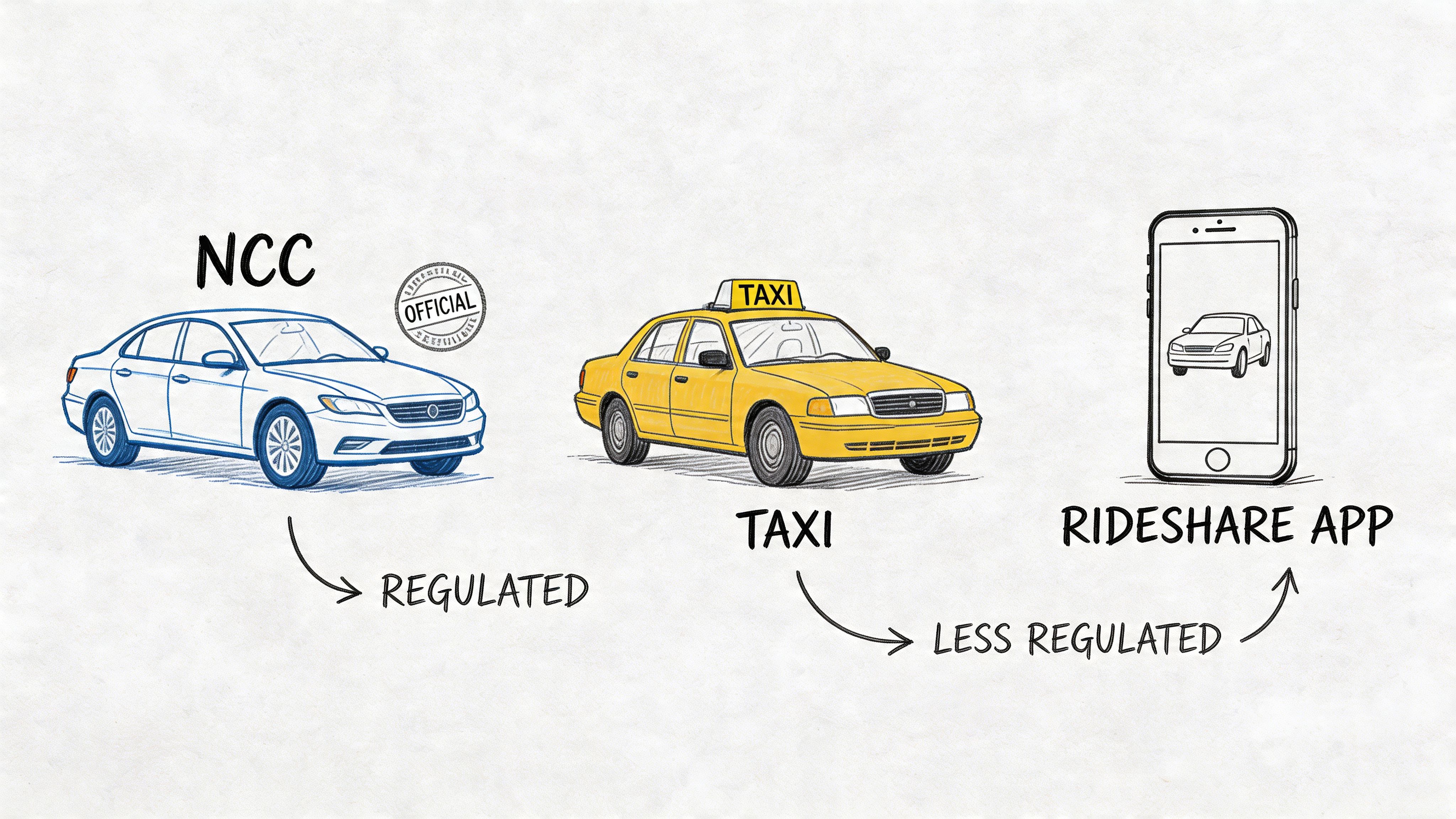
Italy’s legal private chauffeur system has a specific name: NCC, short for Noleggio con Conducente. If you book a car service rather than waving down a street taxi, this is the framework you want.
That matters because Italy has a clear line between licensed chauffeur services and informal operators who look convenient but can create problems fast.
What NCC actually means on the ground
An NCC service is pre-booked and typically offered at a fixed price, rather than a running meter. That changes the whole experience. You agree on the service before pickup. You know who is coming. You know what vehicle is assigned. You know where the meeting point is.
It also changes the legal protections attached to the ride. According to Tiber Limo’s explanation of Italian luxury limo service rules, licensed NCC vehicles must display a municipal crest and authorization number near the rear license plate. The same source states that this means the driver is professionally qualified and carries commercial insurance with liability coverage typically between €10-20 million.
How to spot a legal operator
Most visitors never check this, and they should.
A legitimate NCC car shouldn’t feel vague. It should be identifiable and documented. If a driver approaches you in an airport arrivals hall without clear booking details, I’d be careful. Professional operators normally work from confirmed reservations, not improvised curbside offers.
Use this short checklist:
- Look at the rear plate area. You should see the municipal crest and authorization number.
- Ask for written confirmation. A proper operator sends booking details in advance.
- Check the pricing format. NCC rides are typically quoted ahead of time, not left open-ended.
- Confirm the company identity. The car, driver details, and contact method should match your reservation.
Practical rule: If the pickup feels improvised, undocumented, or oddly insistent, skip it.
There’s also a service difference many travelers notice only after using both. Taxi service is built around availability in the moment. NCC service is built around execution of a reservation. That usually means better coordination for airport arrivals, hotel pickups, exhibitions, lake villas, and wedding logistics where timing matters.
A legal NCC service won’t always be the cheapest option for every short urban ride. It is often the safest and clearest option for pre-arranged travel with luggage, children, multiple stops, or a tight schedule.
Comparing Your Transport Options in Italy
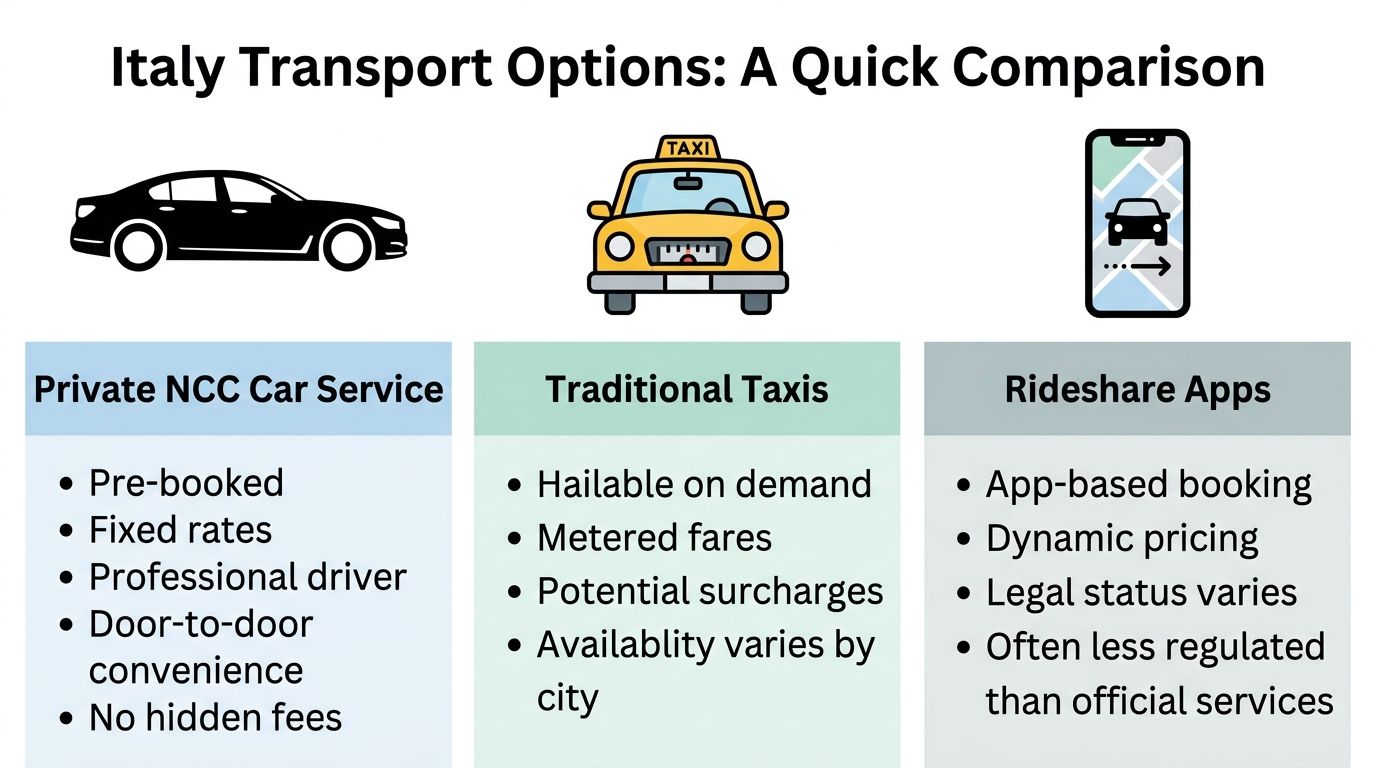
Italy gives you four realistic transport choices for many trips: NCC car service, taxi, train, and in some cities car sharing. They all work. They just don’t work equally well for the same traveler.
The most common mistake is comparing them only on headline price. In practice, the right comparison is convenience, total handling, predictability, and whether the transport matches the route.
For solo travelers and business arrivals
If you’re traveling alone and your destination is close to a major station, the train can be excellent. Milan is strong on rail links, and for simple city-to-city movement it’s often the cleanest solution.
Taxis work when you need immediate departure and don’t want to pre-plan. The trade-off is uncertainty. You may queue, you may hit traffic on a meter, and during busy periods availability can become a significant issue.
An NCC service is usually the strongest choice when the arrival itself needs to be managed well. Business travelers often prefer it for meet-and-greet pickup, fixed invoicing, direct hotel or office drop-off, and the ability to work undisturbed instead of decoding airport signage after a long flight.
For families and groups
Here, transport math changes fast.
A train may look economical on paper, but families often end up paying in effort. You still need the airport connection, station navigation, luggage handling, and then another transfer from the destination station to the final address. If your apartment is on a slope in Bellagio or your hotel is outside the old town core, the “last mile” becomes the whole problem.
For group trips, a dedicated van or minibus is often the practical answer. That’s especially true for lakes, outlet shopping, ski departures, weddings, and multi-generational family travel. If Lake Como is on your itinerary, this guide to transportation from Milan to Bellagio shows why route details matter more than people first assume.
A practical side by side view
Milan also has a strong car-sharing culture. According to Statista’s overview of car sharing usage in Italy, Milan has 18 car-sharing vehicles per 10,000 inhabitants, the highest in the country. That’s useful context, but car sharing solves a different problem. It’s designed for short urban hops, not airport meet-and-greet, not child-seat planning, and not comfortable long-distance travel for a family or group.
| Option | Best use | What works well | What usually doesn’t |
|---|---|---|---|
| NCC car service | Airport transfers, regional routes, groups, business travel | Fixed booking, door-to-door, luggage help, planned pickup | Less useful for a very short spontaneous in-city hop |
| Taxi | Immediate city ride, short direct trips | Easy when available, no advance planning | Meter risk, queue time, limited group comfort |
| Train | Major city-to-city journeys | Efficient between stations, strong for solo travelers | Poor for door-to-door airport transfers and complex luggage |
| Car sharing | Short city errands | Flexible for local urban use | Not ideal for long distances, groups, or airport arrivals |
Car sharing is a city tool. A chauffeur service is a trip tool. Mixing them up leads to bad decisions.
A useful way to decide is simple. If your trip has one station and one backpack, look at rail first. If it has bags, children, timing pressure, a border crossing, or more than two passengers, start with a fixed-price car service.
Navigating Popular Northern Italy Routes
Northern Italy looks compact on a map. On the ground, the routes vary a lot. Airport roads, lake towns, resort access, and low-emission rules create very different conditions from one journey to the next.
That’s why travelers who are perfectly happy using trains elsewhere often switch to a driver for these routes.
Airport to city without guesswork
For Milan arrivals, the challenge is rarely distance alone. It’s congestion, meeting points, and timing. A late landing can turn a simple transfer into a queue, and the queue isn’t always the only issue. You may still need to explain a hotel entrance, a side street, or a ZTL-adjacent drop-off point.
According to Italia Concierge on private chauffeur services across Italy, with Milan’s Area B/C low-emission zones expanding in 2026, many older taxis face restrictions, while licensed NCC fleets maintain compliant vehicles such as Euro 6, helping avoid the 45-60 minute airport taxi delays reported at peak times.
That matters most on arrival days when everything is stacked together. Baggage delay, hotel check-in window, dinner reservation, and city traffic.
Lakes outlets and mountain departures
Lake Como is a classic example of where rail and road serve different needs. If you’re staying near a station town and traveling light, public transport can work. If you’re heading to a lakeside hotel, a private villa, or a hilltop property, a direct driver saves both time and unnecessary transfers.
The same logic applies to outlet trips and ski departures. Serravalle and FoxTown are easy enough by road, but less pleasant when the day involves shopping bags, family members moving at different speeds, or a fixed return time. Ski transfers add another layer. Winter luggage, early departures, and mountain road conditions reward good planning. For alpine travel, this look at a private transfer from Malpensa to Bormio captures the practical side of that journey.
Cross-border travel and restricted zones
Switzerland catches people off guard.
Not because the route is hard, but because the rules are easy to overlook when you’re self-managing. Border documentation, motorway access requirements, toll treatment, and final drop-off logistics all become part of the trip. A pre-booked chauffeur service usually handles those details in the quote and route plan.
Then there are the urban restrictions. Visitors know about old city centers, but they often don’t realize how many access rules affect driving and stopping. In Italy, that can mean low-emission restrictions, limited traffic zones, and awkward hotel approaches where a local driver’s familiarity saves both time and penalties.
On northern routes, local knowledge isn’t decorative. It changes where the vehicle can go, where it can wait, and how cleanly the trip ends.
For groups, the advantage becomes even clearer. One coordinated vehicle arriving at the right entrance is far easier than splitting arrivals across taxis or trying to reassemble after rail connections.
What Should a Private Car Service in Italy Cost
Most travelers don’t mind paying for convenience. What they hate is ambiguity. That’s why fixed-price booking remains the strongest argument for using an NCC service on airport and regional routes.
With a proper quote, you’re buying clarity as much as transport.
Where fixed pricing helps
The classic example is Malpensa into Milan. According to Blacklane’s Italy service page, an official taxi from Malpensa to Milan can cost €100-€120 depending on traffic, while a fixed-price private service is typically €90-€110.
That difference matters because the comparison isn’t just fare versus fare. It’s meter versus confirmed total. In airport traffic, a metered trip keeps moving upward while your patience moves the other way. A fixed quote removes that variable.
The same source notes that for cross-border trips to Switzerland, savings can be over 30%, because private transfers include tolls and vignette costs transparently. That’s one of the hidden-cost areas many visitors miss when they compare only the first number they see.
Fixed pricing works best when the route has uncertainty. Traffic, border formalities, tolls, and airport pickup delays all punish vague pricing.
Sample Fixed vs Metered Costs 2026 Estimates
| Route | Fixed-Price Car Service (NCC) | Metered Taxi (Traffic Dependent) |
|---|---|---|
| Malpensa to Milan city | €90-€110 | €100-€120 |
| Cross-border trip to Switzerland | Fixed quote with tolls and vignette included | Can be higher, with private transfers saving over 30% in some cases |
Two pricing models matter when you book:
- Point-to-point transfer: Best when you need one direct journey from airport, hotel, station, or venue to a final destination.
- Hourly hire: Better for roadshows, shopping days, wedding movements, or a meeting schedule with several stops.
If your plan is simple, point-to-point usually gives the cleanest value. If the day involves waiting, multiple addresses, or uncertain timing, hourly service can be the smarter buy because it removes the need to keep rebooking transport.
For travelers comparing operators, the key question isn’t “What’s your cheapest car?” It’s “What exactly is included in the quoted price?” Fuel, tolls, waiting policy, child seats, and border-route handling all belong in that conversation.
How to Book a Reliable Car Service and Avoid Scams
You land at Malpensa after a long flight, your group has six large bags, and the driver who was "waiting outside" stops answering messages. That is how expensive transport mistakes start in Italy. The safest booking is the one that feels specific before you pay.
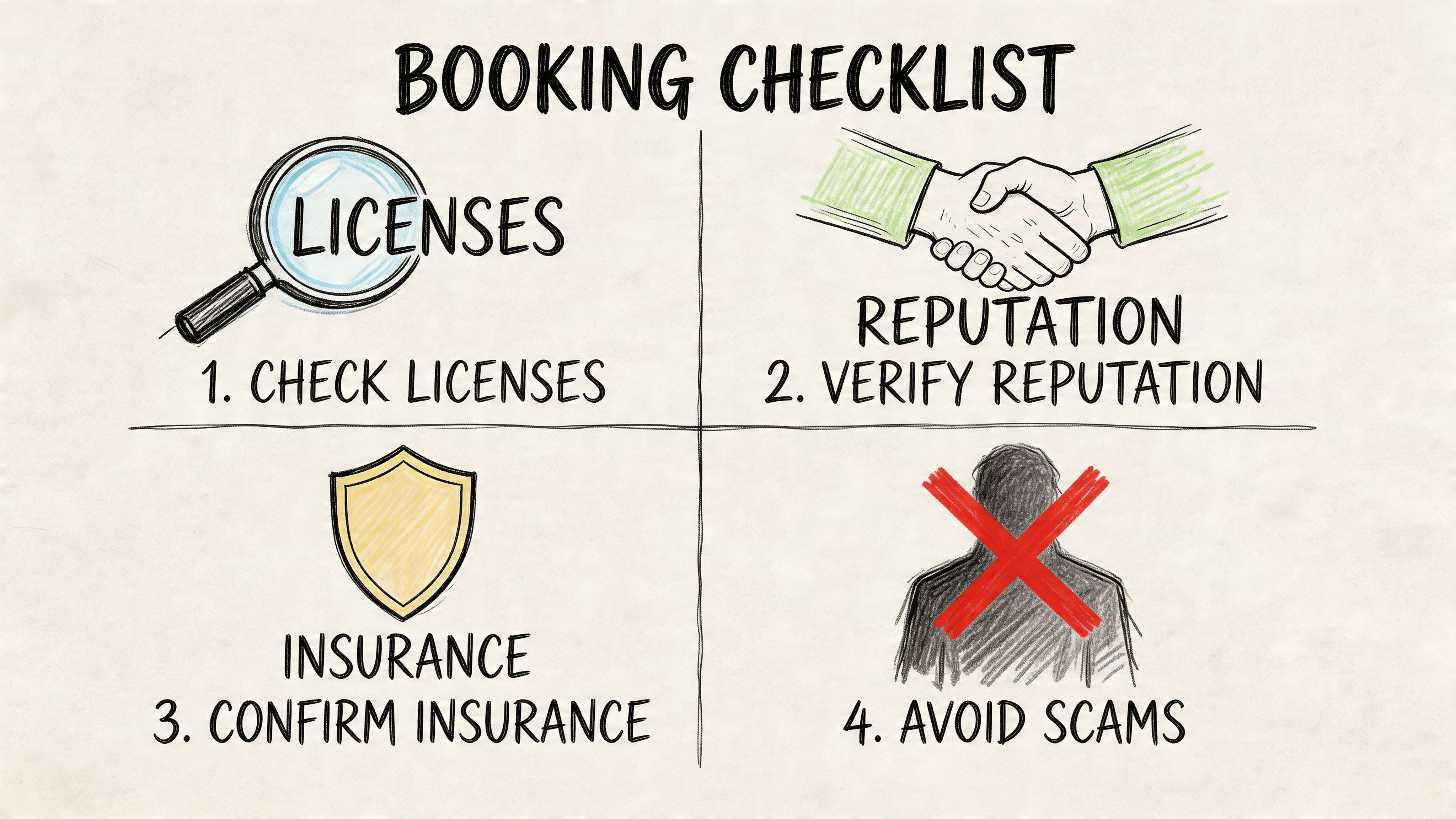
A reliable NCC booking should answer the practical questions upfront. Who is operating the service? Where exactly is the meeting point? What happens if the flight is late? What luggage fits in the booked vehicle? If those answers are vague before payment, expect problems on arrival day.
The booking checks that matter
Start by verifying the operator, not the car photo. Glossy vehicle images are easy to copy. A professional transport company confirms the booking in writing, identifies the service category clearly, and gives you a real contact method that works on the day.
Look for these signs:
- Written confirmation: Full trip details, total price, and pickup instructions should arrive by email or message.
- Named meeting instructions: The operator should tell you whether the driver meets you in arrivals, at a chauffeur desk, or at a specific curbside point.
- Licensing clarity: A legitimate NCC provider should explain its status without hesitation.
- Delay handling: Airport pickups need a clear policy for late landings, baggage delays, or missed connections.
- Vehicle realism: Ask what fits in the car. Two adults with four large suitcases may need a van, not an executive sedan.
TransferMilan.com is one example of an operator in this category. The useful part is not branding. It is the booking format: fixed quotes, written confirmations, multilingual communication, and service built around airport and long-distance transfers.
What to confirm before arrival day
Send the details that affect execution, not just the route:
- Flight number and arrival airport
- Full drop-off address
- Passenger count
- Luggage count and size
- Child seat request
- Any intermediate stops
- Whether the trip crosses into Switzerland or another border area
That last point matters more than many travelers expect in northern Italy. Cross-border trips can fail if the route details are left vague, and last-minute changes often trigger extra charges or dispatch confusion. For groups, one wrong vehicle assignment can cost more than the original fare difference between a sedan and a van.
Here’s a useful visual overview before you reserve:
Two warning signs come up again and again. First, operators who avoid giving a full price in writing. Second, drivers or brokers who promise to "sort the details later." Good dispatch teams confirm early because they are assigning the right vehicle, checking the route, and planning airport timing properly.
If you want to avoid scams, ask one direct question before paying: What is included, and what could change the final price? A serious operator will answer clearly. That is usually the difference between a smooth arrival and an argument in the pickup lane.
Your Car Service Italy Questions Answered
A few practical questions come up again and again, especially from international travelers arriving in Milan.
| Question | Answer |
|---|---|
| Is a private car service in Italy the same as a taxi? | No. A private chauffeur service operates under the NCC system and is usually pre-booked with a quoted fare. |
| Can I use a train instead for airport transfers? | Yes, if you’re traveling light and your destination is close to a station. For families, groups, or exact hotel drop-off, a car is usually easier. |
| Are child seats available? | Many operators can provide them on request, but you need to ask during booking rather than at pickup. |
| Is a car service worth it for groups? | Usually yes. Once several people and multiple bags are involved, a van or minibus often becomes the simplest option. |
| What about flight delays? | Professional airport transfer operators monitor arrival timing and adjust the pickup process. Confirm the delay policy before booking. |
| Can I book for Italy and Switzerland in one trip? | Yes, many private operators handle cross-border transfers. Make sure the quote clearly includes route-related costs and final destination details. |
If you want a straightforward quote for Milan airport transfers, Lake Como trips, outlet runs, business travel, or group transport across northern Italy, TransferMilan.com is a practical place to start.