0 Closest Airport to St. Moritz: Your 2026 Travel Guide
- Travel Tips
- by Tara Malone
- 16-07-2026

Samedan Airport is technically the closest airport to St. Moritz, sitting about 5 km away, but it has no scheduled commercial passenger services and is really a private aviation airport. For most travelers, the practical choice is Milan Bergamo (BGY), the closest major international airport at about 152 km by road with a drive of roughly 2.5 hours under good conditions.
If you're planning a St. Moritz trip right now, you're probably making a common initial check. You open a map, type in the resort, see a tiny airport almost next door, then notice every guide pushes Zurich. That’s where a lot of bad routing decisions begin.
As someone who works from the Milan side of the Alps, I’ll be blunt. Zurich is the default answer, not always the smart answer. If you care about transfer time, simpler road logistics, low-cost flight options, and easier group travel, Milan deserves a lot more attention than it gets. And if you're comparing Milan, Zurich, and Innsbruck, the airport itself matters less than the transfer route that follows.
Table of Contents
- Your 2026 Guide to Reaching St. Moritz
- Samedan Airport The Private Jet Gateway
- Major Airports Near St. Moritz A Head-to-Head Comparison
- The Local's Perspective Why Milan Is Your Smartest Start
- Choosing Your Transfer Private Car Train or Taxi
- Tips for Groups Families and Ski Trips in 2026
- Arrive in St. Moritz Refreshed and Ready
Your 2026 Guide to Reaching St. Moritz
A St. Moritz trip usually starts with the glamorous part. The hotel shortlist, the ski dates, the lake views, the restaurant bookings. Then the practical question lands hard. Which airport gets you there with the least friction?
Most travelers first hear “Zurich.” That’s understandable. It’s a major Swiss hub, it’s well known, and plenty of booking platforms surface it first. But the closest airport to st moritz depends on what you mean by “closest.” If you mean literal runway proximity, it’s Samedan. If you mean realistic commercial access, the conversation changes fast.
The question behind the question
You’re not really asking which airport is nearest on a map. You’re asking which airport gives you the cleanest arrival, the least awkward transfer, and the fewest headaches with luggage, skis, weather, and connections.
That’s why this topic confuses people. Travel guides often mix up three different things:
- Geographic closeness: The airport nearest the resort itself.
- Commercial usefulness: The airport you can book on a normal airline ticket.
- Transfer efficiency: The airport-plus-route combination that gets you to your hotel with the least hassle.
Practical rule: Ignore map distance on its own. Judge the whole chain from landing to hotel door.
My direct recommendation
If you’re flying commercial and want the most practical southern approach, start by checking Milan Bergamo. If your airline schedule works better through Milan Malpensa, that’s also a solid option. Zurich still makes sense for some itineraries, especially if you strongly prefer rail, but it isn’t automatically the winner.
That’s the Milan-side advantage. You’re looking at a route many generic guides underplay, even though it often makes more sense for European travelers and for anyone organizing a smooth private ground transfer.
Samedan Airport The Private Jet Gateway
Samedan answers the literal question. It does not answer the practical one.
Engadin Airport St. Moritz-Samedan (SMV/LSZS) is just minutes from the resort and is Europe’s highest paved airport at 1,707 meters. But its operations are limited to daylight hours under visual flight rules, and the high altitude can reduce aircraft takeoff performance by 20 to 30 percent, which is one reason it serves private charters and specialized flights only, with no scheduled passenger services according to Acukwik airport information for LSZS.
Why most travelers can ignore it
If you're booking on Lufthansa, easyJet, Ryanair, Swiss, British Airways, Emirates, or any standard commercial carrier, Samedan isn’t your arrival airport. It won’t solve your holiday logistics unless you’re already operating in the private aviation world.
That gap matters because “closest” sounds useful until you realize the airport doesn’t function like a normal passenger gateway. For almost everyone, it’s a dead end in search results.
A better way to think about Samedan is this:
- Private jet users can treat it as the final airborne gateway.
- Everyone else still needs to choose a major airport and then plan ground transport properly.
- Luxury travelers without private aircraft often end up using Milan anyway, because the road transfer is the practical part nobody should leave to chance.
When Samedan actually matters
It matters if you’re chartering an aircraft, coordinating executive arrivals, or asking a concierge to build a fully private itinerary. If that’s your world, it helps to understand fixed-base operations and airport handling. A useful primer is Craft Pod private aviation basics, especially if you want a clearer picture of how private jet arrivals differ from commercial terminals.
Samedan is close enough to feel obvious, but restrictive enough to be irrelevant for most bookings.
That’s the key distinction. Don’t confuse airport proximity with traveler accessibility.
Major Airports Near St. Moritz A Head-to-Head Comparison
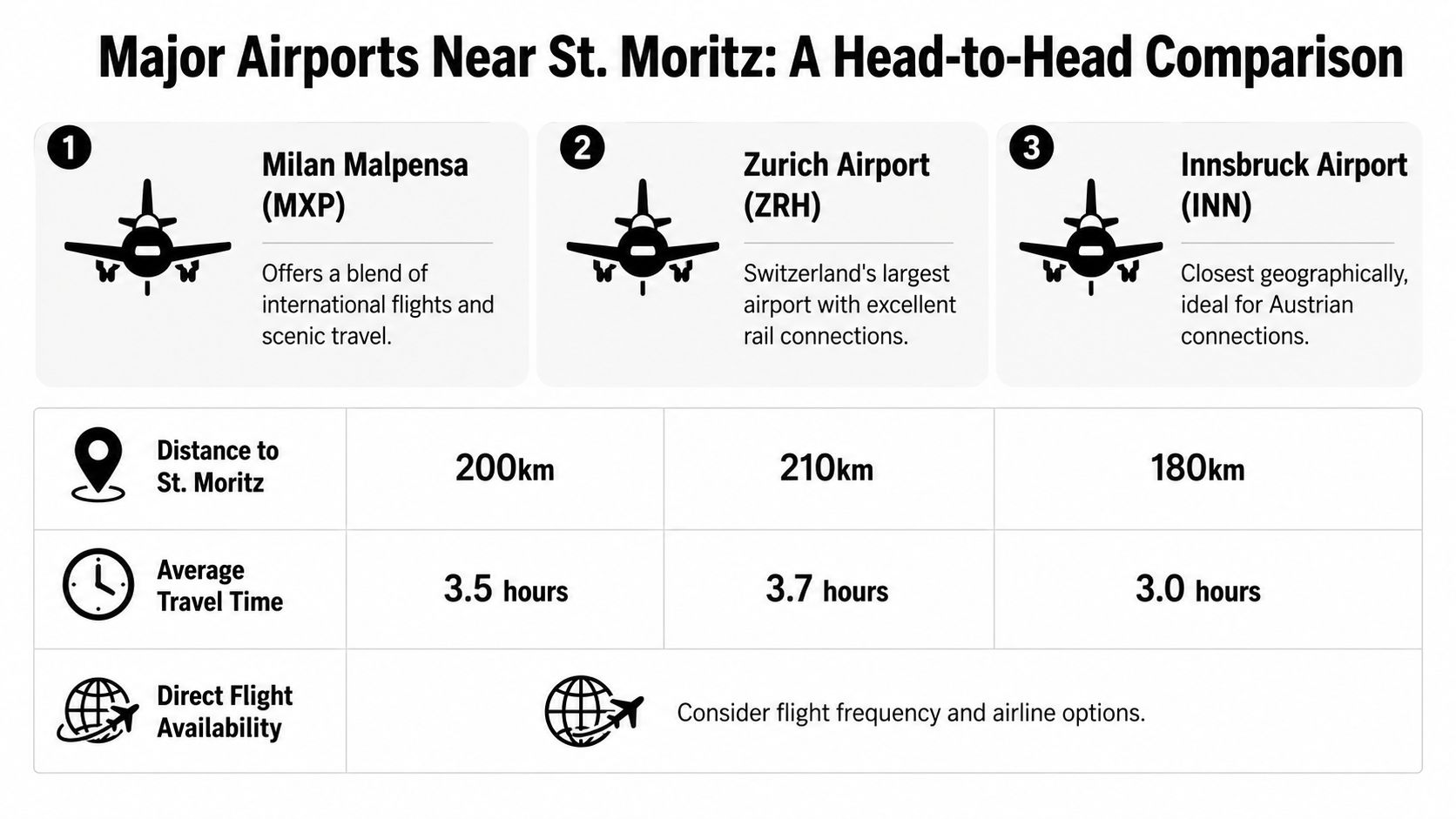
For commercial travelers, there are three names that matter most in real planning conversations. Milan Bergamo, Milan Malpensa, and Zurich. Innsbruck comes up often, but if you’re choosing from the data we can verify here, Milan and Zurich are the meaningful comparison points.
The numbers that matter
The cleanest comparison comes from Ultimate Ski’s St. Moritz access guide. It places Zurich Airport at about 200 km from St. Moritz with an approximate 3-hour drive or 4-hour train, Milan Malpensa at 186 km with an approximate 3-hour drive, and Milan Bergamo at 152 km by road with an approximate 2.5-hour drive, making BGY the closest major international airport.
| Airport | Role for most travelers | Approximate road distance | Approximate drive time |
|---|---|---|---|
| Milan Bergamo BGY | Closest major international option | 152 km | 2.5 hours |
| Milan Malpensa MXP | Strong full-service Milan gateway | 186 km | 3 hours |
| Zurich ZRH | Traditional Swiss hub with rail appeal | 200 km | 3 hours by car or 4 hours by train |
| Samedan SMV | Private aviation only | not the right benchmark for commercial travel | not relevant for scheduled airline passengers |
A quick planning note. If you're the kind of traveler who studies airport wayfinding before departure, the Waymap guide for Calgary departures is a good example of the kind of terminal-prep thinking that saves time anywhere. The airport changes, but the logic is the same: know your arrival flow before you land.
What this means in practice
BGY wins on raw road efficiency. MXP wins when your airline network or long-haul routing is better there. Zurich wins if you want to stay entirely in the Swiss transport ecosystem and don’t mind the longer train journey.
That makes airport choice less about prestige and more about fit.
- Choose BGY if you want the shortest major-airport road approach.
- Choose MXP if you need broader intercontinental flight options through Milan.
- Choose ZRH if rail matters more to you than door-to-door efficiency.
- Ignore SMV unless you’re arranging private aviation.
If you’re comparing other alpine itineraries from the Milan side, this pattern isn’t unique to St. Moritz. The same planning logic shows up in private transfer routes for Bormio from Malpensa, where airport choice shapes the entire ground journey.
The airport isn’t the trip. The route after landing is the trip.
That’s why I push people to stop asking only “Which airport is nearest?” and start asking “Which airport gets me moving cleanly after I land?”
The Local's Perspective Why Milan Is Your Smartest Start
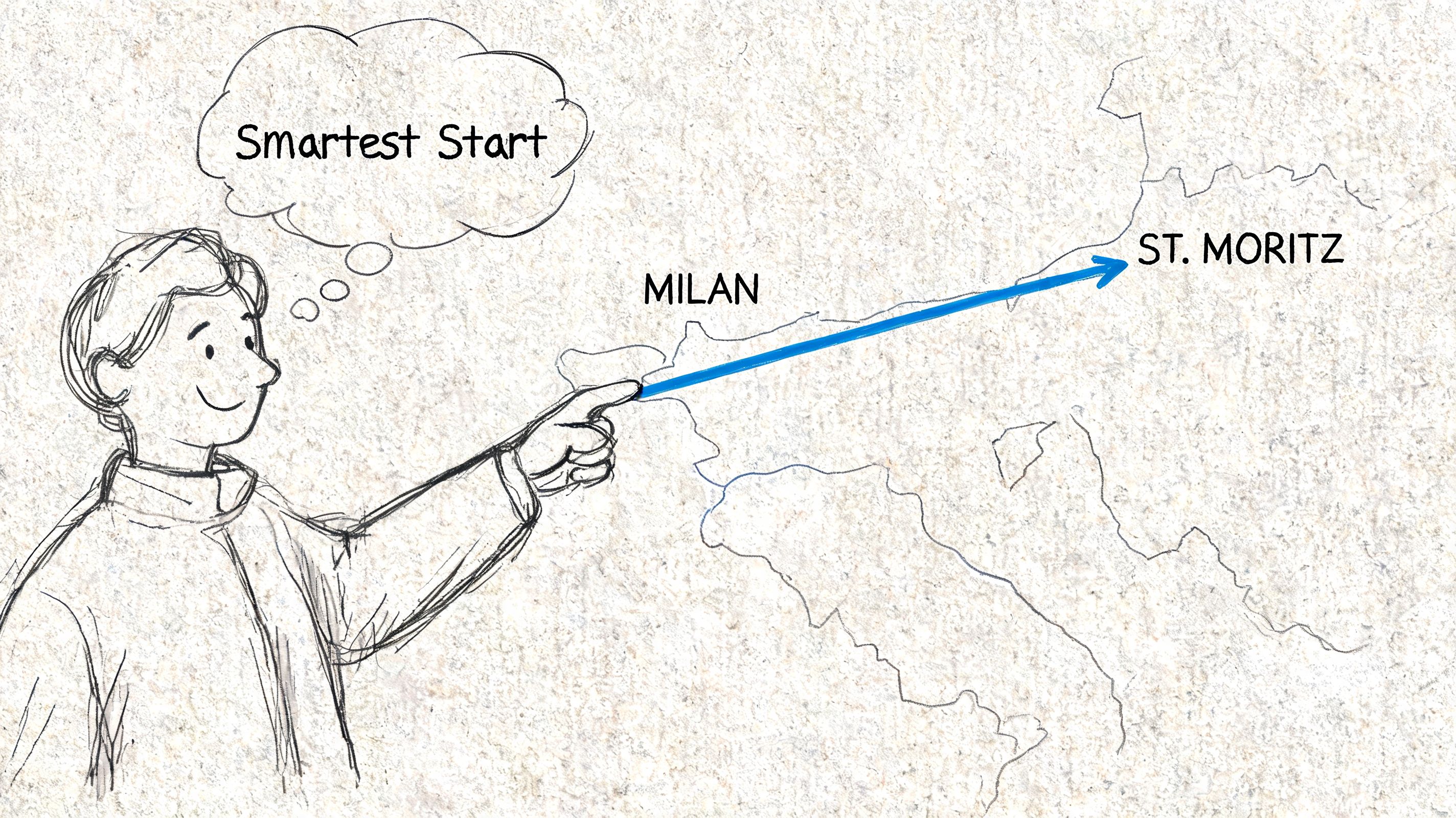
A map won’t tell you what a local driver knows. It won’t show which approach feels straightforward after a long flight, which route makes sense for ski bags, or which airport gives your group the fewest moving parts. That’s where Milan often pulls ahead.
Why Bergamo changes the calculation
The biggest miss in generic guides is simple. They talk about Zurich first because it’s Swiss, not because it’s always the most practical. But the southern approach from Italy deserves serious attention.
The route from Milan Bergamo via the Maloja Pass is not only the shortest by distance, it can also reduce fuel consumption by up to 30 percent compared with the longer journey from Zurich, and the route is served by vehicles using mandatory winter tires from November to April, as noted in the earlier linked airport comparison source. That fuel-efficiency point isn’t just an environmental footnote. It reflects a shorter, more direct approach.
For travelers from southern Europe, and for many people arriving on low-cost carriers, Bergamo is often the sensible airport. You land closer to the practical road route and skip the reflexive detour through Zurich.
What most travel guides miss about the Italian side
The Italian approach feels different. It’s not just about mileage. It’s about travel rhythm.
A few practical observations matter here:
- Low-cost access: Bergamo is especially useful if your flight options favor budget carriers across Europe.
- Road continuity: A private road transfer from Milan is usually simpler than mixing air, train, platform changes, and a final local taxi.
- Group logic: When several people arrive together, one vehicle from the airport is often cleaner than spreading everyone across rail connections.
I also like Milan because it gives travelers flexibility before they head into the mountains. Some people overnight in the city, some meet friends there, and some build a longer Lombardy trip around the ski stay. If that’s part of your plan, this guide to Milan sights, public transport, and airport transfers is a useful starting point.
Coming from Milan often feels less like a transfer problem and more like a controlled handoff from city to mountains.
That’s what people want after a flight. Not theory. Not “maybe.” A route that works.
Choosing Your Transfer Private Car Train or Taxi
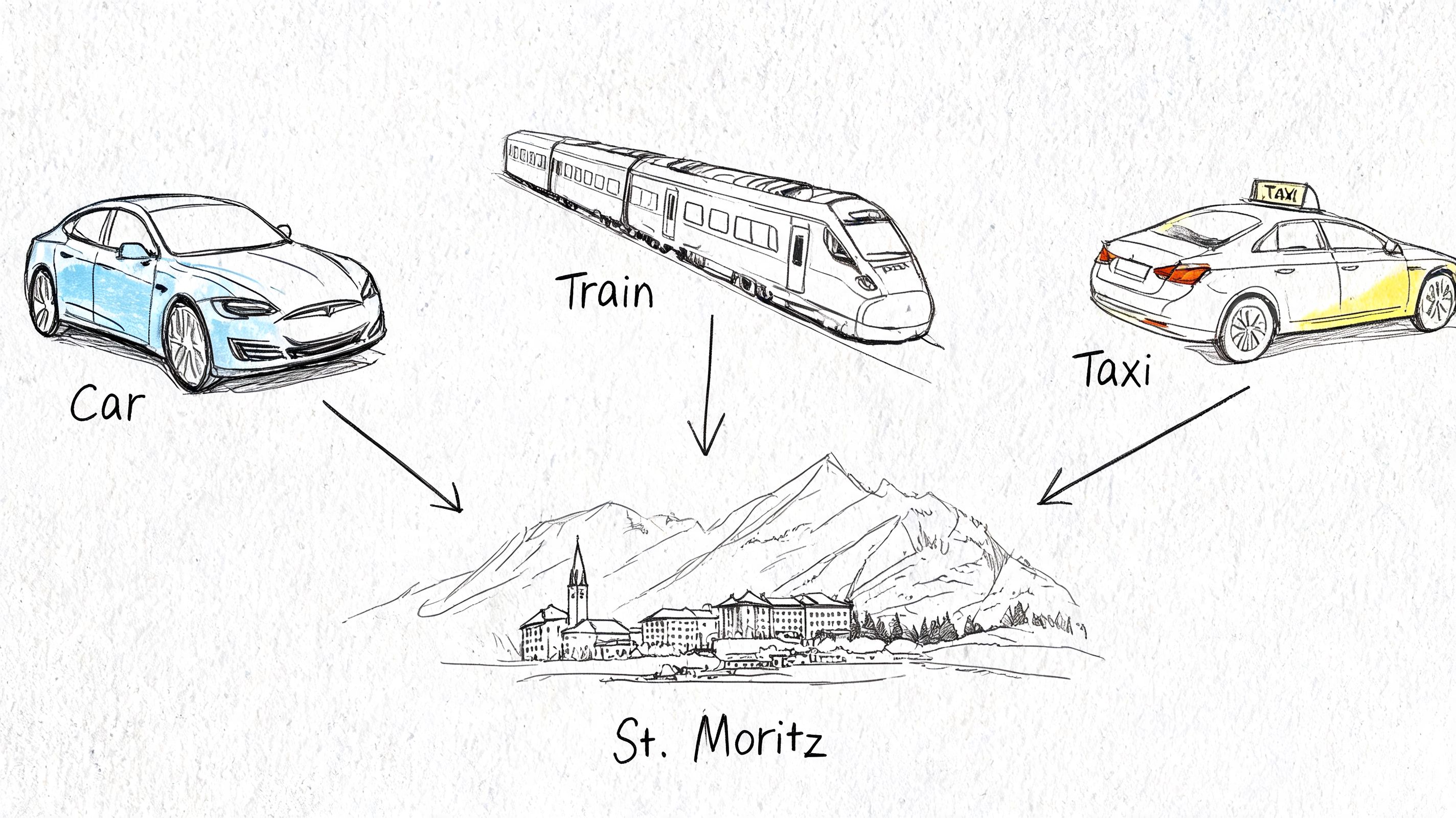
Once you’ve picked the airport, the next decision matters just as much. How do you get to St. Moritz?
Private car when convenience matters
If you value door-to-door travel, a pre-booked private car is the cleanest option. One pickup, one vehicle, one luggage load, one arrival point. That’s why business travelers, families, and ski groups usually prefer it.
The main advantages are practical:
- Door-to-door routing: No platform changes, station transfers, or hotel shuttles.
- Luggage handling: Better for skis, snowboards, and winter bags.
- Fixed planning: You know who’s meeting you and where the trip ends.
- Group coordination: One shared vehicle avoids scattered arrivals.
One option in this category is TransferMilan’s Italy car service and transfer comparison, which outlines how fixed-price airport transfers differ from ad hoc car bookings.
Train when scenery beats simplicity
Train travel from the Swiss side has obvious appeal. The scenery is beautiful, and some travelers enjoy rail more than road. But it’s rarely the easiest choice after a flight, especially if you’re carrying ski equipment or traveling with children.
The tradeoff is friction. Airport to station. Station to train. Train changes. Then station to hotel at the resort. If everything connects neatly, rail can be pleasant. If your arrival is delayed or your group is large, it stops being elegant very quickly.
A few minutes of route footage helps set expectations for alpine driving and arrival conditions:
Taxi when you have no better option
I treat long-distance airport taxis as a fallback, not a plan. They can work, but they’re often the messiest middle ground between a train and a pre-arranged transfer.
Here’s the problem with relying on a taxi rank for an alpine route:
- Availability is uncertain for a long cross-border or mountain journey.
- Vehicle suitability varies, especially if you have bulky luggage.
- Pricing clarity may be weaker than with a booked transfer.
- Group travel becomes awkward fast, because one taxi may not solve the whole move.
If you’re solo, lightly packed, and flexible, you can take more chances. If you’re arriving late, traveling with kids, or trying to keep a ski holiday smooth from minute one, don’t improvise the final leg.
Tips for Groups Families and Ski Trips in 2026
Groups expose every weak point in a transfer plan. The train that looked charming for two adults starts to unravel when you add children, ski bags, extra suitcases, or multiple arrival times. That’s why this is the section many travelers should read first, not last.
The practical reality is simple. For 99% of travelers, St. Moritz access is about ground transport, and the “Samedan Dead Zone” means even affluent groups often fly into Milan and need coordinated overland logistics, a point reflected in the Wikipedia overview of Samedan Airport.
What works better for groups
For a group, the right question isn’t “What is the cheapest ticket per person?” It’s “What creates the fewest failure points?”
A single coordinated vehicle usually beats fragmented transport because it helps with:
- One shared arrival plan: No splitting the party across separate trains or taxis.
- Hotel drop-off: Everyone gets delivered to the actual accommodation, not just a station.
- Shared equipment handling: Ski bags and large suitcases stay with the group.
- Clear supervision for children: Parents aren’t managing platforms and luggage at the same time.
Family and ski gear realities
Families should think less about map theory and more about moments of friction. The hard parts are never the glamorous ones. Car seats, tired children, wet boots, delayed flights, and oversized bags are the main causes of stress.
For ski trips, I recommend deciding three things before you book anything else:
- Your airport based on the road route, not brand recognition
- Your transfer method based on luggage reality
- Your fallback plan if flight timings shift
When a group lands in winter, simplicity is worth more than a clever itinerary.
That’s especially true in 2026, when alpine traffic and winter travel demand will keep pushing travelers toward plans that are easy to execute, not just nice on paper.
Arrive in St. Moritz Refreshed and Ready
The closest airport to st moritz is Samedan. For almost everyone reading this, that fact is useless.
The decision that matters is your major-airport route. On that question, Milan Bergamo is the standout practical choice, and Milan Malpensa is a strong alternative when your flight schedule fits better there. Zurich still has a place, especially for rail-focused travelers, but it’s too often treated as the automatic answer when it should be one option among several.
My advice is direct. If you want the trip to feel organized from the moment you land, build the journey around Milan and pre-arrange the road transfer properly. That gives you a cleaner handoff, better control over luggage and group logistics, and a more straightforward start to a St. Moritz stay.
If you want a fixed-price, door-to-door ride from Milan Malpensa, Linate, or Bergamo to St. Moritz, TransferMilan LLC offers private cars, minivans, minibuses, meet-and-greet service, and luggage support for solo travelers, families, and groups. Request a quote before you fly, lock in the route, and arrive in St. Moritz without turning the last leg into the hardest part of the trip.