0 How to Get Transfer Reviews: A 2026 Playbook
- Travel Tips
- by Mario Berlusco
- 21-04-2026

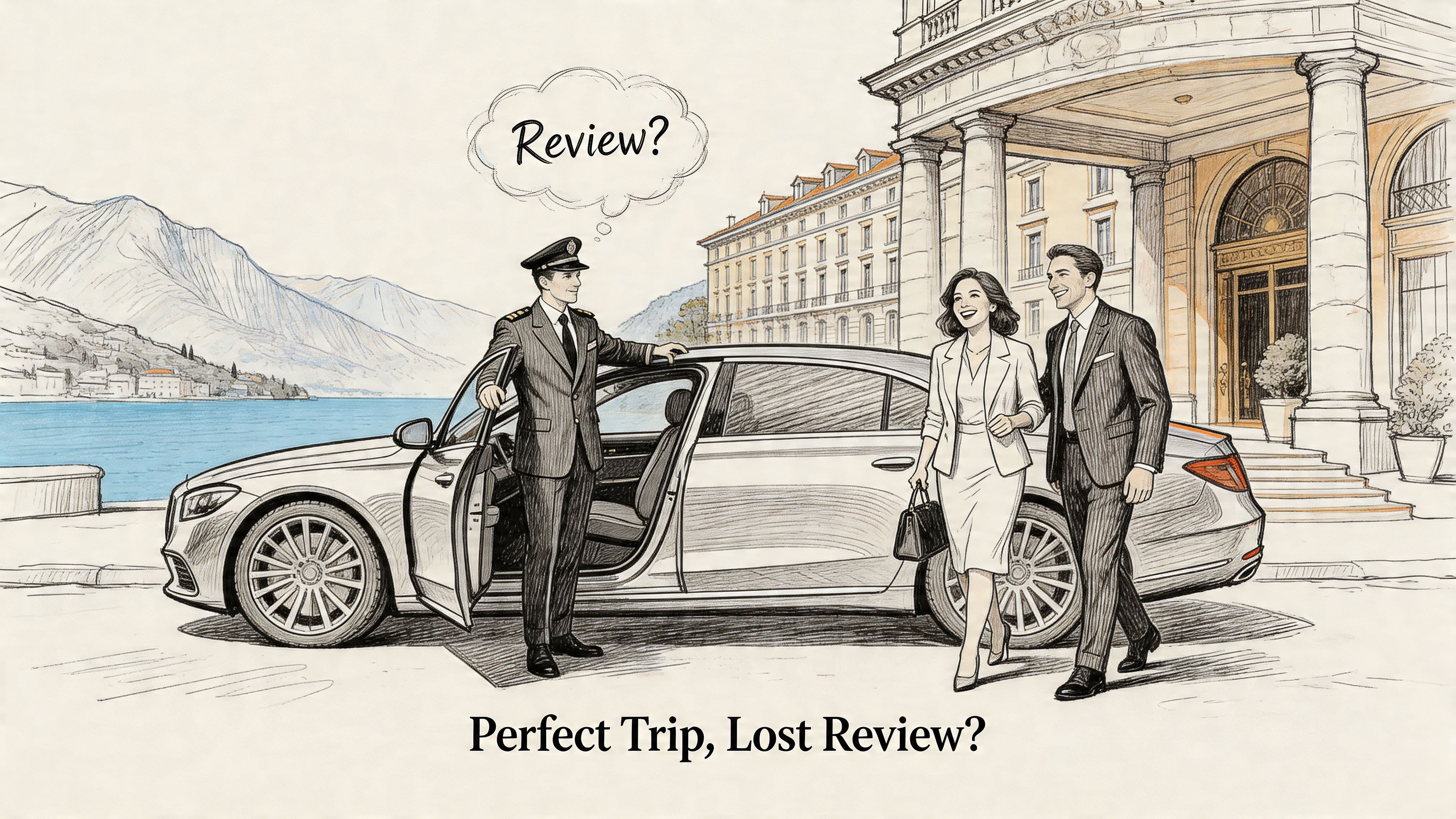
A guest lands at Malpensa after a long flight, clears baggage late, finds the driver exactly where promised, gets helped with luggage, settles into a clean Mercedes, and reaches Lake Como without a single hitch. At drop-off, they smile, say everything was perfect, and disappear into the hotel lobby.
That’s the moment most transfer companies waste.
If you’re searching for get transfer reviews, you’re probably dealing with one of two problems. Either your service is better than your online reputation suggests, or you’re getting reviews inconsistently and can’t turn good trips into visible trust. In private transfers, especially in Northern Italy, that gap hurts more than operators realize. Travelers compare you not only with other chauffeur services, but with taxis, trains, airport buses, and booking marketplaces that often look stronger online than they perform on the ground.
Table of Contents
- Why Most Transfer Companies Fail at Getting Reviews
- The Foundation Your Review Strategy Needs
- Choosing Your Moment and Your Channel
- Mastering Google TripAdvisor and Trustpilot
- Managing Feedback and Leveraging Your Wins
- Key Metrics to Track for Your Review Program
Why Most Transfer Companies Fail at Getting Reviews
Most operators fail because they treat reviews as something that happens after service. In reality, reviews are an operational output. If nobody owns the process, the review request goes out late, the link is missing, the driver forgets to mention it, and the happy client moves on.
In private transfers, social proof does more work than in many other travel categories. A bus rider expects inconvenience. A taxi passenger expects uncertainty. But a guest booking a premium airport transfer to Bellagio, Stresa, Serravalle, or a hotel in central Milan is buying confidence. They want to know the driver will show up, wait if the flight is late, help with bags, and not improvise the price on arrival.
Hope is not a review strategy
The usual mistake sounds harmless. “If the ride is good, they’ll leave a review.” They usually won’t. International travelers are busy, often moving between hotels, trains, villas, and airports. Even very satisfied clients need a prompt, a link, and a reason to spend two minutes helping you.
That matters even more when customers compare direct operators with marketplaces. GetTransfer has accumulated 3,879 verified customer reviews with an average rating of 4.26 stars, and 3,198 customers, about 82% of reviewers, rated the service as excellent, according to verified reviews on reviews.io for GetTransfer. Volume like that creates visible trust. It also shapes what travelers think is normal before they ever contact a local operator.
In this market, weak review coverage costs bookings
A premium transfer company doesn’t just compete with other private cars. It competes with:
| Option | What travelers like | What often goes wrong | Review implication |
|---|---|---|---|
| Taxi | Immediate availability | Price uncertainty, vehicle inconsistency, no pre-trip reassurance | Guests look for proof of professionalism |
| Train | Efficient on some city routes | Poor fit for villas, lakeside hotels, families with luggage | Reviews need to show door-to-door ease |
| Shared shuttle | Lower upfront cost | Timing stress, extra stops, schedule mismatch | Reviews must emphasize reliability and comfort |
| Marketplace platforms | Choice and visibility | Service quality can vary by provider | Direct operators need stronger reputation control |
Practical rule: If your best clients praise you privately but not publicly, your competitor owns the next booking.
The companies that win reviews build them into dispatch, driver training, follow-up, and reputation management. Everyone else waits for goodwill and gets silence.
The Foundation Your Review Strategy Needs
A review request only works when the trip felt polished from the customer’s side. Guests don’t reward effort they can’t see. They reward smoothness.
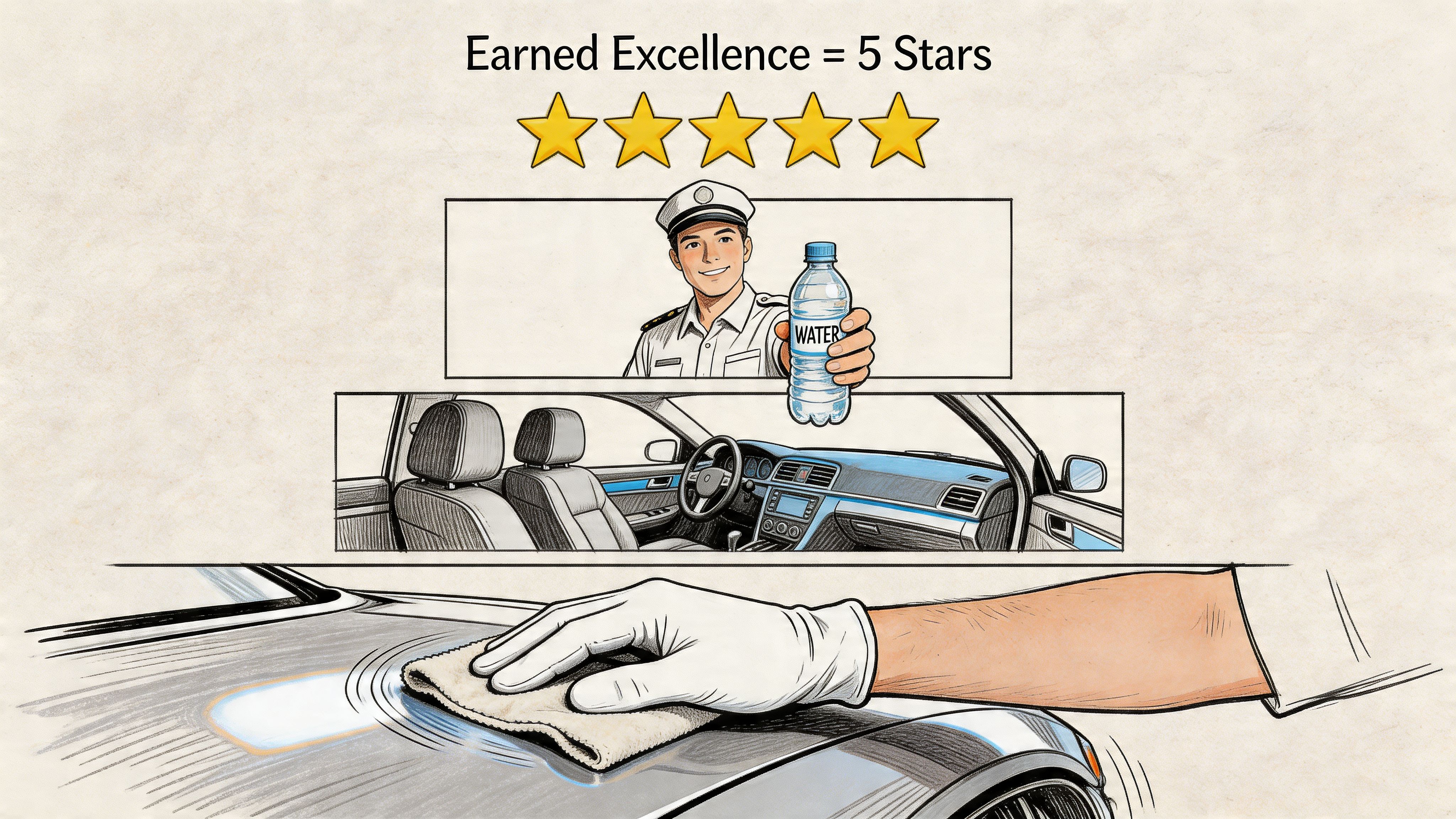
Earn the review before you request it
The first part happens before the car moves. Confirmation has to be clear, written, and specific. Guests should know the pickup point, the meeting method, what happens if the flight is delayed, and who to contact on WhatsApp or phone if they need help.
At Milan’s airports, this matters more than many operators admit. Malpensa can feel straightforward until an overseas family comes out from the wrong side or loses time at baggage reclaim. Linate is easier, but business travelers there have very little patience for vague instructions. Bergamo creates another issue. Many low-cost passengers arrive tired, carrying more bags than expected, then continue to Lake Garda, Milan, or cross-border destinations.
What premium clients notice first
Affluent tourists, wedding groups, executives, and long-haul families notice details that lower-end operators skip. Reviews regularly praise friendly drivers and smooth driving on winding routes, but travelers still ask about licensing, insurance, vehicle inspections, child seats, and multilingual support. That trust gap is especially important for longer trips into Switzerland or France, as noted in Rick Steves community discussions about Milan-area drivers and safety expectations.
If you want better get transfer reviews, make these items visible before the trip:
- Driver credentials: Tell the guest that the assigned driver is qualified for the route and prepared for meet-and-greet.
- Vehicle standard: Name the car class clearly. “Sedan” is weak. “Mercedes E-Class” or “Mercedes S-Class” sets expectations.
- Safety items: Confirm child seats in writing, not by verbal note.
- Border readiness: For Switzerland or France routes, verify documents and route planning before departure.
- Group handling: State how luggage will be managed for groups, not just how many seats exist.
A lot of review problems start as expectation problems.
Guests forgive traffic. They rarely forgive confusion.
A family going to Menaggio or Tremezzo after a red-eye flight wants a driver who understands where hotels sit, which entrances are awkward for luggage, and where large vans can stop without creating a mess. A wedding planner sending guests to Lake Como villas wants timing discipline, not “we’ll call when we arrive.” A shopping group going to Serravalle or FoxTown wants fixed pricing and enough luggage space for the return.
That’s why local detail matters. Operators who know where coaches struggle, where hotel entrances are restricted, and which stations create pickup confusion earn stronger reviews because they remove friction the guest expected to fight through. For more practical travel context around airport transfers and regional movement, the Transfer Milan travel blog covers the kind of local planning details travelers often miss when booking.
Choosing Your Moment and Your Channel
Timing changes everything. Ask too early and the guest hasn’t processed the experience. Ask too late and the emotional peak is gone.
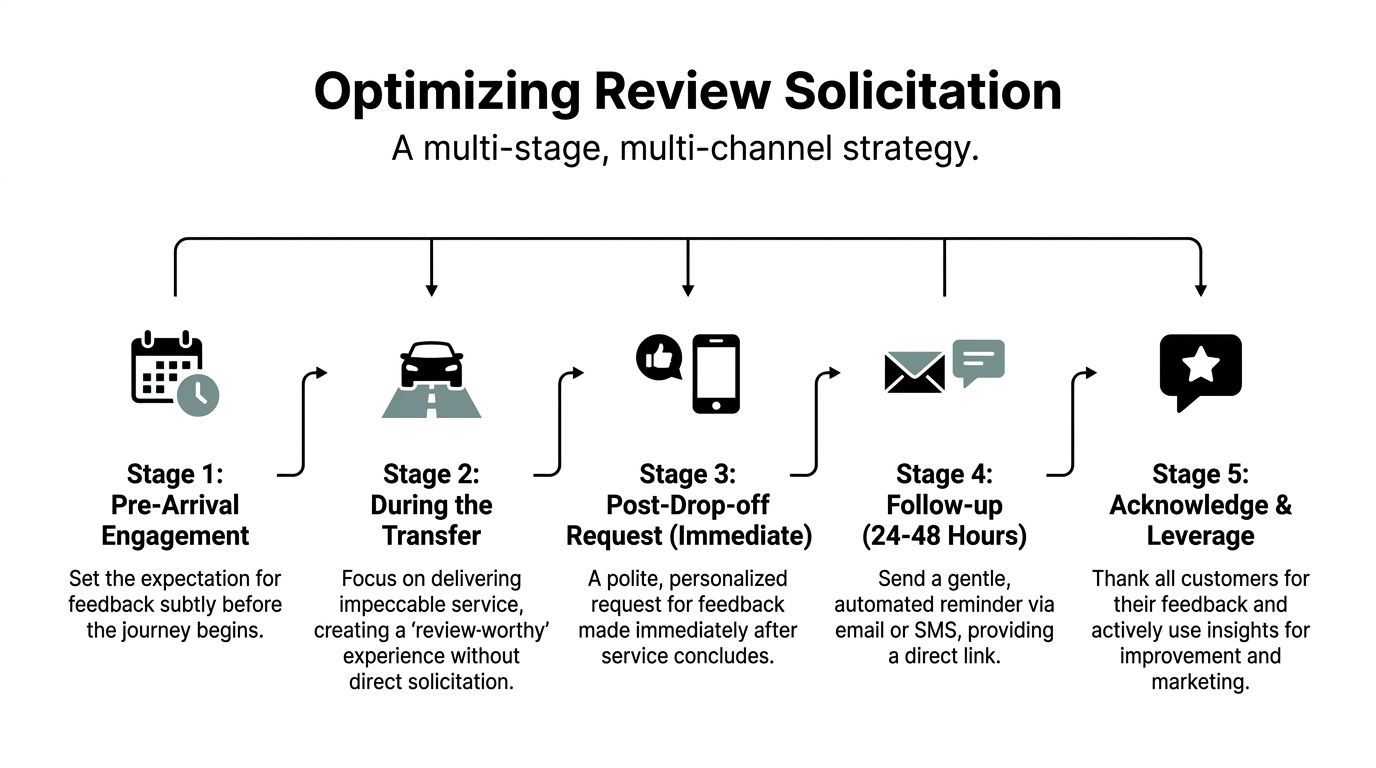
The best review flow uses several light touches instead of one heavy request. Drivers, dispatchers, and automation each have a role. The customer should never feel chased.
The sequence that works
Use this order.
-
Before arrival
Add one soft line to the booking confirmation. Thank the guest for choosing your service and mention that feedback helps keep the service standard high. Don’t include a review link yet. -
At drop-off
The driver closes the trip professionally, helps with luggage, and gives a short verbal prompt only if the interaction was clearly positive. Something simple works best: “If you have a minute later, we’d really appreciate your feedback online.” -
Short message after the ride
Send a brief WhatsApp or SMS once the guest is settled. Private transfers offer an advantage over shuttles and public transport. Travelers often complain that shared services don’t follow the advertised timing, while private rides are praised for punctuality and comfort even when flights run late, according to Tripadvisor feedback on the Malpensa Shuttle experience. That reliability is the exact emotion you want to capture while it’s fresh.
A useful comparison for guests who are still deciding between transport options appears in this guide to Milan tourist places, public transport options, and airport transfers.
Later in the follow-up cycle, video can support your team’s training around service tone and customer handling.
Message templates that don’t feel pushy
Here are templates that work because they sound human.
WhatsApp after drop-off
Thank you for traveling with us today. We hope you arrived comfortably. If you’d like to share feedback on your transfer, this link makes it quick. We appreciate it.
SMS for business travelers
Thank you for using our transfer service today. If the ride met your expectations, we’d value your review. Your feedback helps future travelers book with confidence.
Email sent the next day
Subject: Thank you for your transfer
Body:
Thank you for booking with us. We hope your journey in Northern Italy is going smoothly. If you have a minute, we’d be grateful for your review. Comments about punctuality, driver professionalism, vehicle cleanliness, or the booking experience are especially helpful for other travelers.
A few things don’t work:
- Long explanations: Guests won’t read them.
- Multiple links in one message: Too much choice kills action.
- Generic bulk wording: Luxury clients can spot automation immediately.
- Requests during a stressful transfer: Don’t ask in the car unless the guest opens the conversation.
Mastering Google TripAdvisor and Trustpilot
A lot of operators send people to the wrong platform. That creates shallow coverage everywhere instead of authority where it matters.
Use each platform for a different job
Google is the first priority for any local operator. It influences map visibility and catches guests who search at the last minute from the airport, a hotel lobby, or a trade fair. If your Google profile is weak, you’ll lose bookings to services that may be worse operationally but look safer online.
TripAdvisor matters for international leisure travelers. That audience often books accommodation, tours, and transfers in one research session. They compare comments carefully, especially for routes like Milan to Lake Como, Milan airports to city hotels, and longer private transfers that compete with trains and buses.
Trustpilot works best when your brand is already collecting reviews systematically across different customer types and booking journeys. It can strengthen credibility, but it usually shouldn’t be your first battlefield if Google and TripAdvisor are underdeveloped.
Review platforms can tell very different stories about the same service. GetTransfer shows a 4.26-star average on reviews.io but a much lower 2.9-star rating on Sitejabber based on 713-716 reviews, with recurring complaints around customer service, payment issues, and fraud concerns, as shown on GetTransfer’s Sitejabber review page. That kind of spread can damage trust fast, even if another platform looks strong.
Guide the guest without scripting the review
Don’t tell guests what to write. Do make it easy for them to remember useful specifics.
Use prompts like these in your email or message:
- Mention the route: “Airport to hotel,” “Malpensa to Lake Como,” or “Milan to Serravalle.”
- Mention the service detail: “Punctual pickup,” “clean Mercedes,” “help with luggage,” or “child seat prepared.”
- Mention the driver by name: This makes the review more credible and rewards the chauffeur properly.
- Mention the booking process: Guests often care whether the communication was fast and clear.
Keep the prompt neutral. You’re asking for accurate feedback, not praise.
A short internal note for your team helps too. If the guest was a family, prompt around luggage help and child seats. If they were corporate, prompt around punctuality and discretion. If they were a wedding group, prompt around coordination and timing. The review becomes more detailed because the memory cue matches the trip.
Managing Feedback and Leveraging Your Wins
A guest lands at Malpensa after a delayed long-haul flight, your driver still meets them on time, handles four bags without fuss, and gets them to Bellagio in comfort. If that turns into a five-star review, the job is only half done. Premium operators win more bookings by using that feedback with discipline.
How to respond when the review is positive
A strong public reply is short, specific, and tied to the actual trip. Thank the guest, mention the route or service type, and confirm one detail that matters to the next buyer.
For example:
Thank you for your kind feedback. We’re glad your transfer from Malpensa to Lake Como was smooth and comfortable. We’ll share your comments with your driver.
That reply shows the booking was real. It also signals that your team reads reviews carefully and gives the chauffeur proper credit.
In the Northern Italy luxury market, route specificity matters. A guest looking for Milan fashion week transport does not read reviews the same way as a family booking a private transfer to Garda or a couple arranging wedding transport in Como. Use each strong review where it helps conversion most. Put airport feedback on airport pages. Put wedding feedback on wedding pages. Put executive transfer comments on business transport pages.
That is how premium operators separate themselves from taxis and shared shuttles. Taxis compete on immediacy. Shuttle services compete on price. A private transfer company wins on reliability, discretion, vehicle standard, and local execution. Your best reviews should prove those points with real trip context.
For broader examples of what travelers care about before they book, the Northern Italy travel tips archive is a useful reference for matching review language to real guest concerns.
How to handle a bad review without making it worse
Negative reviews need a written process. If you leave them to whoever is on shift, the tone changes, facts get missed, and the reply often creates a second problem.
Use this sequence:
- Reply quickly: Acknowledge the complaint while the trip is still easy to trace.
- Keep the public response brief: Thank the guest and state that you are reviewing the booking.
- Move the case offline: Ask for the booking reference by email or phone.
- Check operations records: Review pickup time, live driver messages, flight tracking, dispatch notes, and any WhatsApp exchange.
- Decide what failed: Driver late, meet-and-greet confusion, wrong vehicle class, unclear pricing, or guest expectation mismatch.
- Fix the cause internally: Update briefing, routing, chauffeur notes, or customer communication.
Do not argue in public about traffic, airport queues, or whether the guest waited at the wrong exit. Future customers read your tone before they read the facts.
I have found that high-value clients react well to calm, factual language. Corporate bookers want to see control. Villa guests want reassurance. Wedding planners want proof that timing errors are taken seriously. A defensive reply loses all three.
A review response is written for the next customer reading the page.
Use criticism for sales improvement too. If several guests mention unclear meeting points at Linate or confusion outside Santa Lucia in Venice, add better pre-arrival instructions. If reviews praise your chauffeurs by name, feature that consistency in your sales copy. If business travelers repeatedly mention discretion and punctuality, move those phrases higher on your executive transfer pages.
Be careful with incentives. Ask every guest for honest feedback. Do not reward only positive reviews, and do not word the request in a way that pressures the customer to leave a high rating. Neutral, platform-compliant requests protect the account and keep the review profile credible.
Key Metrics to Track for Your Review Program
A review program gets better when you track it like operations, not like vanity marketing.
The dashboard that matters
You don’t need a complex BI stack. A clean spreadsheet or simple CRM view is enough if your team updates it consistently.
Track these metrics:
| Metric | What it tells you | What to look for |
|---|---|---|
| Review volume | Whether requests are being sent consistently | Gaps usually mean staff drift or broken automation |
| Review velocity | Whether new reviews appear steadily | A strong month followed by silence signals process failure |
| Average rating | Broad service health | Useful, but never enough on its own |
| Channel conversion | Which request method works best | Compare driver prompt, WhatsApp, SMS, and email qualitatively |
| Response coverage | Whether your team answers reviews publicly | Missed replies weaken trust |
| Theme tracking | What guests repeatedly mention | Punctuality, luggage help, driver attitude, vehicle cleanliness |
A practical way to judge if your process fits your market
One useful model comes from the TRANSFER Approach, which was designed to assess how well evidence applies in a new setting. Adapted to review management, it helps operators check whether their process fits the actual customer mix, trip type, and operating context. The method looks at factors such as population, intervention, and context, and pilot work reported that a high contextual match could improve reliability perceptions by up to 25%, according to the TRANSFER Approach paper on PubMed Central.
For a Northern Italy transfer business, that means asking practical questions:
- Population fit: Are your review requests written for US, UK, and Middle East travelers, or do they sound like generic local transport messages?
- Intervention fit: Are you asking guests to review the specific service they bought, such as fixed-price luxury transfer, chauffeur hire, or group minibus?
- Context fit: Does your process account for airport delays, multilingual communication, cross-border travel, and seasonal pressure around lakes, fairs, and weddings?
If the answer is no, the program won’t translate well, even if the service is strong. Good get transfer reviews come from matching the request system to the actual journey.
If you want a fixed-price private transfer in Northern Italy with professional chauffeurs, multilingual support, airport meet-and-greet, and vehicle options for solo travelers, families, and groups, book directly with TransferMilan.com.