0 Your 2026 Guide to Transfer from Milan Airport
- Travel Tips
- by Tara Malone
- 24-04-2026
You land in Milan after a long flight, clear passport control, collect luggage, and then hit the real question: what now? That decision is easy to underestimate. A smooth transfer from Milan airport can put you in your hotel, meeting, or lakeside villa with your energy intact. A bad one starts the trip with queues, guesswork, and avoidable stress.
That matters more than most travelers expect. In 2024, Milan Malpensa handled 28.91 million passengers, up 10.9% from 2023, and over 85% of passengers are arrivals or departures needing ground transport, which is exactly why the arrivals hall can feel chaotic if you haven't already chosen your route (Malpensa passenger data).
Milan also isn’t a one-airport city. Your arrival experience changes a lot depending on whether you land at Malpensa, Linate, or Bergamo. The right transfer for a solo traveler with one backpack is often the wrong one for a family with a stroller, or for a team heading straight to a trade fair. If you want more practical arrival planning, Milan-specific travel tips for airport and city logistics are worth reviewing before you fly.
Table of Contents
- Your Milan Journey Begins Before You Land
- Decoding Milan's Three Airports
- Milan Airport Transfer Options Head-to-Head
- How to Choose the Right Transfer for You
- The Smart Choice for Groups and Stress-Free Travel
- Local Expert Tips for a Flawless 2026 Arrival
- Frequently Asked Questions
Your Milan Journey Begins Before You Land
Most airport transfer problems start before the plane touches down. They start when travelers assume Milan works like a compact city where every airport is more or less interchangeable. It doesn't.
A guest arriving at Malpensa after an overnight flight usually wants one thing: someone or something that gets them out fast, with no mental effort. A guest landing at Linate often values speed to the city over everything else. A guest arriving at Bergamo usually booked a cheaper ticket and only discovers later that the cheap flight can produce an awkward, tiring transfer.
The first real service test in Italy isn't the hotel check-in. It's what happens between baggage reclaim and the curb.
That’s why the transfer from milan airport deserves the same attention as the flight itself. If your destination is central Milan, your options are broad. If it’s Lake Como, a design showroom, a wedding venue, Serravalle, or a cross-border stop in Switzerland, the choice becomes much more strategic.
What travelers usually get wrong
Three mistakes come up constantly:
- They choose on headline price only. A cheap bus fare can stop looking cheap when you're tired, carrying bags, or still need a taxi at the other end.
- They ignore airport layout. Malpensa especially can punish assumptions if you don't know your terminal.
- They book for Milan city center, then improvise the rest. That works poorly if your real destination isn't near a major station.
What actually works
Use three filters before you book:
- Arrival airport
- Final destination
- Travel style, meaning solo, business, family, or group
Once those are clear, the right transfer usually becomes obvious. The mistake is trying to solve all arrivals with the same answer.
Decoding Milan's Three Airports
Malpensa is the long-haul gateway
Malpensa (MXP) is the airport that shapes most international arrivals into Milan. It sits 49 km from Milan, and its size changes the transfer calculation immediately. It also has a dual-terminal setup, with Terminal 1 for full-service carriers and Terminal 2 for low-cost carriers, plus a free shuttle running every 15 to 30 minutes between them (Malpensa terminal and shuttle details).
That sounds manageable on paper. In practice, it means pickup planning matters. If a traveler tells a driver “Malpensa” but not the terminal, delays start there. If you're meeting friends arriving on a separate booking, this detail becomes even more important.
For long-haul arrivals, Malpensa usually favors one of two options: train if you're traveling light into the city, or pre-booked door-to-door transport if you're carrying luggage, arriving with family, or heading somewhere beyond central Milan.
Linate works differently
Linate (LIN) is the city airport. It fits short business trips, quick European arrivals, and travelers who want the smallest gap between landing and entering Milan proper.
The transfer logic here is simpler. If your destination is in the city, a direct car transfer is often easy to justify because the airport is already close. Public options can work well too, especially if you're staying near a useful interchange and don't mind a final walk or local taxi.
At Linate, the question usually isn't “How do I reach Milan?” It’s “How much friction do I want between touchdown and my front door?”
For business travelers, Linate often rewards speed and simplicity. For budget travelers with one bag, public transport is usually perfectly reasonable.
Bergamo catches people out
Bergamo Orio al Serio (BGY) serves a different crowd. It’s heavily associated with low-cost flying, and that changes the passenger profile. People arrive having saved on the airfare, then discover they still have to solve the ground journey into Milan or onward into northern Italy.
That creates a common mismatch. Budget ticket, late arrival, multiple bags, unfamiliar route, and a transfer that now feels more complicated than expected.
Practical airport fit by traveler type
| Airport | Best fit | Transfer reality |
|---|---|---|
| MXP | Long-haul, intercontinental, onward lake or regional travel | More planning needed, especially by terminal |
| LIN | Business and short city trips | Fastest path to central Milan |
| BGY | Low-cost leisure arrivals | Cheapest flight can mean the least convenient arrival |
Knowing which airport you’re using is half the battle. The second half is choosing the transport mode that matches the airport, not just your budget.
Milan Airport Transfer Options Head-to-Head
For most travelers, the choice is between train, bus, taxi or ride-hail, and private transfer. The market is clearly segmented. A public bus costs around €10, the train is €13, ride-hailing can surge to €55+, and fixed-price private transfers start around €75 (Milan transfer pricing overview).
Before the detailed trade-offs, use this quick view.
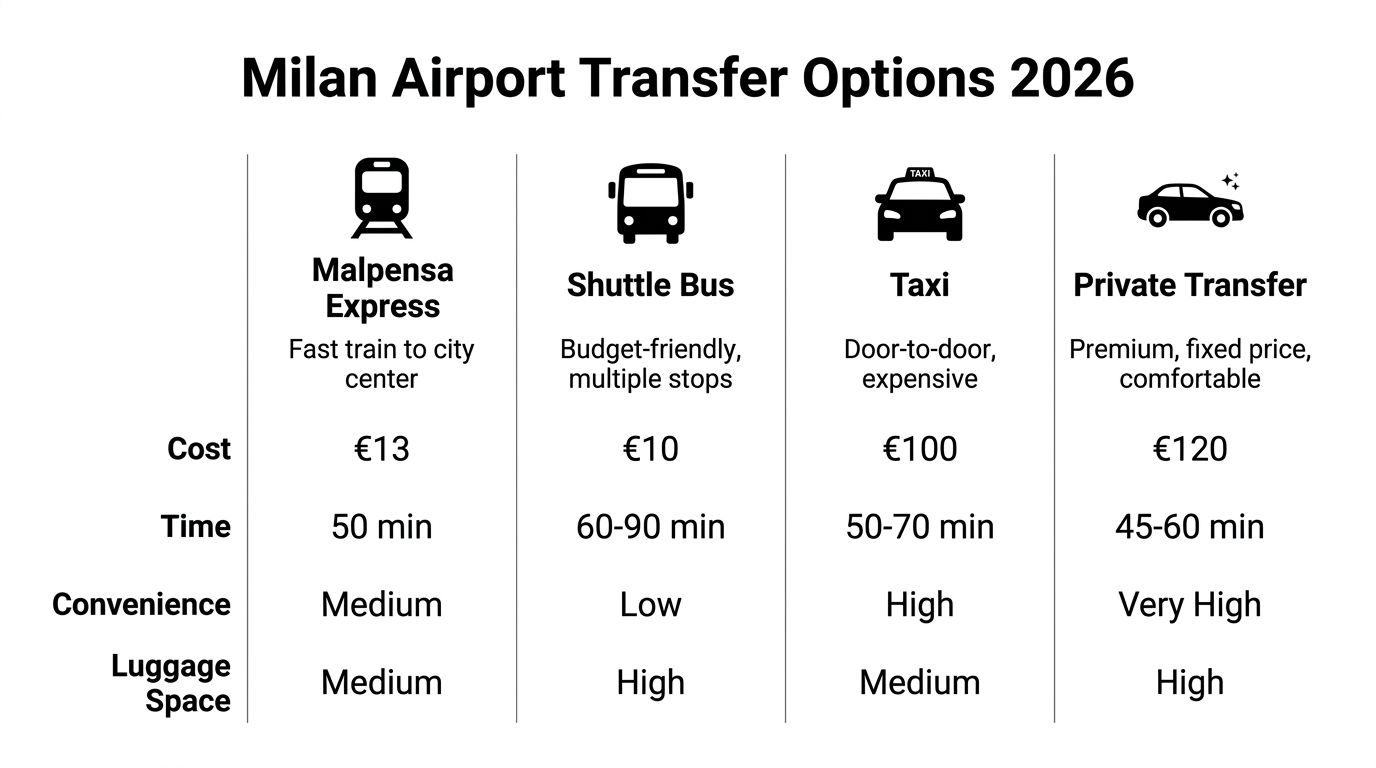
Quick comparison
| Option | Works best for | Main strength | Main weakness |
|---|---|---|---|
| Train | Solo travelers heading near a main station | Predictable route into the city | Not door-to-door |
| Shuttle bus | Budget travelers with time | Low entry cost | Queueing, traffic, fixed drop points |
| Taxi or ride-hail | Travelers who need direct service now | Immediate curbside convenience | Variable pricing or limited certainty |
| Private transfer | Families, groups, business, long-haul arrivals | Fixed planning and direct pickup | Higher upfront cost |
For city sightseeing, station arrivals, and transfer planning beyond the airport, this practical guide to Milan tourist places, public transport options, and airport transfers is useful if you're mapping the whole journey instead of only the airport segment.
What works in real life
The train is efficient when your hotel is close to a station, you have manageable luggage, and you're comfortable reading signs right after landing. It’s especially sensible for travelers who value structure. You know where it goes, and you know the price.
Where the train fails is the “last mile.” If you still need a taxi, a metro connection, or a long walk with bags, the cheap ticket can stop being a bargain.
The shuttle bus appeals to travelers who care most about keeping costs down. It’s straightforward enough, and luggage handling is often less awkward than on a crowded train. But buses are the option most likely to feel slow after a flight. Boarding queues, waiting for departure, and road traffic all stack up.
Practical rule: A transfer is never just the vehicle. Count the queue, the walk, the waiting time, and the final stretch to your hotel.
Taxi and ride-hailing sit in the middle. They offer direct travel without the planning commitment of a pre-booked chauffeur. That can be exactly right for some arrivals. It can also be frustrating when demand is high, pricing shifts, or you’re traveling with a larger party that doesn't fit neatly into one standard car.
Private transfer earns its place when reliability matters more than shaving the price. The value isn't only the car. It's knowing the pickup point, the price, the luggage plan, and who handles the delay if the flight lands late.
What I’d choose by situation
- One person, one cabin bag, central Milan: Train.
- Two adults, flexible schedule, budget-focused: Bus or train, depending on where you're staying.
- Family with stroller and checked bags: Direct car service.
- Executive landing before a meeting: Pre-booked direct pickup.
- Group heading outside Milan: Minivan or larger vehicle, booked in advance.
The mistake is comparing these options as if they solve the same problem. They don't. They serve different kinds of arrivals.
How to Choose the Right Transfer for You
A transfer from milan airport only feels “good value” when it matches the traveler. The same route can be easy, annoying, or expensive depending on who's taking it.
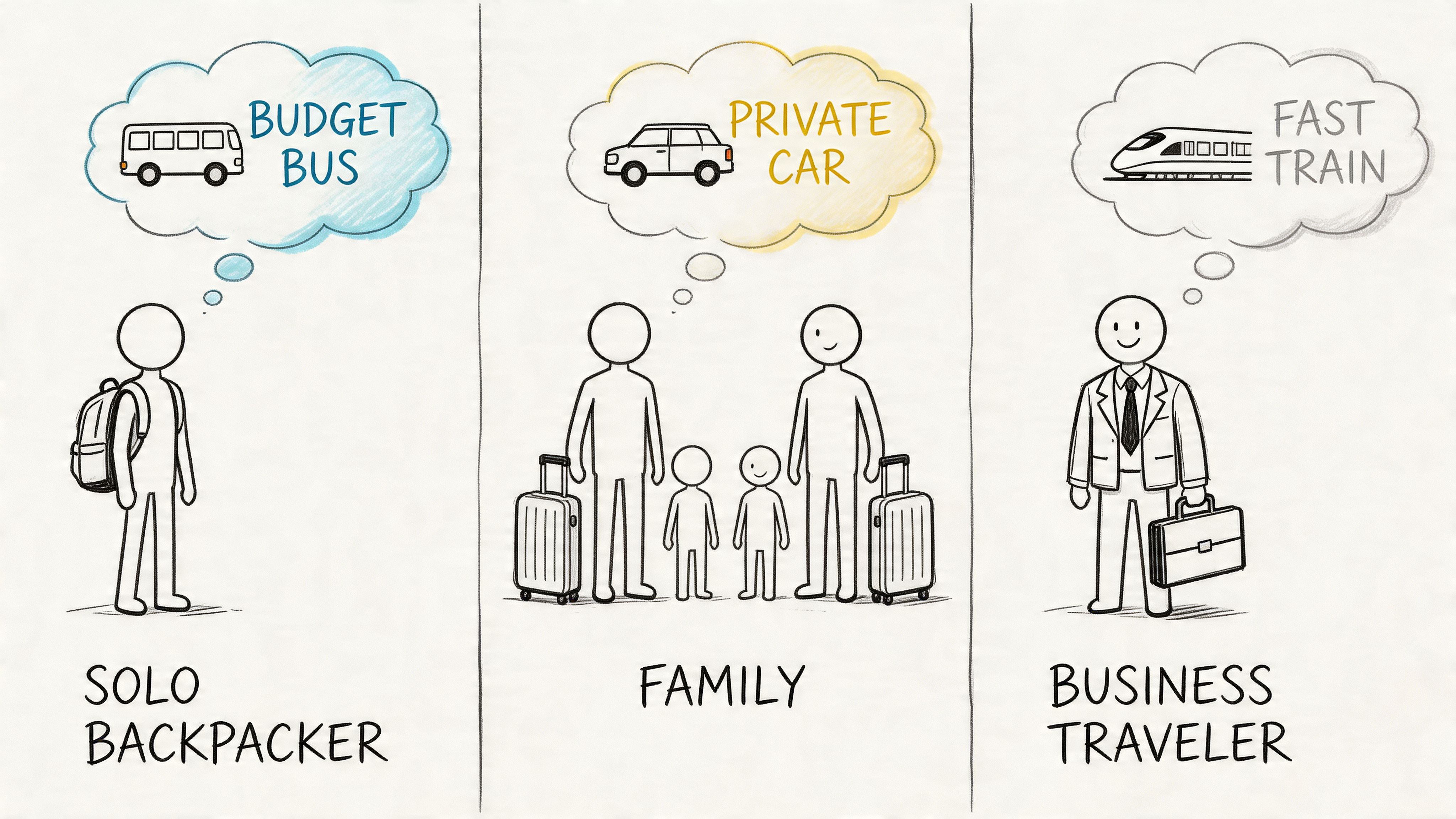
If you're traveling solo
A solo traveler has the most flexibility. If your hotel is near a rail hub or a simple city connection, public transport is often the practical answer. You save money, and the inconvenience stays manageable because you're only responsible for yourself and your own bags.
That changes if you land late, carry bulky luggage, or need to go somewhere that isn't central. The less linear your route, the less attractive the cheapest option becomes.
If you're traveling for business
Business arrivals should judge transfers by one criterion first: control. Not cost. Not theory. Control.
If you need to be at a hotel quickly, take calls, change clothes, or go directly to an office, train-and-walk combinations are rarely the smartest choice. A direct car lets you work around your schedule instead of around the transport network.
Consider these decision points:
- Tight timing: Choose a booked pickup.
- Need for receipts and fixed planning: Avoid variable pricing where possible.
- Arrival with colleagues: Put everyone in one vehicle if the schedule matters.
If being late creates a business problem, paying less for the transfer usually isn't the saving you think it is.
If you're a family or a group
Families feel airport friction first. Strollers, tired children, checked bags, and the need for door-to-door simplicity change everything. Public transport can still be done, but the margin for error gets smaller fast.
Groups have a different problem. Coordination breaks down quickly when people split across multiple vehicles or deal with separate tickets after landing.
What usually works best
- Families with young kids: Book a car or van with enough room from the start. Ask for child seats before arrival, not at the curb.
- Three to six travelers: A single minivan is usually easier than trying to fit everyone into standard taxis with luggage.
- Larger leisure groups: One shared vehicle keeps everyone on the same timeline.
- Wedding or event groups: Build around the least mobile person, not the most confident traveler.
A simple way to decide
Use this sequence:
- Start with luggage volume, not passenger count alone.
- Add destination type. City center is easier than a villa, outlet, or mountain route.
- Check who in the group will struggle most with transfers, stairs, or waiting.
- Choose the option that protects that person’s experience.
That’s the concierge rule that saves the most headaches. The strongest traveler in the group can adapt. The tired child, the older parent, or the executive on a deadline usually can't.
The Smart Choice for Groups and Stress-Free Travel
There are trips where public transport is perfectly sensible. Then there are trips where trying to save on the transfer creates the whole day’s problem.
That second category includes families after long-haul flights, business teams on a fixed schedule, wedding guests, ski groups, and travelers heading somewhere beyond central Milan. In those cases, fixed-price private transport solves issues that buses and taxis often leave unresolved.
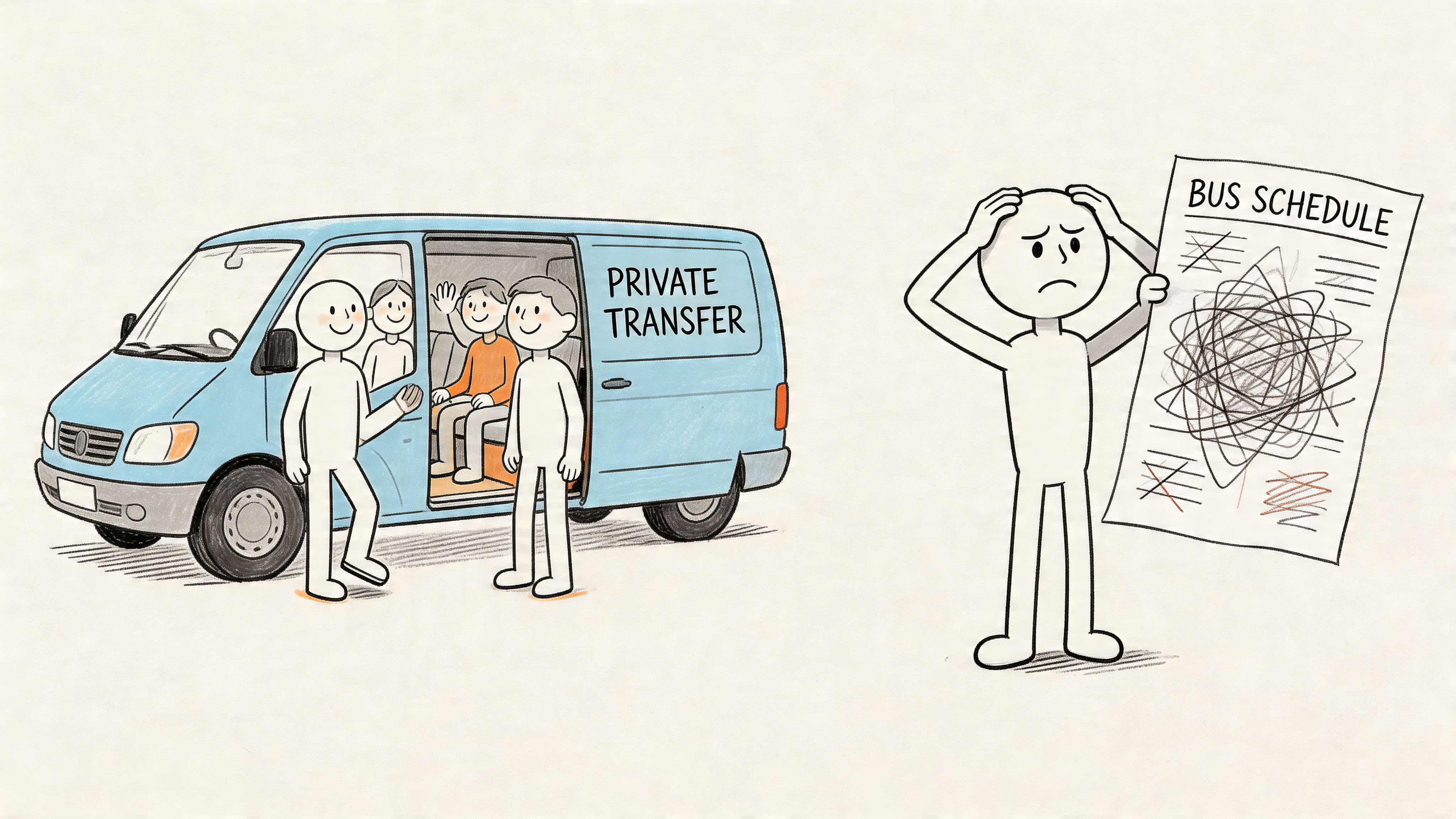
Why private transfers solve the hard parts
A major benefit is coordination. Someone tracks the flight, knows the airport, meets the passenger, handles luggage, and takes the group directly where it needs to go. That strips out the weakest parts of the arrival chain: guessing, queueing, splitting up, and improvising.
For groups, this matters even more because every extra step multiplies. One person misses the bus boarding. Another waits for luggage. A third isn't sure which terminal exit to use. Suddenly the “cheap” option costs everyone time and patience.
A practical service model is what matters here. For example, TransferMilan.com operates fixed-price airport and long-distance transfers with sedans, minivans, minibuses, and coaches, including routes beyond Milan for ski and regional travel. That's the kind of setup that fits travelers who need one booking to cover the whole party and destination.
Where this matters most in 2026
One notable 2026 travel pattern is the rising demand for private group transfers to cross-border destinations such as Swiss outlets and ski resorts, where public transport doesn't provide direct solutions, and coaches for 7 to 50 passengers become the only practical option for weddings, corporate movements, and large family travel (private group transfer trend for 2026).
That trend matches what travelers often discover too late: Milan is frequently the entry point, not the final stop. If the destination is FoxTown, a ski base, a wedding venue, or a remote hotel, the old city-center comparison between train and taxi stops being useful.
Where private booking pays for itself
- Airport to villa or resort: No final-mile scramble.
- Group airport arrival: Everyone leaves together.
- Children and bulky luggage: One loading process, one vehicle.
- Cross-border route: One operator handles the journey cleanly.
- Event travel: Timing stays under one plan instead of five separate apps.
Good transfer planning isn't luxury. Often it's just disciplined logistics.
For travelers who want certainty, fixed-price private transport is less about indulgence and more about removing weak links from the itinerary.
Local Expert Tips for a Flawless 2026 Arrival
The Bergamo rule
If you’re landing at Bergamo Orio al Serio, book your ground transport before the flight if timing or budget matters. Many guides mention a transfer time of about 50 minutes, but in rush hour that trip can stretch to 1.5 hours, and Bergamo doesn’t have a fixed taxi fare to Milan, which means the final cost can be uncertain (Bergamo traffic and taxi fare context).
Travelers get caught booking the cheaper flight, assuming the airport transfer will be simple, and then losing both time and price certainty on arrival.
The Malpensa pickup detail people miss
At Malpensa, always confirm terminal first, airline second when arranging a pickup. People often do it the other way around. That’s fine until an airline mix-up, a codeshare, or a group arriving on separate tickets creates confusion at the curb.
If two members of your party land at different terminals, decide in advance whether one side transfers internally or whether each traveler gets collected separately. Don’t improvise this after landing.
Why strikes change the calculation
Italy has periodic transport strikes, known locally as scioperi. Visitors often hear about them only after they affect trains or airport buses. When that happens, the cheapest transfer option suddenly becomes the least dependable one.
Three habits that save trouble
- Save your driver or operator contact in advance. Don't rely on airport Wi-Fi after arrival.
- Book according to arrival hour, not just route. Late-evening and peak-hour arrivals punish weak planning.
- Match the vehicle to the luggage. Two large cases and a stroller can rule out a standard sedan very quickly.
A smooth arrival in Milan usually comes down to one thing. Remove uncertainty before you land.
Frequently Asked Questions
What happens if my flight is delayed
With a pre-booked private transfer, the standard expectation is that the operator tracks your flight and adjusts pickup timing. Check this before you confirm, especially if you’re arriving on an international flight or traveling during a busy season.
Can I book a transfer with more than one stop
Usually, yes. This is common for travelers who need to stop at a hotel, office, exhibition venue, or station. Ask for the full route in writing before booking so the service can assign the right vehicle and timing.
How do I know if our luggage will fit
Don’t book by passenger count alone. Book by people plus bags plus special items such as strollers, garment bags, or ski equipment. If you’re unsure, send the luggage breakdown to the operator and ask them to confirm the vehicle class.
Is public transport still worth using
Yes, if you’re traveling light, staying near a main connection, and don’t mind handling the final stretch yourself. It stops being attractive when the route gets fragmented, the arrival is late, or the group needs to stay together.
If you want a transfer from milan airport arranged before you fly, TransferMilan.com offers fixed-price airport pickups from Malpensa, Linate, and Bergamo, with vehicle options ranging from sedans to coaches for larger groups, plus support for longer routes across northern Italy and beyond.