0 10 Luxury Travel Hacks for Milan in 2026
- Travel Tips
- by Tara Malone
- 22-04-2026

You land at Malpensa after an overnight flight. Your phone reconnects, bags take longer than expected, and the queue outside is already forming. It is at this juncture that most “luxury” trips in Northern Italy often lose their luster. Not at the hotel. Not at dinner. At arrivals, when tired travelers start comparing taxis, train connections, rideshare apps, and unclear pickup points.
The best luxury travel hacks for Milan in 2026 start before you leave home. Ground transportation is the detail that decides whether your trip begins calmly or begins with friction. In Northern Italy, that matters more than many visitors expect. Distances look short on a map, but airport layout, traffic patterns, lake roads, trade show timing, and luggage volume change everything.
Luxury travel is also getting bigger, not smaller. The global luxury travel market reached USD 1,432 billion in 2023, up from USD 1,328 billion in 2022, with a projected 7.80% CAGR, and Europe held 33.8% market share according to Market.us luxury travel statistics. More affluent travelers are booking premium trips, which means the simple parts of travel need more planning, not less.
This playbook gets straight to the practical side. It focuses on what works for affluent international travelers arriving at Malpensa, Linate, and Bergamo, then moving through Milan, Lake Como, shopping outlets, exhibitions, and the wider north.
Table of Contents
- 1. Pre-Arrange Premium Airport Transfers with Fixed Pricing
- 2. Utilize Per-Hour Car Hire for Maximum Flexibility
- 3. Leverage Meet-and-Greet Services to Eliminate Airport Confusion
- 4. Combine Transportation with Curated Destination Experiences
- 5. Select Appropriate Vehicle Class for Professional Image and Comfort
- 6. Book Transfers to Align with Business Event Schedules and Trade Shows
- 7. Coordinate Wedding Transportation for Ceremony, Reception, and Guest Management
- 8. Use Multilingual Communication for International Travel Coordination
- 9. Arrange Special-Rate Transfers to Luxury Shopping Destinations
- 10. Use Travel Agency and Hotel Partnerships for Integrated Service
- Luxury Travel Hacks: 10-Point Comparison
- Your Blueprint for Smooth Milan Travel
1. Pre-Arrange Premium Airport Transfers with Fixed Pricing
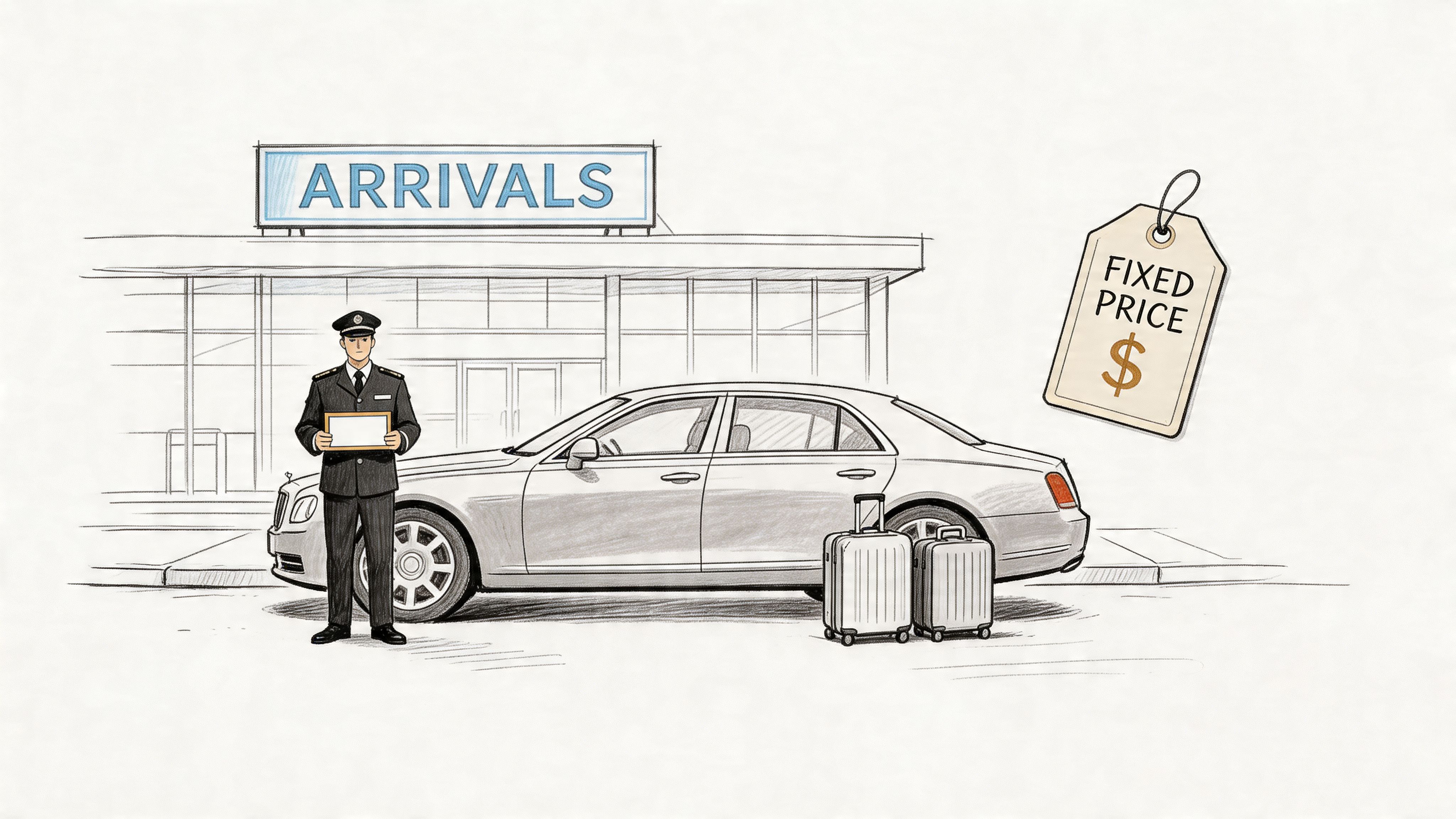
Your flight lands at Malpensa after an overnight from New York or Dubai. You clear passport control, collect four pieces of luggage, and step into a crowded arrivals hall where every small delay starts to affect the rest of the day. For affluent travelers arriving in the Milan area in 2026, the smart move is to settle the first ground transport decision before departure, with the price, vehicle, and pickup terms confirmed in writing.
Fixed pricing removes the two problems that cause the most friction on arrival. The first is uncertainty over total cost, especially on longer routes such as Malpensa to Lake Como, Bergamo to a villa on Lake Garda, or an airport pickup that later becomes a direct run to a shopping destination or mountain resort. The second is ambiguity. You want to know who is collecting you, where they will be waiting, and what happens if the flight lands late.
Why fixed price beats improvising
A taxi rank can work for a short, simple ride. It is a weaker option for families, executives on a schedule, couples carrying luxury purchases, or anyone heading beyond central Milan. Public transport is efficient on the right route, but it becomes less practical with jet lag, children, formalwear, ski equipment, or a hotel that is not close to a major station.
Pre-booked airport transfers are usually the better choice when the trip has real value attached to timing. That includes same-day meetings in Porta Nuova, fashion appointments in the Quadrilatero, a transfer straight to Bellagio or Menaggio, or a winter arrival with plans to continue into the Alps. If Bormio is part of the itinerary, this private transfer from Malpensa to Bormio guide shows the kind of route planning worth confirming in advance.
The trade-off is straightforward. Fixed-price service can cost more than improvising if your route is very short and your needs are minimal. In return, you get control at the exact point in the journey where international travelers are usually least interested in making decisions.
Use this checklist before you book:
- Send full flight details: Include airline, arrival time, and flight number so delays can be tracked properly.
- State the final destination precisely: “Lake Como” is not enough. Como city, Tremezzo, and Bellagio require different timing and routing.
- Declare luggage accurately: Garment bags, large checked cases, strollers, and shopping space all affect vehicle choice.
- Ask for the pickup protocol in writing: Get the driver’s name, phone number, meeting point, and wait-time terms before travel day.
- Confirm what the fixed rate includes: Tolls, parking, airport waiting time, and any night supplement should be clear upfront.
Practical rule: If the airport pickup is vague, the rest of the itinerary usually becomes harder than it needs to be.
2. Utilize Per-Hour Car Hire for Maximum Flexibility
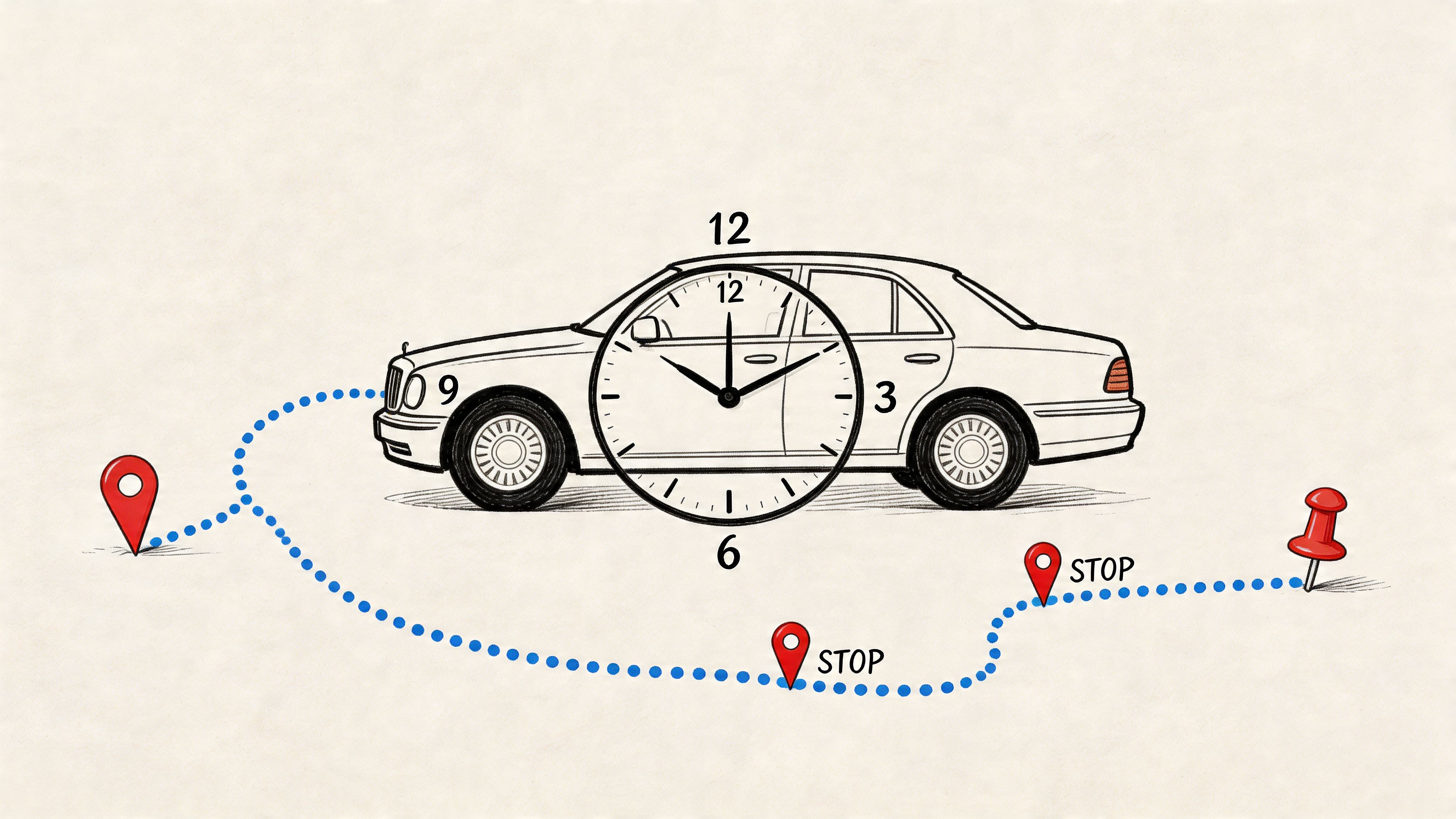
A Milan day can change by the hour. A buyer finishes early in the Quadrilatero and wants to add Serravalle. A family heading toward Lake Como decides to stop for lunch in Cernobbio instead of driving straight through. An executive leaves a meeting near Porta Nuova and needs one more stop before dinner in Brera. In those cases, per-hour car hire gives you control without forcing you to rebuild the itinerary every time plans shift.
Point-to-point service is still the right choice for a single, clean transfer. Hourly hire makes more sense when the day includes waiting time, multiple addresses, uncertain timing, or a mix of city and regional stops. That distinction matters in Northern Italy, where a route that looks simple on a map can involve traffic into Milan, limited access areas, lake road slowdowns, valet delays, or a change of destination after the first appointment.
When hourly service is smarter than point-to-point
Hourly service works best for travelers who are buying time as much as transport.
Typical examples include:
- Business days with several stops: hotel, showroom, office, lunch, fairground, then dinner
- Lake itineraries from Milan: Como, Cernobbio, Tremezzo, Bellagio, then back on your schedule
- Shopping circuits: Via Montenapoleone appointments, outlet visits, VAT refund errands, and hotel return
- Family travel: museum stop, lunch break, rest time, and a flexible return without queueing for the next car
It also compares well with the usual alternatives:
- Vs taxis: better if the driver needs to wait, stay with you, or handle a sequence of stops
- Vs trains: better if your destinations are villas, hotels, outlets, or restaurants away from station centers
- Vs rental cars: better if you want to avoid ZTL restrictions, parking searches, toll handling, and unfamiliar lake roads
There is a trade-off. If you only need one direct ride, hourly billing can cost more than a fixed transfer. If your schedule may change twice before lunch, it often costs less than stitching together separate bookings and losing time between them.
Book it like a planner, not like a tourist.
- Set a realistic minimum number of hours: Milan city appointments often run late, and lake routes nearly always take longer than first-time visitors expect.
- List every likely stop in advance: include confirmed addresses and probable additions, even if they are provisional.
- Ask how waiting time is handled: some services include short pauses. Others bill strictly from start to finish.
- Confirm operating area: a car booked for central Milan may not be priced the same way if the day expands to Como, Franciacorta, or the outlets.
- Match the vehicle to the day: an S-Class works well for executive calls. A van is often the better choice for families, shoppers, or anyone carrying samples and garment bags.
One local rule helps in 2026 as much as it does now. If the day includes both Milan and the Lakes, avoid starting at peak commuter time unless the first appointment requires it. Leaving a little later usually buys a calmer drive, better timing for lunch stops, and fewer expensive dead minutes on the clock.
3. Leverage Meet-and-Greet Services to Eliminate Airport Confusion
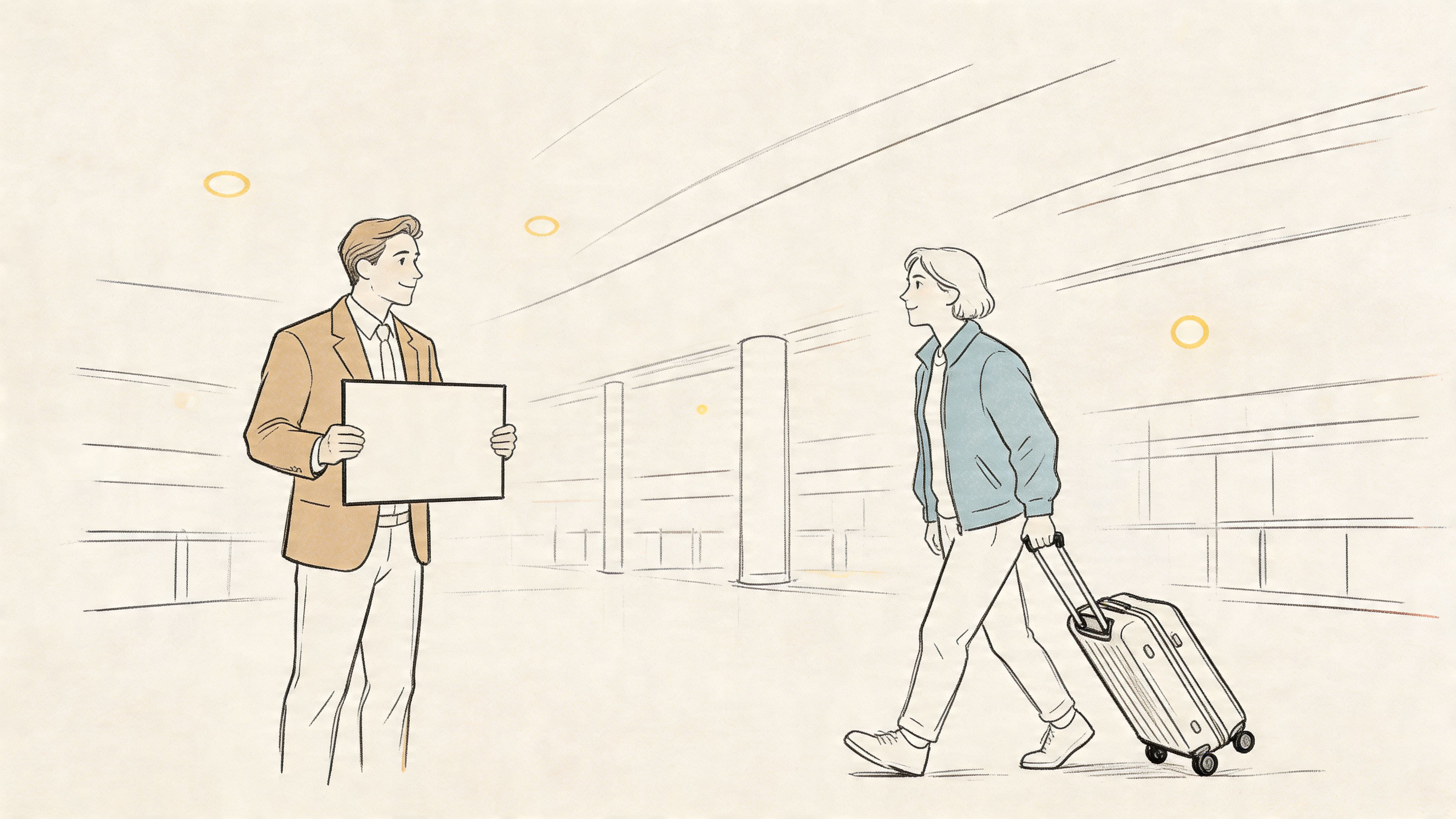
Meet-and-greet sounds like a small upgrade until you arrive tired, with weak mobile signal, and a terminal full of people holding signs. Then it becomes the difference between a smooth start and wasted time.
At Milan airports, confusion usually happens in three places: after customs, at the curb, and during terminal mix-ups. International travelers often assume the pickup area is obvious. It isn’t always, especially if family members emerge at different times or baggage is delayed.
Where airport arrivals go wrong
A standard taxi works if you can reach the line, communicate the destination, and fit everyone plus luggage into the first available vehicle. Public transport works if your next step is predictable and close to a station. Meet-and-greet wins when the cost of confusion is higher than the cost of planning.
That includes:
- families with children and strollers
- executives headed straight to meetings
- wedding travelers carrying formalwear
- groups arriving on different flights
- guests unfamiliar with Italian airport layouts
Arrivals are not the moment to negotiate logistics. They’re the moment to hand them over.
When you arrange meet-and-greet well, the driver already has the flight details, knows how many bags to expect, and understands whether the client needs a quiet business transfer or more active assistance. That’s particularly useful for travelers from the US, UK, and Middle East who may be landing after overnight journeys and going directly to Lake Como, a city hotel, or a trade show venue.
A few practical details matter more than generally assumed:
- Send the exact flight number: Airline and arrival time alone aren’t enough.
- State special items: Golf clubs, ski bags, and garment bags affect vehicle choice.
- Confirm how the driver will identify you: Full name board, company name, or private code.
- Keep one live contact method: WhatsApp is often the easiest option after landing.
4. Combine Transportation with Curated Destination Experiences
Most luxury travel content treats transportation as a separate problem. In Northern Italy, that’s a mistake. The better strategy is to combine the car with the day itself.
That means booking one service that covers movement and local rhythm. Airport to hotel, then a wine route. Shopping outlet plus lunch reservation. Ceremony venue plus photography stops. A simple transfer can become a curated day if the operator understands the region and the client’s priorities.
Local pairings that work well
A common mistake is trying to stack too many famous places into one day. Milan to Como to Bellagio to Lugano to dinner back in Milan sounds glamorous on paper. In practice, it can turn into a day spent entering and exiting vehicles. Better luxury travel hacks respect pacing.
These combinations tend to work well:
- Lake day with one anchor town: Transfer from Milan or Malpensa, time by the water, lunch, and a slow return.
- Wine route with one or two estates: Better than trying to “collect” wineries.
- Outlet shopping plus meal stop: Especially useful when travelers need space for purchases and don’t want to juggle bags on trains.
- Winter transfer plus mountain continuation: Ideal for travelers connecting from airport to alpine destination without changing modes.
The trade-off is simple. Public transport is cheaper and can be charming on straightforward routes. It’s weaker once you add reservations, luggage, children, or premium timing. A chauffeur costs more, but it protects the quality of the day.
One insider point that many visitors miss: some of the best luxury experiences near Milan are not the hardest to reach, but they are the easiest to mishandle with poor sequencing. The car is not just transportation. It’s what keeps the rest of the itinerary from collapsing into rushed connections.
5. Select Appropriate Vehicle Class for Professional Image and Comfort
Vehicle choice sends a message before anyone speaks. In Milan, that matters in business settings, weddings, and high-end leisure travel. The right car feels invisible in the best way. It matches the occasion so well that nobody notices the logistics.
An S-Class works for executive arrivals, investor meetings, and situations where presentation counts. An E-Class is often the better value for day-to-day business movement. A minivan is usually the smartest choice for families, not because it’s glamorous, but because space, easy entry, and luggage capacity beat style when children and bags are involved.
A look at the available fleet helps clients choose accurately. You can review TransferMilan’s vehicle options here.
Match the car to the occasion
A poor match creates avoidable friction. I’ve seen travelers insist on the sleekest sedan possible, then realize too late that two large suitcases, shopping bags, and child equipment turn elegance into inconvenience.
Use this logic instead:
- Executive arrival: S-Class if image and privacy matter.
- Daily meetings: E-Class or business sedan for comfort without excess.
- Family transfer: Minivan with child seats requested in advance.
- Wedding guest movement: Minibus or coordinated fleet.
- Large group: Coach service, especially for airport waves or event schedules.
This short video gives a better sense of how vehicle class shapes the experience.
The least luxurious move is under-booking space. Comfort is not just leather seats and climate control. It’s whether everyone enters easily, luggage fits without debate, and the car still feels calm after an hour on the road.
6. Book Transfers to Align with Business Event Schedules and Trade Shows
Business travelers lose time in different ways than leisure travelers do. A tourist can absorb a delay. An executive headed to a fair, showroom, conference, or dinner meeting often can’t.
In Milan, event traffic has its own rhythm. Hotels may be close to the venue in theory but awkward in practice during peak arrival and departure windows. Taxis can work for a single run, but they’re less reliable when the day includes multiple timed stops and you need the same standard of service each time. Public transport can be fast on direct routes, though it rarely solves the last-mile problem elegantly when you’re carrying samples, presentation material, or formal attire.
Business timing is different from leisure timing
The smart move is to book around the day’s anchors, not around simple distance. If your first meeting is at a trade show, your real target is calm arrival, not just arrival. Build in time to clear the hotel, get through venue security, and enter the correct gate.
This is one area where “just call a car when needed” often fails. During busy event windows, the best vehicles are already allocated, and ad hoc decisions create unnecessary risk.
Local operator advice: For exhibitions and client days, book the return ride at the same time as the outbound. End-of-day pickup points are often more chaotic than morning arrivals.
A good business transfer plan includes:
- Precise addresses: Venue entrance, gate, or hotel driveway, not just the building name.
- Schedule buffers: Especially for central Milan movement.
- Driver contact saved in advance: For time-sensitive changes.
- A vehicle suited to the day: Business sedan for solo executives, larger vehicle for team movement or equipment.
For corporate groups, synchronization matters as much as punctuality. If half the team arrives smoothly and half arrives scattered, the logistics still failed.
7. Coordinate Wedding Transportation for Ceremony, Reception, and Guest Management
Destination weddings in Northern Italy look effortless only when someone is controlling the transport plan. Couples often focus on flowers, menus, photography, and venue styling first. Guests remember the transport just as clearly.
Wedding transport isn’t one ride. It’s a chain. Airport arrivals, hotel check-ins, rehearsal dinner, beauty appointments, ceremony timing, reception departures, and often next-day brunch movement. Taxis can patch together small gaps, but they don’t give planners much control. Trains and buses are rarely suitable once guests are dressed formally, carrying gifts, or traveling to hillside or lakeside venues.
What wedding guests need most
Guests need clarity more than luxury language. They want to know who is picking them up, where, when, and what happens if their flight is late. Couples need one operator who can manage different passenger counts and different vehicle types without turning every arrival into a separate negotiation.
The strongest setups usually include:
- Airport coordination by guest wave: Especially if friends and family land at Malpensa, Linate, and Bergamo.
- Vehicle mix: Sedans for parents or VIP guests, minivans and minibuses for groups.
- Venue-specific routing: Some beautiful venues have awkward access points.
- Late-night return planning: Better than leaving guests to solve it at the end of the reception.
One trade-off deserves honesty. A unified transport plan costs more upfront than asking guests to “find a taxi.” But it removes stress from the people who matter most, and it protects the event schedule.
A practical local note: if the ceremony is near Lake Como or in a countryside venue, don’t judge timing by map distance alone. Narrow roads, guest loading, and photo pauses all add complexity. Wedding days need transport that can absorb imperfections without showing them.
8. Use Multilingual Communication for International Travel Coordination
Your flight lands on time at Malpensa. Your assistant has sent the hotel name in English, your family office has shared the billing details in Italian, and a relative arriving later is messaging in Russian. If those details sit across three channels and two spellings, small errors turn into the wrong terminal pickup, the wrong hotel entrance, or a driver waiting under the wrong name.
For Milan arrivals in 2026, language support is not a courtesy feature. It is part of transport accuracy. International clients often combine airport pickup, a city stay, a Lake Como transfer, and shopping appointments in one trip. The transport plan only works if every handoff is clear in writing and understood by the operations team, not just by the driver.
English covers many bookings. Italian helps with local venues, private apartments, and event staff. Russian and other major international languages can be useful for family groups, UHNW travelers, and bookings handled through assistants, concierges, or security teams. The practical goal is simple. Fewer assumptions, fewer last-minute calls, fewer billing disputes.
A setup that works well usually includes:
- One written channel for the full itinerary: WhatsApp or email keeps timings, addresses, and passenger updates in one place.
- Exact flight and rail details: Date, carrier, flight number, arrival airport, and final destination in a single message.
- Property names checked against map pins: In the Milan area, similar hotel or villa names cause more errors than clients expect.
- Passenger names written as they should appear on signage: Especially for VIP meet-and-greet or corporate arrivals.
- Reconfirmation for changes: Additions such as outlet shopping, a dinner in Brera, or a next-day lake transfer should be approved in writing.
This matters even more outside central Milan. A driver can usually recover from a vague address in the city. It is harder when the destination is a private villa near Como, a lesser-known entrance at a fairground, or an outlet stop added after lunch. If shopping is part of the itinerary, it helps to send the destination exactly as booked, especially for places like Serravalle Designer Outlet transfers from Milan.
One trade-off is worth stating clearly. A multilingual operations team often costs more than a basic transfer desk. For affluent international travelers, that extra coordination usually saves money elsewhere by preventing missed pickups, overtime caused by avoidable confusion, and itinerary errors that are expensive to fix once the car is already on the road.
The best operators handle language at the booking stage, then back it up with written confirmations, local knowledge, and a dispatcher who can resolve changes quickly. That is what keeps a complex Milan itinerary under control.
9. Arrange Special-Rate Transfers to Luxury Shopping Destinations
Shopping days look easy on Instagram and messy in real life. Bags multiply. VAT paperwork takes time. One boutique visit becomes six. Suddenly the return journey matters as much as the shopping itself.
For affluent travelers heading to Serravalle or FoxTown, private transfer is less about status than efficiency. You leave when you want, carry what you buy, and avoid the fatigue of juggling purchases on public transport. It’s also one of the best group travel ideas in the region. Friends, families, and visiting clients often enjoy shopping more when the day is built around comfort rather than transport compromise.
Shop well without turning the day into logistics
A direct train or bus can make sense for budget-conscious travelers with light plans. It’s less attractive if the day includes luxury purchases, restaurant reservations, or a second stop. Taxis are possible, but return availability and luggage space can become the weak point.
Special-rate or hourly shopping transfers make sense in situations such as:
- Serravalle for a full browsing day
- FoxTown as part of a cross-border outing
- Multi-stop shopping with lunch included
- Family shopping days where one person wants flexibility and another wants a guaranteed return
One useful local resource is this Serravalle Designer Outlet transfer guide, which helps travelers think through access, brands, and planning.
A few practical habits make these days smoother:
- Choose a larger vehicle than you think you need: Shopping expands.
- Go midweek if possible: The atmosphere is calmer.
- Keep the return time flexible: The best shopping days rarely finish exactly on schedule.
The luxury hack here is not finding more things to buy. It’s protecting your time and energy so the day still feels good by late afternoon.
10. Use Travel Agency and Hotel Partnerships for Integrated Service
A Milan arrival can go wrong in small, expensive ways. The hotel expects an early check-in window, the assistant changes the pickup name, the family adds extra luggage after shopping in Paris, and the driver at the airport has only half the brief. The fix is simple. Put the hotel, travel advisor, and transport operator on the same plan from the start.
That setup works especially well for affluent international travelers coming into Malpensa, Linate, or private terminals in 2026, then continuing to Lake Como, Lake Garda, Franciacorta, central Milan, or an outlet stop before check-in. One booking contact reduces handoff errors. It also keeps payment, timing, passenger details, and special requests in one place.
Why coordinated partnerships work better
A significant benefit is accountability. If the flight lands late, the suite is not ready, or the client decides to stop in Quadrilatero della Moda before heading to the lake, a known local operator can adjust with the hotel or agency directly. That is far better than asking the traveler to relay updates across three separate vendors while standing in arrivals.
I see the difference most clearly with complex itineraries:
- business travelers arriving for Salone del Mobile, fashion week, or major medical and industrial fairs
- families with children, nannies, and significant luggage
- wedding groups split across multiple flights and properties
- travel advisors planning Milan plus the Lakes in one trip
- luxury hotels that want transport handled to the same standard as check-in and concierge service
There is also a service advantage that guests rarely see. A good hotel or agency partner will brief the chauffeur team properly before arrival. That includes the correct terminal, passenger count, luggage load, child seats, language preferences, restaurant timing, and whether the guest wants a direct transfer or a stop en route. Fewer assumptions usually means a better day.
One local point matters here. The best partner is not always the largest or most visible brand. In Northern Italy, the stronger choice is often the operator the property trusts during difficult days. Late arrivals at Malpensa, villa check-ins around the Lakes, last-minute schedule changes during trade-show weeks, and cross-border timing issues toward Lugano all test a provider more than a routine airport run.
For travelers, the practical move is clear. Ask your hotel or advisor one direct question: who handles your high-value airport and intercity transfers when plans change? The answer usually tells you more than the brochure does.
Luxury Travel Hacks: 10-Point Comparison
For high-net-worth travelers arriving in Milan in 2026, the weak point is often not the hotel or restaurant booking. It is the ground plan between airport, city, Lakes, outlet villages, and event venues. This comparison table focuses on the decisions that protect time, privacy, and presentation once you land.
| Service | ???? Implementation Complexity | ⚡ Resource Requirements | ⭐ Expected Outcomes | ???? Ideal Use Cases | ???? Key Advantages / Tips |
|---|---|---|---|---|---|
| Pre-Arrange Premium Airport Transfers with Fixed Pricing | Low to medium, with advance booking and flight coordination | Dedicated luxury vehicles, professional multilingual drivers, booking platform, 24 to 48 hours lead time | Predictable spend, calmer arrival, professional pickup | Executive travel, wedding guests, international arrivals | Book 24 to 48 hours ahead. Share flight details. Confirm meet-and-greet and luggage count |
| Utilize Per-Hour Car Hire for Maximum Flexibility | Medium, with schedule control and route changes | Chauffeur, luxury vehicle on hourly service, fuel and toll planning, 4 to 8+ hour blocks | Strong flexibility, efficient multi-stop days, easier changes on the go | Lake day trips, outlet shopping, unpredictable business schedules | Add a time buffer of 15 to 20 percent. Confirm whether fuel, tolls, parking, and waiting time are included |
| Use Meet-and-Greet Services to Eliminate Airport Confusion | Low, with terminal and arrival tracking | Driver at arrivals with signage, real-time flight tracking, luggage assistance | Faster handover, lower stress, polished first impression | VIPs, long-haul international arrivals, wedding parties | Provide terminal and flight number. Get the driver's contact in advance. Agree on the exact identification method |
| Combine Transportation with Curated Destination Experiences | High, with multi-stop timing and supplier coordination | Coordination with estates, restaurants, guides, and day-trip scheduling | Smooth, well-paced experiences with local access and fewer wasted transfers | Wine days, Lake Como or Lake Maggiore outings, wedding itineraries | State preferences early. Reserve popular stops well ahead. Leave room in the schedule for traffic and long lunches |
| Select Appropriate Vehicle Class for Professional Image and Comfort | Low to medium, based on trip purpose and passenger mix | Fleet options such as E-Class, S-Class, minivans, minibuses, child seats, Wi-Fi, chargers | Better presentation, stronger comfort, safer fit for the group | Executive meetings, family travel, wedding fleets, corporate groups | Match the vehicle to the day. S-Class suits senior executives. A luxury minivan is often the better choice for families and shoppers with purchases |
| Book Transfers to Align with Business Event Schedules and Trade Shows | Medium, with exact timing and realistic buffers | Punctual drivers, live traffic tracking, multilingual support, written confirmations | Better punctuality, protected professional image, tighter day planning | Trade shows, conferences, client roadshows | Book 48 to 72 hours ahead during major fair periods. Confirm the exact gate or entrance, not just the venue name |
| Coordinate Wedding Transportation for Ceremony, Reception, and Guest Management | High, with manifests, staging, and strict timing | Minibuses or coaches, coordinated schedules, rehearsals, guest lists | On-time guest movement, cleaner logistics, consistent presentation | Destination weddings, large ceremonies, guest transfers | Book early. Share the full manifest. Confirm venue access, parking rules, and return timings for late departures |
| Use Multilingual Communication for International Travel Coordination | Low, with language coverage and clear channels | Multilingual operators, phone, WhatsApp, chat, time-zone support | Fewer misunderstandings, quicker confirmations, better handling of changes | International travelers, complex itineraries, non-Italian speakers | Use one written channel for all updates. Ask for confirmations in your preferred language, especially for names, addresses, and timing |
| Arrange Special-Rate Transfers to Luxury Shopping Destinations | Medium, with route planning, waiting time, and package pricing | Drivers who know the outlets, luggage support, possible hourly booking | More predictable shopping spend, smooth logistics, easier handling of purchases | Serravalle Designer Outlet and FoxTown shopping days | Reserve hourly service for multi-stop shopping days. Check trunk space before departure. Midweek trips are usually easier and faster |
| Utilize Travel Agency and Hotel Partnerships for Integrated Service Coordination | Low to medium, depending on partner setup | Hotel or agency-approved providers, shared billing options, concierge coordination | One point of contact, better availability, simpler payment handling | Hotel guests, agency clients, corporate travel programs | Ask which operator the hotel or advisor uses for high-value arrivals and last-minute changes. That answer usually tells you more than the brochure |
Your Blueprint for Smooth Milan Travel
A traveler lands at Malpensa after an overnight flight, steps into arrivals with two large cases, a watch appointment in central Milan, and lunch on Lake Como the same day. That itinerary can feel polished or chaotic within the first 20 minutes. In Northern Italy, the result usually depends less on the hotel than on the ground plan.
For affluent international travelers arriving in the Milan area in 2026, premium transport is not a finishing touch. It is the operating system for the trip. A well-run arrival protects timing, privacy, and energy. A poor one creates small failures that follow the rest of the day, from delayed check-in to missed shopping windows, rushed business meetings, or a strained start to a family stay.
The strongest Milan travel tactics are practical. Reserve airport transfers before departure. Use hourly chauffeur service on days with several stops. Choose a vehicle that fits both passengers and luggage, not just headcount. Build plans around real road conditions between airports, the city, the Lakes, and outlet destinations. Keep names, pickup points, and timing in one written thread. Ask your hotel, advisor, or local operator to coordinate the pieces that need to connect.
Trade-offs matter. Taxis work for short city trips with light luggage. Rail is efficient for certain station-to-station journeys. Those options stop making sense when the day includes shopping purchases, family members, exhibition schedules, or a cross-border route toward Switzerland. Premium travelers usually pay for certainty as much as transport. They want the car to be waiting, the fare agreed in advance, the driver briefed, and the day protected from avoidable friction.
That is especially true around Milan because the city is rarely the whole trip.
Many high-value itineraries in this region extend fast. One day starts at Linate, moves to a showroom or trade fair, then continues to Lake Como. Another includes Serravalle Designer Outlet with extra luggage and a dinner return. Wedding guests may need staggered pickups between villas, churches, and reception venues. On paper, these look manageable. In practice, they run well only when the transport plan accounts for traffic patterns, access rules, parking constraints, and timing drift between appointments.
The market has also changed. Affluent travelers now expect smooth digital booking, dependable execution, and payment that does not create extra work. The best local operators respond with clear confirmations, live communication, and service standards that fit international expectations. They are not selling a simple ride from point A to point B. They are supporting the full rhythm of the itinerary.
Use a simple formula. Book early enough to secure the right class of vehicle. Send exact flight details, luggage count, and destination notes. Confirm the final price in writing when budget certainty matters. Choose hourly service for shopping days, lake circuits, roadshows, and wedding logistics. Leave margin around fairs and business events, especially during busy Milan calendar periods. If the itinerary has status, complexity, or multiple handoffs, treat ground transport as core trip planning.
That approach keeps Milan efficient, calm, and well paced from arrival onward.
For dependable, fixed-price transfers across Milan, Lake Como, shopping outlets, exhibition venues, and destinations across Northern Italy, TransferMilan.com is a practical local choice. The service covers Malpensa, Linate, and Bergamo with private airport transfers, hourly chauffeur hire, multilingual booking support, group transport, wedding logistics, and a fleet that ranges from business sedans to luxury cars, minibuses, and coaches.