0 Best Ways: Venezia Airport to Train Station 2026
- Travel Tips
- by Tara Malone
- 18-05-2026

You've landed, switched your phone back on, and now the central question starts: how do you get from venezia airport to train station without wasting the first hour of your trip? Most travelers look at the ticket price first. In Venice, that's the wrong first filter.
The better filter is total effort. A cheap bus can still become the most expensive choice in practice if you lose time in the queue, stand waiting with bags, then drag those bags over bridges after you arrive. A pricier transfer can save money in another currency: energy, timing, and a cleaner start to the trip.
Venice makes this decision trickier because “the train station” can mean two different places. Some travelers need Venezia Mestre on the mainland. Others need Venezia Santa Lucia, the station inside historic Venice. Those are not interchangeable. If you choose the wrong one, you add an extra transfer right when you're tired and loaded with luggage.
For anyone arriving from abroad, it also helps to sort the basics before boarding. Simple prep like storing booking confirmations offline and checking how your destination is reached after the train station saves a lot of friction. These tips for stress-free international travel are worth reviewing before you fly. If you already know you want a direct car option, this Venice transfer overview gives a useful benchmark for what a pre-booked ride usually includes.
Table of Contents
- Your Arrival in Venice Planning Your First Step
- Navigating from Marco Polo Airport VCE to Santa Lucia
- Your Guide from Treviso Airport TSF to Santa Lucia
- Pro Tips for a Stress-Free Airport Transfer
- Which Venice Transfer Option Is Right for You
- Your Seamless Arrival in Venice
Your Arrival in Venice Planning Your First Step
You land, collect your bags, and see signs for buses, taxis, water shuttles, and car services. The expensive mistake is choosing too fast.
Start with two decisions. Which airport are you at, and is your real target Mestre, Santa Lucia, or just the road terminal at Piazzale Roma? Those are different arrivals with different workloads once you add suitcases, queues, and walking time.
Marco Polo is the simpler case because it sits close to Venice. Visit Venice Italy notes that the airport is 12 kilometers by road and 10 kilometers by water from Venice. Treviso needs more planning because the transfer is longer, and the “cheap” option often gets less attractive after a flight delay or a long wait for checked luggage.
Start with destination logic
If your train leaves from Mestre, stay on the mainland and keep the transfer simple. If your train leaves from Santa Lucia, make sure your route finishes at Venice's edge and does not leave you with another segment, another ticket line, or a long drag over bridges with bags.
That last part matters more than many guides admit.
Travelers often treat Mestre and Santa Lucia like interchangeable station names. They are not. One can save time. The other can add an extra transfer at the worst point of the day, when you are tired, carrying luggage, and trying to get your bearings in a crowded arrival area.
Use this quick filter:
- Choose Mestre if your onward train departs from the mainland.
- Choose Santa Lucia if your hotel or rail departure is inside Venice proper.
- Treat Piazzale Roma as a road drop-off point, not the station itself.
I tell clients to price the full chain, not the first ticket. A low bus fare loses its appeal if you spend the savings on extra porterage, a water bus connection, or 20 minutes wrestling bags over steps.
What usually saves the most effort
Public transport works well for travelers with one small case, no time pressure, and a straightforward route. It gets less attractive once you add children, mobility limits, oversized luggage, or an apartment that sits beyond several bridges.
In those cases, the smarter comparison is total effort per person, not headline price. That is why many travelers book a private Venice airport transfer to the right arrival point when they want predictable timing and fewer moving parts.
My rule is simple:
- Use the most direct option to your actual station or drop-off point.
- Pay for a private transfer sooner if you have multiple bags, a tight rail connection, or a group.
- Pick water transport for the experience, not because you expect it to be the fastest choice.
If you want to reduce friction before you even land, these tips for stress-free international travel help with the part many Venice guides skip: arrival fatigue changes what counts as “easy.”
Navigating from Marco Polo Airport VCE to Santa Lucia
You land at Marco Polo, clear baggage claim, and see a bus that looks cheap and direct. Then the actual transfer starts. Ticket machines have a line, the next bus is full, and once you reach Piazzale Roma you still have to get yourself and your bags to Santa Lucia.
That is why the right comparison is total journey time and effort, not the first fare you see.
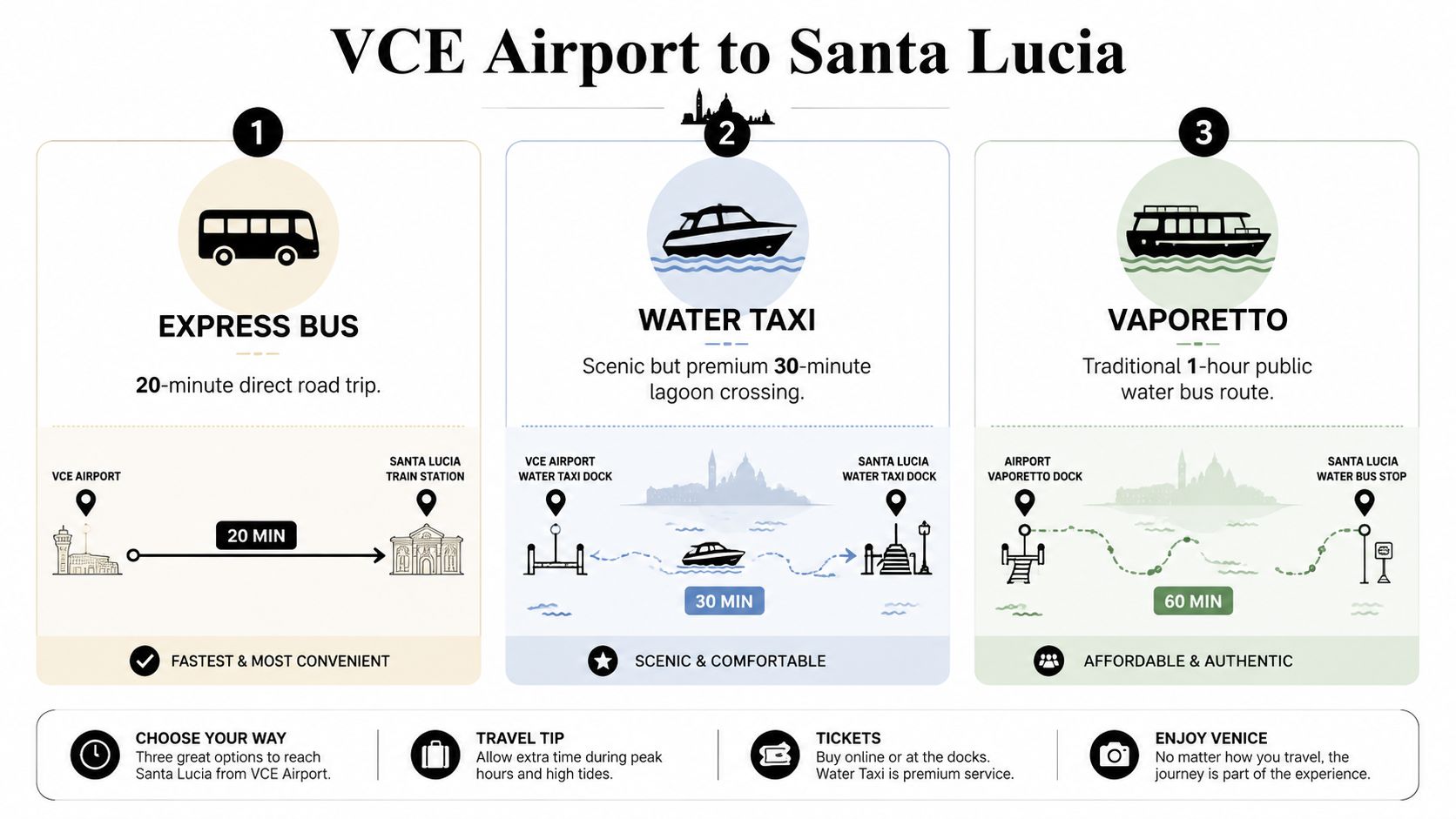
Marco Polo is manageable if your target is clear. For Santa Lucia, the airport gives you three realistic patterns: bus to Piazzale Roma and walk, bus to Mestre and train on, or a private car to the closest practical road access point. Water services exist, but they are rarely the smartest station transfer if your end goal is the rail platforms.
According to Visit Venice Italy's airport transport overview, Marco Polo sits on the mainland, with a shorter road approach than many first-time visitors expect. That geography is the reason every airport transfer into Venice turns into a handoff at some point.
Know which station chain you are buying
The Mestre option looks efficient if you are comfortable with one extra change. You take an airport bus to Mestre, then continue by train to Santa Lucia. I only recommend that chain to travelers who already know they need Mestre for a mainland connection, or who are traveling very light and arrive at an easy hour.
For travelers whose actual destination is Santa Lucia, the more direct public route is usually the airport bus to Piazzale Roma, followed by the walk to the station. On paper, that sounds simple. In practice, the walk is where the route gets mispriced. Rolling a cabin bag is easy enough. Pulling two large cases through crowds and over the bridge approach is another story.
The public option that usually makes the most sense
The main airport buses leave from outside arrivals, and the direct express service to Piazzale Roma is a popular choice because it is straightforward and runs regularly. It is often the best-value public option for solo travelers and couples with one manageable bag each.
The weak point is not the ride itself. It is everything around it.
You may wait to buy tickets. You may queue to board. If several flights land close together, the first bus can fill. After drop-off, you still have the final walk to Santa Lucia with all your luggage. That final stretch is short enough to look harmless on a map, but it often feels longest when you are tired, late, or traveling with children.
A practical comparison looks like this:
| Option | Best for | Main trade-off |
|---|---|---|
| Bus to Piazzale Roma | Solo travelers, couples, light packers | Final walk to Santa Lucia adds effort |
| Bus to Mestre plus train | Travelers continuing on mainland rail routes | One more transfer, one more chance to lose time |
| Private car to the nearest road access point | Families, groups, heavy luggage, tight schedules | Higher upfront cost, lower friction |
For readers who like transport guides that explain station logic clearly in another destination, this piece on reliable Algarve travel information is a good example of how much easier travel gets when you focus on transfer flow, not only fares.
Water and private options
The airport boat appeals to first-time visitors because the arrival feels unmistakably Venetian. It can be a good experience. It is usually not the fastest or least tiring way to reach Santa Lucia station.
A land taxi has a limit too. It can only take you as far as the road network goes. The advantage of a pre-booked private transfer is not magic door-to-door access inside the historic center. The advantage is controlled timing, no ticket queue, no guesswork after landing, and a cleaner handoff if you are trying to catch a train.
That matters more than many travelers expect.
If you are on a budget and carrying little, the direct bus works fine. If you are arriving during a busy bank of flights, carrying multiple bags, traveling with family, or protecting a rail connection, paying more upfront for a private transfer is often the smarter buy once you count the whole chain.
Your Guide from Treviso Airport TSF to Santa Lucia
Treviso changes the mood of the transfer. At Marco Polo, you're solving a short access problem. At Treviso, you're solving a longer positioning problem first, then Venice starts.
Why Treviso needs more planning
Treviso is commonly used by budget carriers, and that usually means travelers arrive expecting a cheaper overall journey. Sometimes that's true. Sometimes the savings disappear once you factor in the longer coach ride, the waiting, and the final on-foot section in Venice.
The public route most travelers use is a dedicated coach toward Piazzale Roma. It's the standard budget move because it keeps the process simple: one airport bus, then a final walk to Santa Lucia. The weakness is obvious when you arrive tired. A longer coach trip is still a coach trip, and the difficult part often starts after drop-off.
For Santa Lucia-bound passengers, the public route usually works best when all of these are true:
- You're traveling light
- Your arrival time is flexible
- You don't mind a long sit followed by a walk
- You're not managing children, strollers, or bulky luggage
If even one of those points doesn't fit, the appeal of the cheap ticket fades fast.
When a long road transfer is worth paying for
On a long airport approach like Treviso, private transport starts making more sense than it does on very short airport hops. Not because public transport is impossible, but because fatigue compounds. By the time you reach Venice's edge, most travelers don't care that they saved a little if they still have to haul bags through a crowded terminal area.
That shift is even more visible with groups. A family or small group often discovers that the “budget” option means paying separately per person, then coordinating seats, luggage, and a final walk. One vehicle with a fixed arrangement can be easier to price mentally because it removes the moving parts.
This is also where many travelers underestimate the emotional value of a clean arrival. A calm pickup after a budget flight often feels better than squeezing one last savings decision out of the journey.
Here's a useful visual if you want to get a feel for the route environment before landing:
Pro Tips for a Stress-Free Airport Transfer
The genuine Venice transfer problem isn't usually the airport leg. It's the handoff after the airport leg. Travelers plan the first segment, then get caught by the final segment.
The luggage problem most guides skip
The single biggest mistake is evaluating the journey as if it ends at Santa Lucia. For many people, it doesn't. The journey doesn't end at the station. Expert logistics analysis reveals that 68% of passengers must take secondary transport from Santa Lucia, like a vaporetto water bus (€9.50+), and those with 2+ bags see their total journey time extended by 22-30% due to boarding constraints and navigating bridges, according to Italy's Venice airport transfer analysis.
That means your airport choice should be shaped by what happens after the station, not only before it.
If you're staying in Venice proper, ask yourself:
- Is my hotel walkable from Santa Lucia?
- Will I need a vaporetto after the station?
- How many bridges stand between me and the hotel?
- Am I carrying 2+ bags?
If the answers are inconvenient, the cheapest airport transfer often stops being the smartest one.
Venice punishes bad luggage decisions quickly. A bag that felt manageable in a terminal can feel much heavier on a bridge ramp or a crowded vaporetto platform.
Accessibility and family reality
Public transport can work well enough for mobile adults traveling light. It's less forgiving for travelers with reduced mobility, families with strollers, or anyone carrying bulky cases.
What's often missing from generic guides is detail. The airport bus option sounds simple until a stroller needs folding, the luggage footprint gets awkward, or the transfer area is crowded. Families usually don't struggle on the road portion alone. They struggle during the waiting, boarding, unloading, and final navigation after arrival.
For those passengers, the better planning questions are practical:
- Can everyone board quickly without pressure from other passengers?
- Will luggage and child gear slow down the walk from drop-off to station?
- Does anyone in the group need minimal walking or direct assistance?
- Would one coordinated vehicle remove two or three stressful steps at once?
If the answer is yes, direct private transport is usually the cleanest solution, even before you compare prices.
The station mistake that causes the most hassle
The most common planning error is simple: booking for Mestre when you need Santa Lucia, or aiming for Santa Lucia when your rail connection is easier from Mestre.
Use this quick rule:
| You should aim for | If your next step is |
|---|---|
| Mestre | A mainland rail departure or connection onward through northern Italy |
| Santa Lucia | A stay in Venice proper, or a train that departs from the island station |
| Piazzale Roma | A road drop-off point, not your final rail destination |
A second mistake is buying local tickets only after landing. Pre-arrival booking cuts friction, and digital access matters more in Venice than many first-time visitors expect because queueing and orientation take longer when the arrivals area is busy.
Which Venice Transfer Option Is Right for You
You feel the difference in Venice at the end of the transfer, not on the price screen at booking. Ten euros saved can disappear fast if you lose time at the ticket machine, wait through a full bus, then drag bags through crowded access points to reach the right platform.
The right choice depends on your real arrival conditions: how much luggage you have, how tired you will be after the flight, what time you land, and whether you need Santa Lucia fast or as cheaply as possible.
Quick comparison by traveler type
Solo traveler on a tight budget
The bus is usually the practical choice. If you travel with one compact bag and you do not mind a bit of walking, it keeps costs down and gets the job done. The trade-off is effort. A cheap transfer can turn into a slow one if arrivals are busy or you need extra time to get from drop-off to your train.
Couple on a short city break
Couples often face the most awkward decision. On paper, public transport looks easy enough. In practice, it depends on luggage, arrival time, and how tight your schedule is. Two light cases and no rush. The bus works well. One large suitcase each, an evening arrival, or a hotel plan that already involves more walking. A booked car starts to make more sense because it cuts out queueing and reduces the amount of carrying.
Family with children
For families, the math changes quickly. Buying several bus tickets can still look cheaper at first glance, but the full trip is rarely just the ride itself. Parents lose time in lines, during boarding, and while keeping bags and children moving in the same direction. One pre-booked vehicle often costs less than people expect, and it removes the most tiring parts of the transfer.
Group of friends
A group can split costs well in a private vehicle, especially if everyone has bags. A key advantage is coordination. You stay together, leave together, and arrive together, instead of trying to regroup after ticket checks, queues, or a crowded bus boarding.
Business traveler
For work trips, reliability usually matters more than saving a small amount on the first leg. If you have a meeting, a rail connection, or need to arrive clear-headed, reduce variables early. For a broader look at the trade-offs between chauffeur booking, taxi, and standard transfer options, this car service comparison for Italy in 2026 is a useful reference.
Public transport suits travelers who can absorb a slower, more physical arrival. Private transfer suits travelers who want the shortest path with the least handling.
| Traveler type | Best fit | Why |
|---|---|---|
| Solo, light luggage | Bus to Piazzale Roma | Lowest spend, manageable effort |
| Couple with moderate luggage | Bus or private transfer | Best choice depends on timing, bags, and walking tolerance |
| Family or group | Private transfer | Easier coordination, less waiting, less carrying |
| Business traveler | Private transfer | Faster, more predictable arrival |
Your Seamless Arrival in Venice
You land thinking the hard part is over. Then come the baggage wait, the ticket machine, the line for the bus, and the final walk over bridges with a rolling suitcase that does not roll well on stone. That first hour is where Venice either feels manageable or unnecessarily tiring.
The best venezia airport to train station choice is rarely the cheapest ticket on paper. The actual calculation includes queue time, how many times you handle your bags, how far you walk once you arrive, and how predictable the transfer is if your flight lands late or the airport is busy.
A bus still makes sense for travelers with light luggage, flexible timing, and no issue standing in line or walking the last stretch. It is the lower-cost option, and for the right traveler, that is enough.
Private transfer earns its value elsewhere. It cuts out the ticket step, reduces waiting, and avoids the usual scramble of keeping people and bags together after a flight. For families, small groups, older travelers, or anyone with a train to catch, that usually matters more than saving a modest amount on the first leg.
A good arrival plan feels easier because it removes effort, not because it looks cheap at the booking stage.
If you'd rather skip the queue, the bus crowding, and the luggage shuffle, TransferMilan LLC offers fixed-price private transfers across northern Italy with meet-and-greet service, luggage assistance, and vehicles sized for solo travelers, families, and larger groups. It's the practical choice when you want your Venice arrival handled cleanly from the start.