0 How to Get From Milan to Portofino: Best 2026 Routes
- Travel Tips
- by Tara Malone
- 30-07-2026

You've landed in Milan, looked at a map, and Portofino seems deceptively simple. It's not far. The photos make it feel like an easy hop from the city to the harbor. Then the practical questions start. Do you take the train? Is there a direct bus? Should you rent a car? Is a taxi sensible, or just expensive and inconvenient?
That's where this route catches people out. The main Milan to Liguria leg is straightforward. The last stretch into Portofino is where plans either stay smooth or start fraying. Schedules, luggage, parking, coastal traffic, and the fact that Portofino itself is effectively not a normal car destination matter more than most generic guides admit.
If you're still deciding how to get from Milan to Portofino, this guide is built for real travelers, not for postcard itineraries. It covers what works in 2026, which options suit solo travelers versus families and groups, and why the final approach changes the whole decision. If you're still shaping your Riviera plans, it also helps to discover luxury Italian coastal trips and pair that inspiration with practical local routing. For a wider look at the Ligurian coastline beyond Portofino, this overview of traveling along the Italian Riviera from Genoa to San Remo is useful context.
Table of Contents
- Planning Your Escape to the Italian Riviera
- Your Milan to Portofino Options at a Glance
- The Gold Standard for Comfort Private Transfer
- The Scenic Route Combining Train and Ferry
- The Adventurous Path Driving Yourself to the Riviera
- Expert Tips for a Flawless Journey in 2026
- Frequently Asked Questions
- Is a day trip from Milan to Portofino realistic
- What's the cheapest way to get from Milan to Portofino
- Is there a direct train from Milan to Portofino
- Are taxis easy to get from Santa Margherita Ligure
- What's the best option in winter or the off-season
- Is self-driving worth it for families
- What's the best option for a group
Planning Your Escape to the Italian Riviera
A lot of travelers start with the same assumption. Milan to Portofino looks like a short transfer, so any transport option should be fine. In practice, the route asks a different question. Not just how you'll leave Milan, but how you want to arrive on the coast.
That matters more now because travel behavior on the Ligurian coast has shifted. Recent data from 2024 to 2025 shows a nearly 20% increase in travelers opting for guided or private transfers on the Ligurian coast, linked to congestion and parking shortages in places like Portofino, according to Portofino day trip guide. That doesn't mean public transport is wrong. It means more people are finding that the elegant option on paper isn't always the easiest one in real life.
What travelers usually get right and wrong
Travelers correctly identify three realistic choices:
- Private car transfer
- Train plus ferry
- Rental car or self-drive
Where they go wrong is treating these as if they were equal except for price. They're not.
A business traveler landing at Malpensa with a cabin bag has very different needs from a family arriving at Linate with strollers and suitcases, or a wedding group moving several people on a fixed schedule. The route works differently depending on luggage, season, arrival airport, and whether you care more about scenery, simplicity, or time control.
The Milan part is easy. The Portofino part decides whether the day feels polished or stressful.
The real planning question
When clients ask how to get from Milan to Portofino, the most useful answer isn't “take the cheapest” or “take the fastest.” It's this: decide where you want to spend your energy.
If you want the coast to begin when you leave your hotel or airport, choose a door-to-door option. If you enjoy transport changes and don't mind coordinating rail and sea connections, train and ferry can be a pleasant day. If you want full independence, self-driving gives freedom, but only if you're comfortable with narrow coastal roads and imperfect parking logistics.
Your Milan to Portofino Options at a Glance
Choosing the right option depends less on the Milan departure and more on how you want to arrive at the coast. The motorway portion is straightforward. The last stretch into Portofino is the part that changes the feel of the day, especially in high season, when the coastal road slows down and parking stops being a small detail.
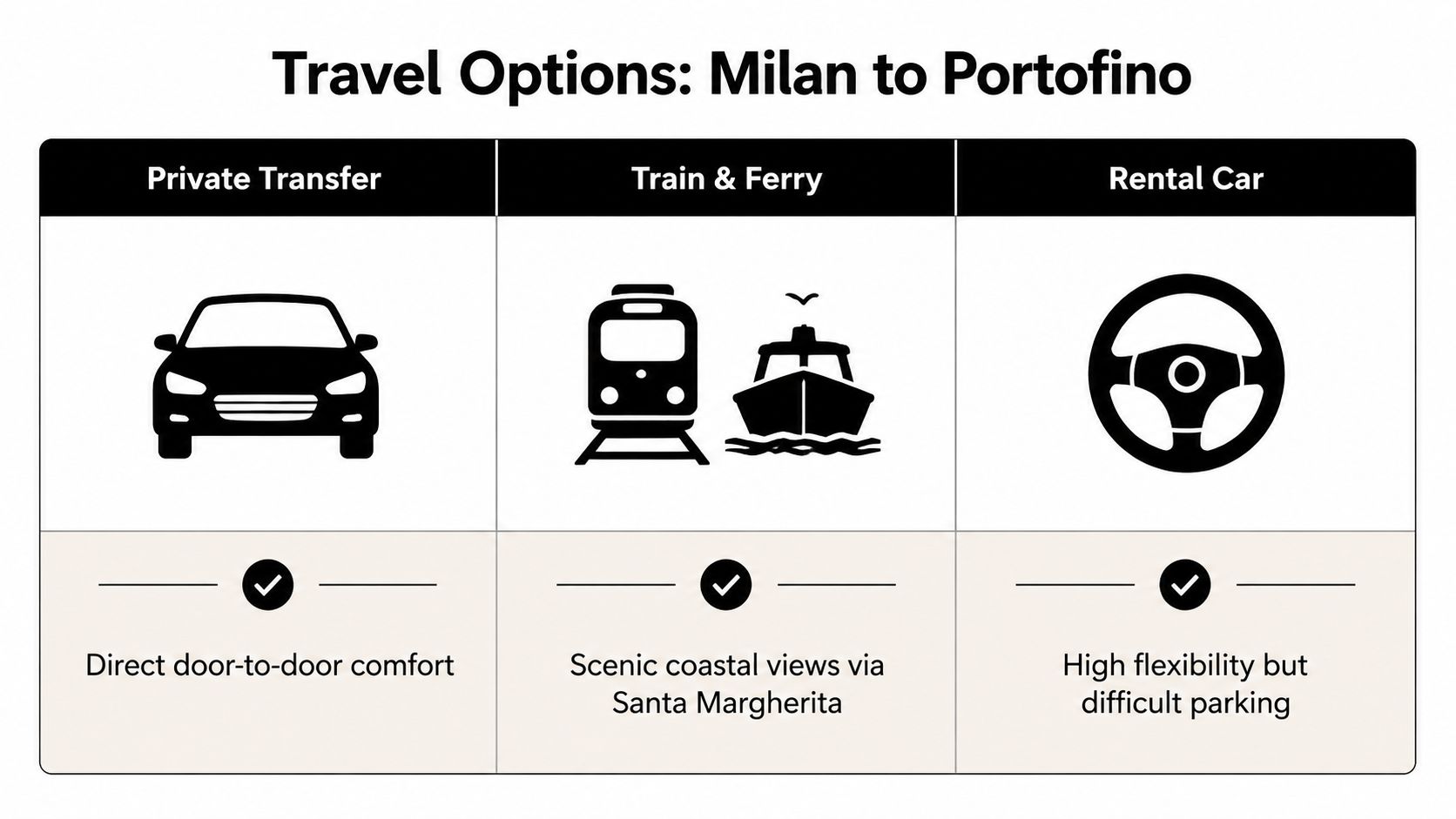
Milan to Portofino Travel Options Compared 2026
| Method | Total Time | Estimated Cost (per person) | Convenience | Best For |
|---|---|---|---|---|
| Private transfer | Direct journey, usually the quickest door-to-door option | Higher than public transport | Very high | Families, business travelers, couples, groups, airport arrivals |
| Train and ferry | Multi-step journey with timing dependent on connections and season | Lower than a private car in most cases | Medium | Solo travelers, couples traveling light, scenic-day travelers |
| Rental car | Variable. The final coastal approach often adds delay | Fuel, tolls, rental, parking | Medium to low near arrival | Confident drivers who want flexibility outside Portofino |
The short version
Private transfer is the cleanest choice if the goal is to get from Milan to your hotel or meeting point with the fewest weak spots. Train and ferry works well for travelers packing light who do not mind a staged journey. A rental car gives independence on the Riviera, but Portofino itself is the place where that freedom starts to narrow because road access and parking are limited.
That last point matters more than many guides admit.
A car is useful between towns like Santa Margherita Ligure, Rapallo, and Camogli. Portofino is different. Once you get close, traffic control, seasonal congestion, and the search for parking can turn a simple arrival into the hardest part of the trip. That is why travelers comparing options should look at arrival handling, not only price or line-haul travel time. If you are weighing comfort against cost, this guide to comparing private car services in Italy for 2026 helps clarify what changes in practice.
There is also a fourth option travelers ask about. Taxi from Milan. For a journey of this length, it sits in the same category as a pre-booked long-distance car service, but usually with less certainty on vehicle size, luggage space, and pickup coordination. For city rides in Milan, taxis are practical. For a cross-region trip to Portofino, a booked transfer is usually the more predictable setup.
Practical rule: If you're arriving from an airport, carrying more than one suitcase per person, or traveling with children, compare door-to-door friction, not just ticket price.
What works for groups
Groups change the equation quickly. Two people can absorb a missed connection or a short walk with bags. Six people with wedding clothes, children, or varied arrival times usually cannot.
That is where private vans start making financial sense as well as logistical sense. Public transport remains possible, but once you add multiple tickets, platform changes, ferry timing, and the final handoff into Portofino, coordination becomes the actual cost.
The Gold Standard for Comfort Private Transfer
For travelers who care about a clean, controlled journey, a private vehicle is the strongest option. On this route, that isn't just about comfort. It's about removing weak points.
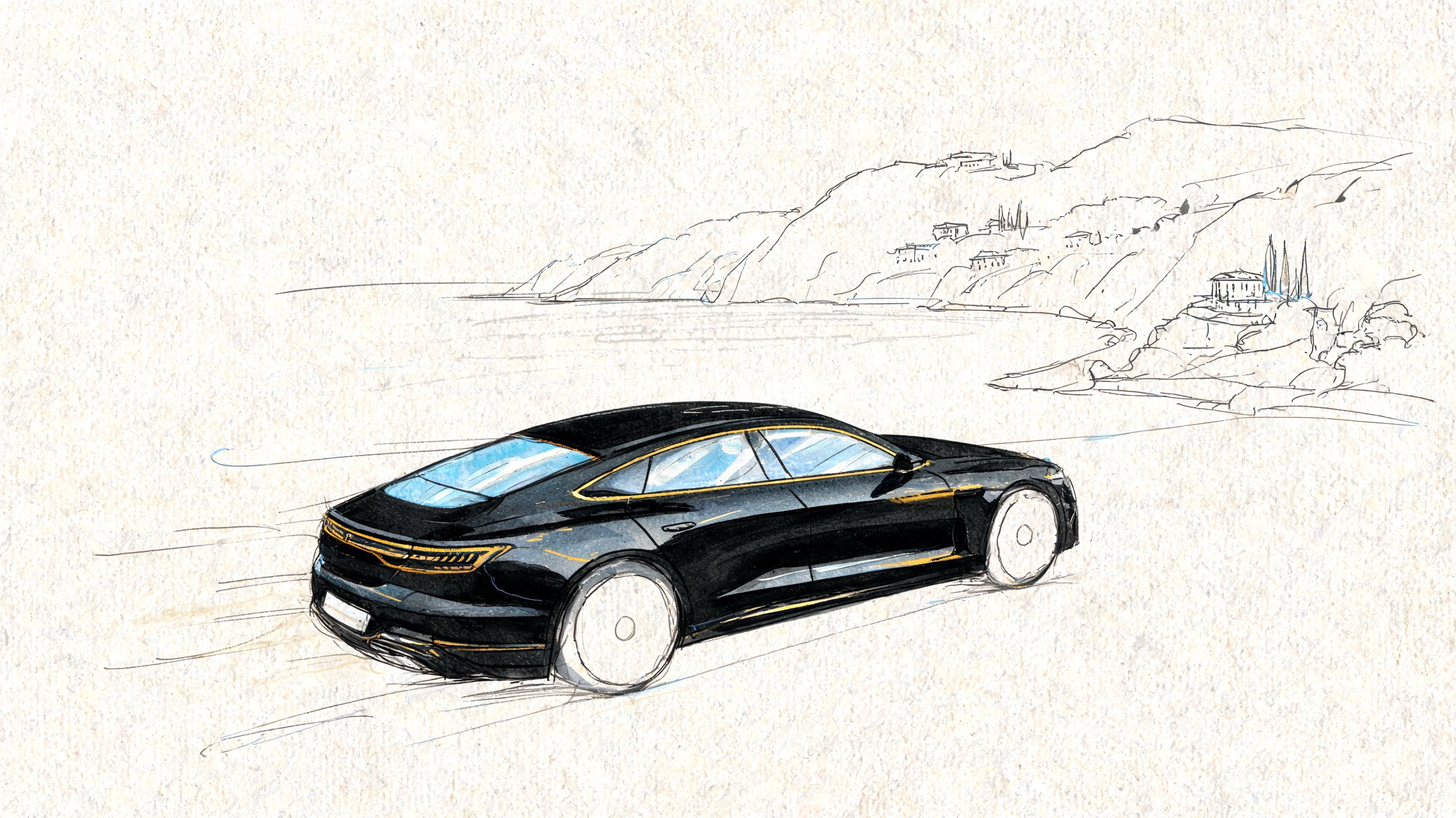
According to Milan and Portofino driving overview, public transit journeys take over 3 hours, while a private vehicle covers the 175 km in approximately 1 hour 53 minutes. That difference matters most for airport arrivals, same-day hotel check-ins, business travelers, and anyone trying to protect time on the Riviera instead of spending it in transitions.
Why private transfer changes the experience
The obvious benefit is door-to-door travel. You leave from your Milan hotel, Milano Centrale, Malpensa, Linate, or Bergamo and go directly toward the coast without station changes, ferry coordination, or standing with luggage on crowded platforms.
The less obvious benefit is what happens at the end.
Most visitors picture the route as motorway driving followed by a simple arrival into a glamorous seaside village. It doesn't work like that. The final access is where local road knowledge starts to matter, especially in season. A professional long-distance chauffeur handles that as part of the job. A first-time visitor often hits the difficult part when they're already tired.
Better than a taxi for this route
A city taxi and a pre-booked transfer can look similar from a distance. In practice, they serve different travel patterns.
For Milan to Portofino, international travelers usually need more than a ride. They need:
- A known pickup point at airport, hotel, or station
- Vehicle sizing that matches people and luggage
- Meet-and-greet support after a flight
- Fixed pricing instead of uncertainty over a long route
- A driver prepared for the coast, not only for urban work
That's why travelers comparing options often look at a dedicated chauffeur service rather than treating this like a standard taxi journey. If you want to compare route planning, vehicle classes, and service differences, this guide to car service in Italy in 2026 and how transfers compare is a useful reference.
Who benefits most
Private transfer isn't only for luxury travelers. It's often the sensible choice for specific trip types.
- Families with children: Car seats can be arranged in advance, luggage stays with you, and nobody has to manage train-to-ferry changes with tired children.
- Couples on a short stay: If you're doing one night or a premium weekend, saving stress often matters more than squeezing transport costs.
- Business travelers: Direct routing protects your timetable and gives a more predictable arrival.
- Groups: One vehicle keeps everyone on the same plan. That's hard to replicate with separate taxis or staggered public transport arrivals.
- Wedding and event travel: Timed arrivals matter. Coordinated vehicles matter even more.
If your day has one immovable time, a ceremony, hotel check-in, lunch reservation, or return flight, the safest plan is the one with the fewest handoffs.
The trade-off
The trade-off is simple. You pay more than rail. But what you're buying isn't just speed. You're buying certainty, luggage handling, simpler arrivals, and less decision-making on the move. On this route, those things often matter more than the line-item fare.
TransferMilan is one Milan-based option for this route, offering fixed-price door-to-door transfers from the city and major airports with vehicle choices ranging from sedans to larger group transport.
The Scenic Route Combining Train and Ferry
You step off the train on the Ligurian coast, see Portofino on the map, and assume the hard part is over. It isn't. The last stretch is where this route either feels charming or starts to feel awkward, especially once you're handling bags, looking for the ferry point, and trying to time the connection on a busy waterfront.
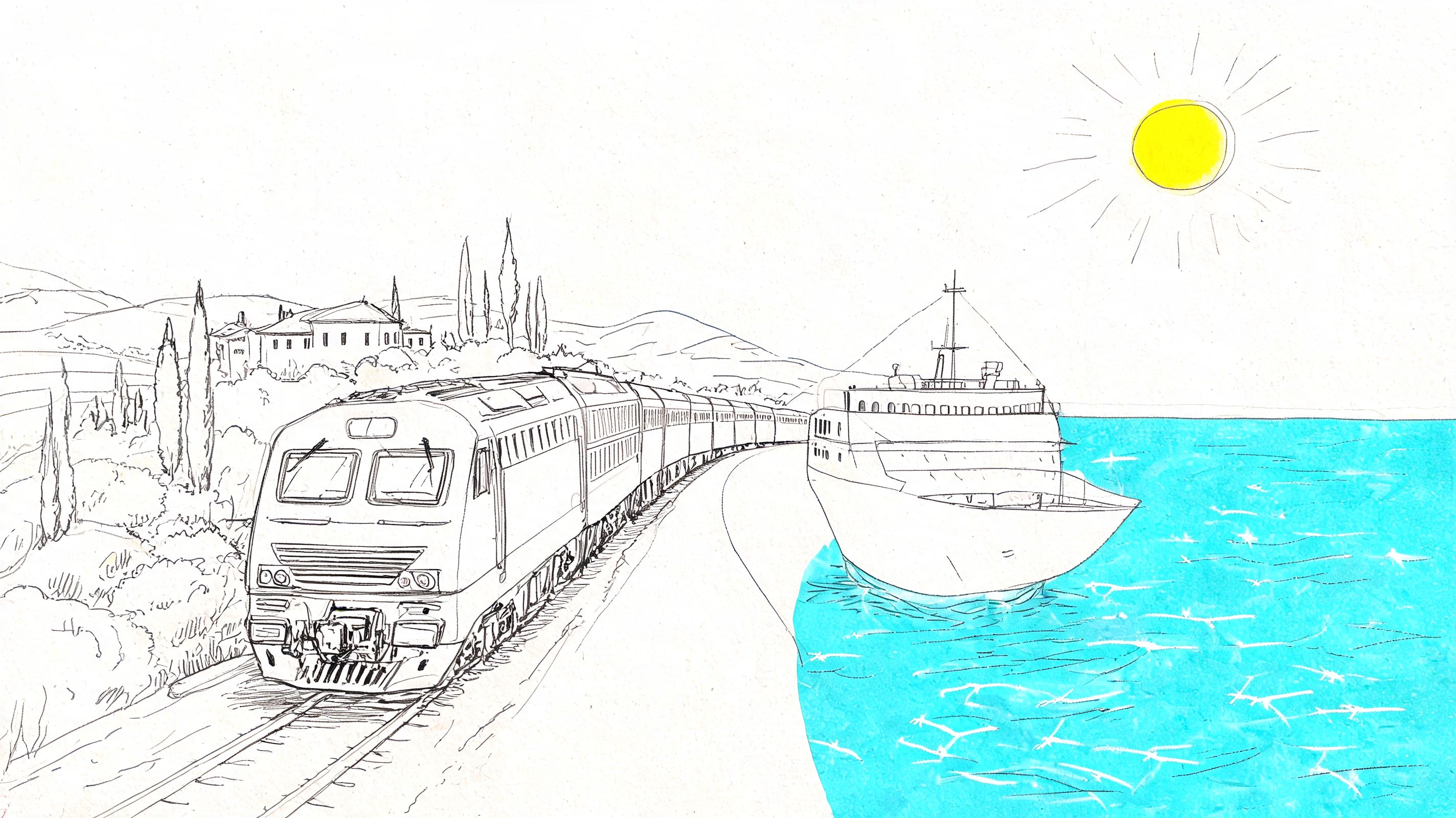
For travelers who want scenery and are happy to accept a few handoffs, train plus ferry is the best public-transport version of this journey. The usual rail leg runs from Milano Centrale to Santa Margherita Ligure-Portofino. From there, you continue to the harbor and take the boat into Portofino.
The route looks simple on paper. In practice, the handoff in Santa Margherita decides whether the day stays relaxed.
How to book the route properly
Book the train first. That is the fixed part of the journey and the part with the widest range of departure choices. Aim for Santa Margherita Ligure-Portofino station, not Rapallo or Genoa, if Portofino is your final destination and you want the cleanest public-transport finish.
Then check the ferry schedule separately before you travel. Do not assume the next boat will leave when you arrive. Services vary by season, weather, and time of day, and a small train delay can turn an easy connection into a wait on the quay.
I usually advise visitors to build in margin here. Ten careful minutes on a booking screen can save you an hour of standing around with luggage later.
The part most guides gloss over
The train gets you near Portofino. It does not solve the final approach.
From Santa Margherita, you still need to leave the station, get your bearings, reach the ferry departure point, and queue with everyone else heading down the same stretch of coast. In high season, that last leg is exactly where pressure builds. The coastal road into Portofino is narrow and crowded, parking is limited, and public options absorb that same demand. Even if you are arriving by boat rather than car, the congestion around the shoreline affects the whole system.
That is why this route works very differently depending on how you travel. With a backpack and a flexible afternoon, it can be enjoyable. With two large cases, children, or a hotel check-in you care about, the romance fades quickly.
Ferry or bus from Santa Margherita
The ferry is the reason to choose this option. The arrival by water is beautiful, and on a clear day it gives you the classic Portofino approach visitors come for.
The bus is the fallback. It can be useful when the sea is rough, the ferry schedule does not line up well, or you prefer to stay on land. It is usually less pleasant in busy periods because you are dealing with the same coastal traffic that slows every arrival into Portofino.
A quick visual can help if you want to see the coastal context before booking:
A practical way to judge this option
Choose train and ferry if the journey itself is part of the day. It suits travelers who enjoy public transport, want the sea approach, and can tolerate a connection that may not feel perfectly tidy.
It is less suited to arrival days with luggage, tight reservations, or anyone who wants to get dropped close to the hotel without extra decisions. On this route, that final stretch matters more than first-time visitors expect.
Some travelers also compare broader road-trip planning before deciding between rail and car, especially if Portofino is one stop on a longer Italy itinerary. This Dutch guide on met de elektrische auto naar Rome is useful for thinking about how transport style changes the travel day, even if your Portofino segment is not by electric car.
Who should choose this option
Train and ferry works best for:
- Solo travelers with light luggage
- Couples who care more about the experience than the cleanest arrival
- Visitors with flexible plans, especially those staying nearby for a night or two
- Travelers comfortable with one more transfer before reaching Portofino
It is a weaker fit for airport arrivals, formal events, family groups, and anyone whose day depends on showing up at a specific time without hassle.
The Adventurous Path Driving Yourself to the Riviera
Self-driving attracts a certain kind of traveler for good reason. You control your schedule, you can stop where you like, and if Portofino is part of a wider Ligurian road trip, a rental car may already be in your plan.
The problem is that many drivers evaluate the route by motorway logic. The motorway section is not the issue. The arrival is.
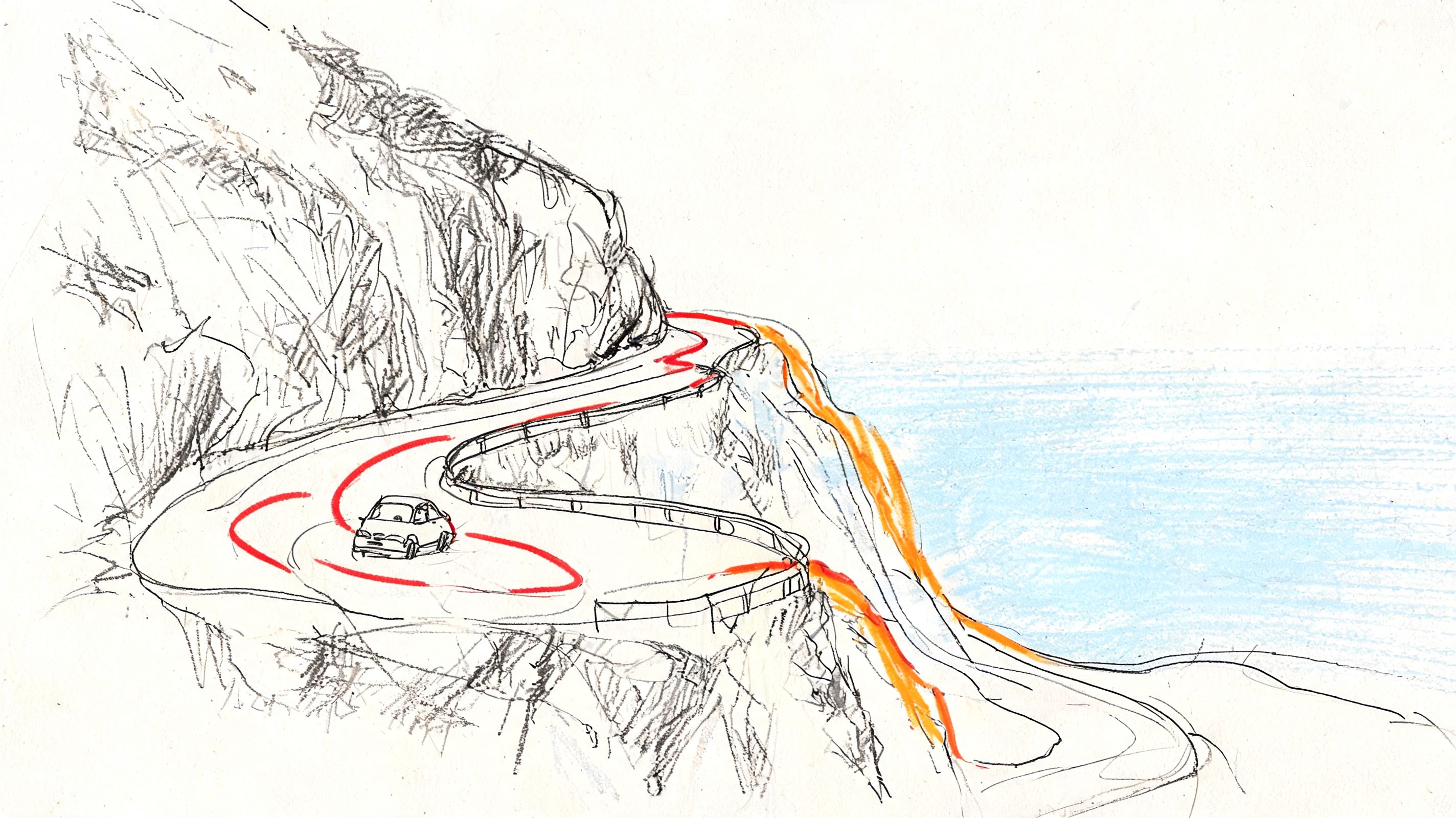
According to Wanderlog's coastal driving notes for Milan to Portofino, the final 3-mile approach to Portofino is a major bottleneck. The road is narrow and winding, and speeds often drop to 25 to 35 km/h during peak hours. Portofino itself is car-free, with only two small, expensive parking lots that reach 90% capacity on summer weekends.
What online maps don't show well
A route planner can suggest a clean arrival. It doesn't show how quickly confidence drops on a coastal road with bends, narrow sections, opposing traffic, and pedestrians appearing near the busiest points.
That doesn't mean you shouldn't drive. It means you should drive only if you're comfortable with:
- Tight coastal roads
- Slow progress near the destination
- The possibility of parking stress at the end
- Adjusting your arrival expectations in season
When self-drive works and when it doesn't
Self-drive makes more sense if Portofino is one stop among several, or if you're staying outside the village and using the car for the rest of the coast. It makes less sense if Portofino is the main event and you're expecting a simple pull-up-and-arrive experience.
The closer you get to Portofino, the less useful “freedom” feels if parking becomes the next problem to solve.
For experienced European drivers, this may be manageable. For travelers arriving off a long-haul flight, driving a rental immediately into a coastal bottleneck is usually the weakest version of the trip.
A realistic comparison with taxis and transfers
People often compare rental cars with trains and forget the middle category. A hired car with driver removes the hardest part of self-drive while keeping the direct route. That's the main reason it competes so strongly on this journey.
If what you really want is independence before or after Portofino, rent a car. If what you want is a clean arrival into Portofino itself, driving yourself is often solving the wrong problem.
Expert Tips for a Flawless Journey in 2026
Most travel mistakes on this route aren't dramatic. They're small planning errors that stack up. Late booking. Too much luggage for a multi-leg day. Assuming a group can “just split up.” Underestimating how tiring it is to make decisions after a flight.
One useful baseline is service frequency. The Milan to Portofino corridor has approximately 76 trains and 17 buses running daily, according to TM's route overview. That gives you options. But the same source notes that booking at least 2 to 3 weeks in advance for summer travel is critical, because the fastest and cheapest seats sell out quickly and last-minute fares can be 50 to 75% higher.
Booking advice that actually helps
- Book summer rail early: If you know your date, reserve sooner rather than later. This route rewards early planning.
- Match the mode to your luggage: A direct car becomes more attractive every time you add another suitcase, garment bag, or child item.
- Protect airport arrivals: If you're landing in Milan and continuing the same day, leave less to chance. Flights slip. Bags arrive late. Public timetables don't adapt to your landing.
- Don't overpack for the scenic route: Train and ferry is far more pleasant with compact luggage than with hard-shell cases and extra bags.
Group travel changes everything
A route that feels simple for two people can become clumsy for six, eight, or more. The pain points are always the same. People arrive from different flights. Not everyone walks at the same pace. Someone always has extra luggage. One delayed person can break the train plan.
For groups, think in terms of coordination, not only cost.
A single minivan or larger vehicle often works better than separate taxis because everyone leaves together and arrives together. For wedding guests, extended families, and corporate groups, that matters more than shaving a little off the transport budget.
Accessibility and comfort
Travelers with mobility concerns should be especially careful with public multi-leg plans. Trains can be fine. The issue is the full chain of movement: station navigation, platform changes, harbor transfer, and getting on and off the final sea or road connection.
If smooth movement matters, simplify the chain. Every transfer you remove lowers the physical load of the day.
Pack for the route you're actually taking, not the hotel you're checking into.
One local planning habit worth copying
On Italian coastal routes, locals rarely assume the last leg will take exactly what the app says. They build margin into arrivals, especially when the destination is small, scenic, and heavily visited. That habit saves more trips than any packing list.
Frequently Asked Questions
Is a day trip from Milan to Portofino realistic
Yes, but only if you're honest about your style of travel. A day trip works best when transport is simple and your departure is early. If you use public transport, you'll spend a meaningful part of the day moving between legs. If you use a direct car, the day feels more like an outing and less like a transport exercise.
For travelers who value relaxed meals and time by the harbor, an overnight stay is usually the better match for Portofino.
What's the cheapest way to get from Milan to Portofino
Public transport is usually the lower-cost choice. The train plus ferry route is the standard budget-conscious plan. It works best when you're traveling light and have flexibility with timing.
The hidden cost is effort. That matters if you're arriving from an airport or traveling with bags.
Is there a direct train from Milan to Portofino
No train goes directly into Portofino itself. The practical rail stop is Santa Margherita Ligure-Portofino, and from there you continue by ferry or another local connection.
That's the detail many travelers miss when they first search the route.
Are taxis easy to get from Santa Margherita Ligure
Sometimes, but relying on finding one exactly when you want it isn't the strongest plan in busy periods. If you're comfortable improvising, that may be fine. If you want a timed, orderly arrival, pre-booking a car is safer than assuming immediate taxi availability.
What's the best option in winter or the off-season
In the off-season, road traffic can feel easier, but public transport requires more attention because the sea leg may not feel as straightforward as in peak visitor months. A direct car tends to be the simplest winter plan because it removes the need to coordinate multiple services.
The route itself remains easy enough from Milan. The question is still how many changes you want near the end.
Is self-driving worth it for families
Usually only if the car is part of a bigger itinerary. For a family going straight from Milan to Portofino, self-drive often creates more work at the exact moment everyone is tired. Children, luggage, coastal traffic, and parking don't combine particularly well.
What's the best option for a group
For groups, direct vehicle transport is usually the cleanest answer. The larger the group, the less attractive separate taxis and staggered public transport become. Keeping everyone together saves time and avoids the common problem of fragmented arrivals.
If you want a direct, fixed-price way to travel from Milan, Malpensa, Linate, or Bergamo to the Riviera, TransferMilan LLC arranges door-to-door chauffeur transfers with sedans, minivans, minibuses, and larger vehicles for groups. It's a practical option for airport arrivals, families with luggage, business travel, and coordinated group transport when you'd rather reach Portofino without managing the final coastal leg yourself.