0 MXP to Venice: Your 2026 Transfer Guide
- Travel Tips
- by Tara Malone
- 03-06-2026
MXP to Venice: Your 2026 Transfer Guide
You land at Malpensa after a long flight, clear the airport, collect your bags, and the easy part is suddenly over. Venice is next. Not Venice airport, not Milan city center, but a car-free destination where the final stretch matters more than the headline journey time.
That's why mxp to Venice trips confuse so many travelers. The route looks simple on a map. It rarely feels simple in real life. There are no nonstop flights between Milan Malpensa and Venice, so your real choice is on the ground, per the TransferMilan MXP to VCE route page.
Venice also isn't a niche destination where you can improvise. It's one of Italy's biggest tourism markets. Statista's tourism overview for Venice reports about 5.7 million tourist arrivals in 2023, with international visitors making up more than 70% of those arrivals. A huge share of people making this journey have just stepped off a long-haul flight, often with luggage, children, or a hotel check-in to make.
Table of Contents
- Arriving at MXP Your Journey to Venice Begins
- Comparing Your Options Train vs Bus vs Private Transfer
- The Train Journey High-Speed Travel with a Catch
- The Budget Route Navigating the Bus to Venice
- The Direct Solution A Private Transfer to Venice
- Recommendations for Your 2026 Travel Style
- Insider Tips for a Flawless Arrival in Venice
- Frequently Asked Questions
Arriving at MXP Your Journey to Venice Begins
Malpensa is where many Venice trips become stressful. You're tired, your phone battery is lower than you'd like, baggage claim took longer than expected, and now you have to decide whether to chase a train, wait for a bus, or get in a car and keep moving.
For many international visitors, the pressure starts before they even land. Families traveling with pets often need extra paperwork and carrier rules sorted well in advance, so a practical resource like this ultimate guide for flying with pets can save time before the airport part of the trip even begins.
What catches travelers off guard
People often assume the hard part is getting to Italy. Often it isn't. The harder part is the first ground leg after arrival, especially when the destination is Venice, where cars don't take you all the way to the hotel.
A lot of travelers also underestimate how useful a short Milan stop can be if they decide not to push straight on. If you do break the journey, this guide to exploring Milan and using public transport from the airports helps you make that stop count instead of wasting it.
Venice rewards travelers who plan the arrival as carefully as the hotel.
Comparing Your Options Train vs Bus vs Private Transfer
The three realistic choices are train, bus, and private transfer. Each one works. Each one also has a failure point. What matters isn't pure line-haul speed. It's how the whole trip behaves after a real flight, with real bags, at a real arrival time.

What door-to-door really means
A route page usually tells you the cleanest possible version of a trip. Travelers don't experience clean versions. They experience escalators, platform changes, delayed baggage, airport walks, and the final handoff into Venice.
The TM MXP to Venice route overview makes that gap clear. The drive is about 2h 56m to 3h over 310 to 311 km, while rail is often about 3h 38m to 4h 19m and usually includes 1 change. Bus options are slower at roughly 4h 15m to 4h 24m on average. In other words, the "fastest" option on paper doesn't always feel fastest once airport exit, station transfer, and luggage handling are added.
MXP to Venice transport options at a glance
| Transport Mode | Avg. Door-to-Door Time | Estimated Cost (per person) | Best For |
|---|---|---|---|
| Train | Usually around the typical rail range covered above, but highly dependent on connection quality | Varies by ticket type and booking timing | Solo travelers, couples, anyone comfortable changing stations and managing bags |
| Bus | Often the longest and least predictable option | Usually the lowest-cost choice | Flexible budget travelers with light luggage |
| Private transfer | Often competitive in real end-to-end time because there's no station transfer | Higher than public transport, especially for solo travelers | Families, groups, business travelers, late arrivals |
A few practical truths matter more than marketing copy:
- Train wins on structure, not simplicity. It can be efficient, but only if your connection lines up well.
- Bus wins on entry price. It loses that win once waiting time, traffic, and drop-off limitations start to stack up.
- Private car wins on friction. You skip the station change and stay with your luggage from airport pickup to Venice access point.
Practical rule: If you're arriving from a long-haul flight and care more about a smooth arrival than shaving every euro, judge this route by total handling effort. Not by timetable headlines.
The Train Journey High-Speed Travel with a Catch
The train is the option many travelers want to like. For good reason. Italy's intercity rail network is strong, and once you're on the high-speed segment, the ride is comfortable and easy. The catch is that mxp to Venice by train is a two-part journey, and the connection is where things get messy.
How the rail trip actually works
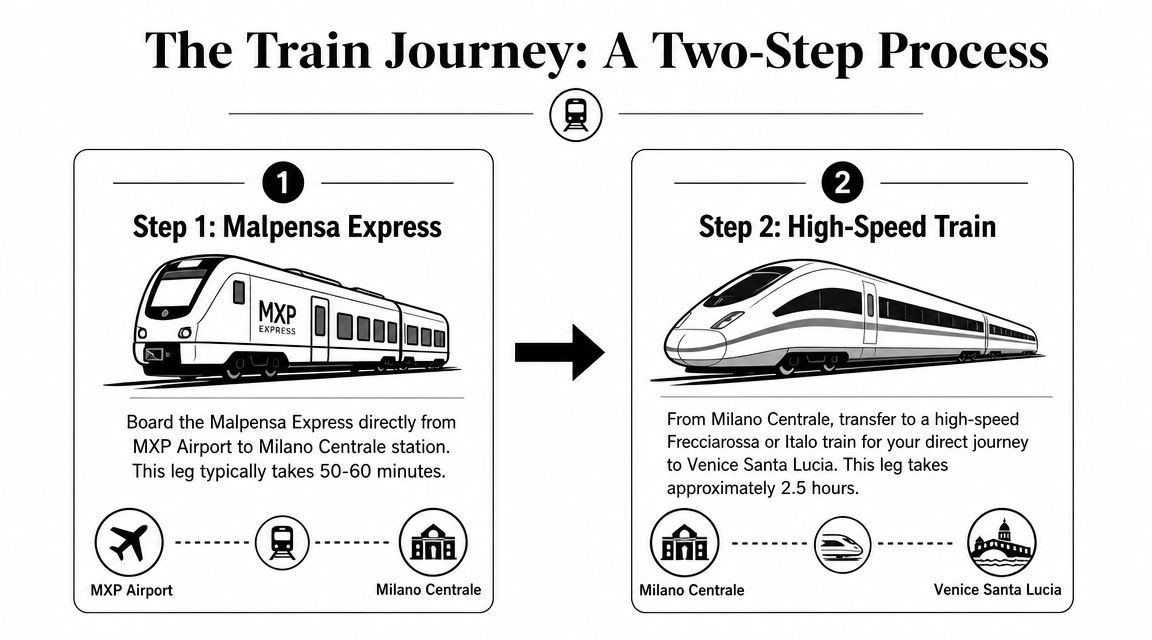
First, you go from Malpensa to Milano Centrale. Then you switch to a high-speed service toward Venice. That second leg is the pleasant part. The first leg is easy enough. The transfer between them is what travelers usually misjudge.
Trainline's Malpensa Airport to Venice timetable page shows the fastest rail option at about 3h12m to 3h15m over roughly 282 to 283 km, but the more typical end-to-end journey is closer to 4h18m to 4h28m. That spread tells you everything important. The fastest version depends on a very clean connection at Milano Centrale. Miss that rhythm and the trip becomes ordinary very quickly.
A simple working method helps:
- Don't book the tightest possible connection if you're arriving on an international flight.
- Keep luggage manageable because Milano Centrale is large and busy.
- Know your destination station. If you're staying in Venice proper, Santa Lucia is very different from stopping earlier on the mainland.
- Assume the published minimum time is not your personal travel time.
Here's a useful visual explainer before you book the rail option:
Where train travel works well
Train is a good fit when your flight lands with enough daylight left, you're comfortable with one major transfer, and you want a predictable transport system rather than a road journey. It also suits travelers staying near Venezia Santa Lucia or those who don't mind finishing the trip on foot or by Vaporetto.
Where train usually fails is not speed. It's fragility.
- Bad for oversized luggage: The station change is the tax you pay.
- Weak for tired families: Children don't care that the timetable looked efficient.
- Risky for tight same-day plans: A delayed arrival at MXP can cascade into a missed connection.
If your itinerary depends on a perfect train connection, your itinerary is tighter than it should be.
The Budget Route Navigating the Bus to Venice
Bus is the low-cost option people pick when price comes first. Sometimes that's completely sensible. If you're traveling light, arriving at a convenient time, and don't mind a slower ride, it can do the job.
What budget travelers should expect
The issue isn't only that bus is slower. It's that bus times on this route are volatile. FlixBus's Malpensa to Venice route page shows some services at roughly 4h15m, while other schedules run over 7 hours. That range is a warning sign, not a detail.
Bus also tends to work better on paper than after a flight. You may face a wait at the airport, the drop-off may be on the mainland rather than your actual destination, and traffic can erase any timetable confidence you thought you had.
A realistic bus checklist looks like this:
- Good choice if: You're a solo traveler, you have one manageable bag, and cost matters more than comfort.
- Think twice if: You've got children, valuable work gear, or a hotel check-in that needs a dependable arrival time.
- Watch the drop-off carefully: "Venice" in a booking path can mean Mestre or another practical stop, not the historic center experience many visitors imagine.
For some travelers, bus is fine. For anyone arriving tired with luggage, it's the mode most likely to feel longer than expected.
The Direct Solution A Private Transfer to Venice
Private transfer works best for travelers who want the whole MXP to Venice trip handled as one door-to-door journey, not a series of separate fixes after landing. That matters on this route because the road portion ends at Piazzale Roma, while your hotel may still require a water taxi, a Vaporetto ride, or a walk over bridges with luggage.
The practical advantage is control. You exit the terminal, meet the driver, load once, and go. There is no station transfer in Milan, no platform timing, and no need to re-organize bags halfway through the day. For travelers arriving tired, with children, or with more than one suitcase, that difference is felt immediately.
Why a planned transfer is different from a long-distance taxi
A generic long-distance taxi may get you there. A planned transfer treats Piazzale Roma as one step in the arrival process, with the final handoff considered in advance.
The Milan Malpensa to Venice city transfer reference notes that private transfer service typically runs to Piazzale Roma, after which you continue by water taxi, Vaporetto, or on foot depending on your address. That is the part many comparison pages skip. They compare airport-to-city times as if Venice were a normal city with curbside hotel access.
It is not.
A good car service plans for the actual endpoint. If your hotel is near Santa Lucia, Piazzale Roma may be a simple short walk. If you are staying deeper in San Marco, Dorsoduro, or Cannaregio, the smart question is not only how fast the car ride is. It is how much effort remains after the car stops.
The better setup usually includes:
- Meet-and-pickup at MXP: Clear collection after arrival instead of joining an airport taxi queue.
- One luggage cycle: Bags go into the vehicle once and come out at the Venice access point.
- Pre-set route and price: Fewer surprises than negotiating a long ride on the spot.
- Last-mile planning: Water taxi, Vaporetto, or walking handoff matched to your hotel location.
Travelers comparing operator types can use this 2026 guide to car service in Italy and transfer booking options to see the difference between a simple point-to-point ride and a structured chauffeured transfer. One factual option on this route is TransferMilan LLC, which offers Malpensa transfers to Venice with drop-off at Piazzale Roma.
Who gets the most value from it
Private transfer makes the most sense when the hidden parts of the trip are doing most of the damage.
Families feel it first. The hard part is rarely the highway drive itself. It's keeping everyone together from baggage claim to the edge of Venice, then sorting out the final approach without turning arrival day into a logistics exercise.
Small groups often do well with a van because the cost is shared while the handling becomes much simpler. Business travelers also benefit when timing matters and they would rather arrive composed than spend their energy on connections, stairs, and luggage moves.
Recommendations for Your 2026 Travel Style
The right choice depends less on the route itself and more on what kind of traveler you are on arrival day. That's the part generic comparison pages usually miss.
For business travelers
If you have a meeting, a cruise boarding time, an event, or even just a tightly planned hotel arrival, don't build your day around a fragile connection. Train can work, but only when your arrival buffer is generous and you're comfortable moving fast through Milano Centrale with luggage.
Private transfer is usually the safer fit when punctuality matters more than public transport savings. The ride is linear, quiet, and easier to work around if your flight lands a little off schedule.
For families and groups
This route is much easier when everyone stays together from the airport onward. Families with children lose time at every handoff: baggage claim, station access, platform changes, and then the final move into Venice.
For groups, the equation changes further:
- Shared vehicle logic: A van or minibus can make more sense than multiple train tickets plus the stress of moving as a pack.
- Luggage control: Sports bags, shopping, baby gear, and larger suitcases are easier to manage in one vehicle.
- Arrival quality: The first day of the trip stays intact instead of turning into a transport exercise.
For solo and budget-conscious travelers
If you're traveling alone, light, and don't mind handling your own transfers, train is often the strongest public option. It gives you a structured trip and a comfortable long leg once you're settled on board.
Bus only makes sense if low fare matters enough that you're willing to accept extra uncertainty. Some travelers are fine with that. If your schedule is open and your budget is tight, it can be acceptable.
A simple way to choose:
| Traveler type | Usually the better fit | Why |
|---|---|---|
| Business traveler | Private transfer | Fewer failure points and easier schedule control |
| Family with luggage | Private transfer | Less handling, simpler group movement |
| Couple on a flexible itinerary | Train | Good balance of cost and comfort |
| Solo budget traveler | Train or bus | Depends on tolerance for transfers and delays |
Insider Tips for a Flawless Arrival in Venice
The final part of the trip is where local knowledge saves you time. Venice doesn't reward assumptions. It rewards knowing where your road journey ends and what happens next.
Handle the last mile before you arrive
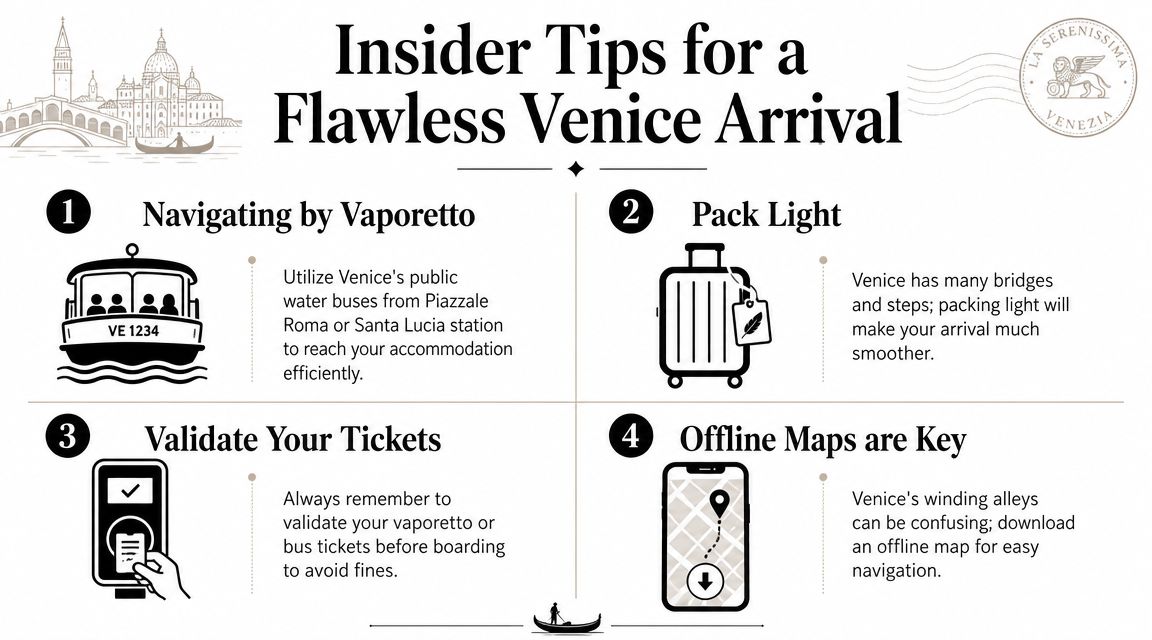
If your car or bus ends at Piazzale Roma, that's normal. From there, your hotel may still require a Vaporetto ride, a water taxi, or a walk over bridges. That's not a minor detail. It's part of the route.
A few local habits make arrival smoother:
- Pack for bridges, not just flights. Rolling a heavy suitcase in Venice is rarely elegant.
- Check your hotel's nearest water stop. Don't assume the street address tells you much.
- Know the difference between mainland and island arrivals. Venezia Mestre and Venezia Santa Lucia are not interchangeable in practical terms.
- Download your map offline before landing. Venice is easy to enjoy and annoyingly easy to misread on the spot.
The worst luggage in Venice isn't the heaviest one. It's the one you have to drag across bridges you didn't expect.
Late flights need a different plan
Late arrivals are where many travelers make poor decisions. They assume they'll "catch the train" after landing. That often doesn't hold up.
Rail Europe's Malpensa Airport T2 to Venice train page shows that the last convenient departures are typically around 7:00 to 7:30 PM, with first and last trains around 05:37 and 19:07 to 19:37, and about 18 trains per day. If your flight lands late, especially with any delay, forcing a same-day rail connection may be impractical. At that point, practical choices usually include a pre-booked private transfer or an overnight stop near Milan.
Frequently Asked Questions
1. Is train better than private transfer?
For some travelers, yes. For others, no.
The train usually makes sense for solo travelers, light packers, and anyone landing early enough to absorb the extra steps: airport exit, transfer to the rail station, at least one change, and then the final move from Santa Lucia or Mestre toward the hotel. A private transfer is usually the smarter choice for families, small groups, late arrivals, travelers with bulky luggage, or anyone who wants the road portion handled in one booking before reaching Venice's car-free zone.
2. Where does a car actually stop in Venice?
Road vehicles stop at Piazzale Roma. That is the practical road gateway to Venice, not the end of the full trip.
From Piazzale Roma, you still continue on foot, by Vaporetto, or by water taxi depending on where you are staying. That last stretch can be quick or surprisingly awkward if you arrive with multiple bags, children, or a hotel deep inside the sestieri.
3. Should I book in advance?
Yes, especially if your arrival time is fixed.
Booking ahead gives you better control over the whole door-to-door plan, not just the main leg from MXP. It matters more on busy weekends, during holidays, and on late flights, when missed connections and limited availability create expensive last-minute decisions.
4. Is Venezia Mestre the same as Venezia Santa Lucia?
No. Venezia Mestre is on the mainland. Venezia Santa Lucia puts you in Venice proper.
That difference matters in real terms. If you get off at Mestre, you still need another leg into Venice. If you arrive at Santa Lucia, you are in the historic center, but you may still face bridges, boats, and a longer hotel transfer than expected.
5. Are taxis or rideshare apps a good backup?
Usually not for this route.
The problem is not only cost. It is reliability, luggage space, and whether the driver is prepared for a long airport-to-Venice run with the right drop-off point at Piazzale Roma. For travelers who want that part handled cleanly, a pre-booked transfer is usually the more dependable option.
If you want the simplest way to handle mxp to Venice without juggling train changes, bus timing, and the Venice last mile on arrival day, TransferMilan LLC offers fixed-price airport transfers from Malpensa to Piazzale Roma, with vehicle options for solo travelers, families, and larger groups.