0 Services Similar to Uber: Your 2026 Milan Guide
- Travel Tips
- by Tara Malone
- 01-08-2026
You`ve just landed at Malpensa, Linate, or Bergamo. Your phone says Uber. Your instincts say tap the app and solve the problem in two minutes. Then Milan does what Milan often does to visitors. It turns a simple airport ride into a decision about rules, timing, luggage, queues, language, and whether your destination is really “Milan” or somewhere much farther, like Lake Como, Serravalle, Lugano, or a hotel near Centrale.
That gap between expectation and reality is why travelers keep searching for services similar to uber and still arrive confused.
In many cities, that search is easy. In northern Italy, it isn`t. You have taxis, app-based taxi platforms, trains, buses, and pre-booked chauffeur services. Each works well in a specific situation. Each fails badly in another. The difference matters most when you are tired, carrying bags, arriving late, traveling with children, heading to a fairground, or trying to move a group without splitting everyone into separate cars.
The smart move in Milan isn`t picking one transport type and using it for everything. It`s matching the ride to the job.
Table of Contents
- The Milan Arrival Dilemma Why Uber Isn`t the Answer
- Your Ground Transport Options in Milan and Northern Italy
- Comparing Your Choices for Key Travel Scenarios
- Insider Tips for Booking Transport in Milan for 2026
- Navigating Group Travel and Cross-Border Trips
- When a Private Transfer Is Your Best Option
- Frequently Asked Questions About Milan Transport
The Milan Arrival Dilemma Why Uber Isn`t the Answer
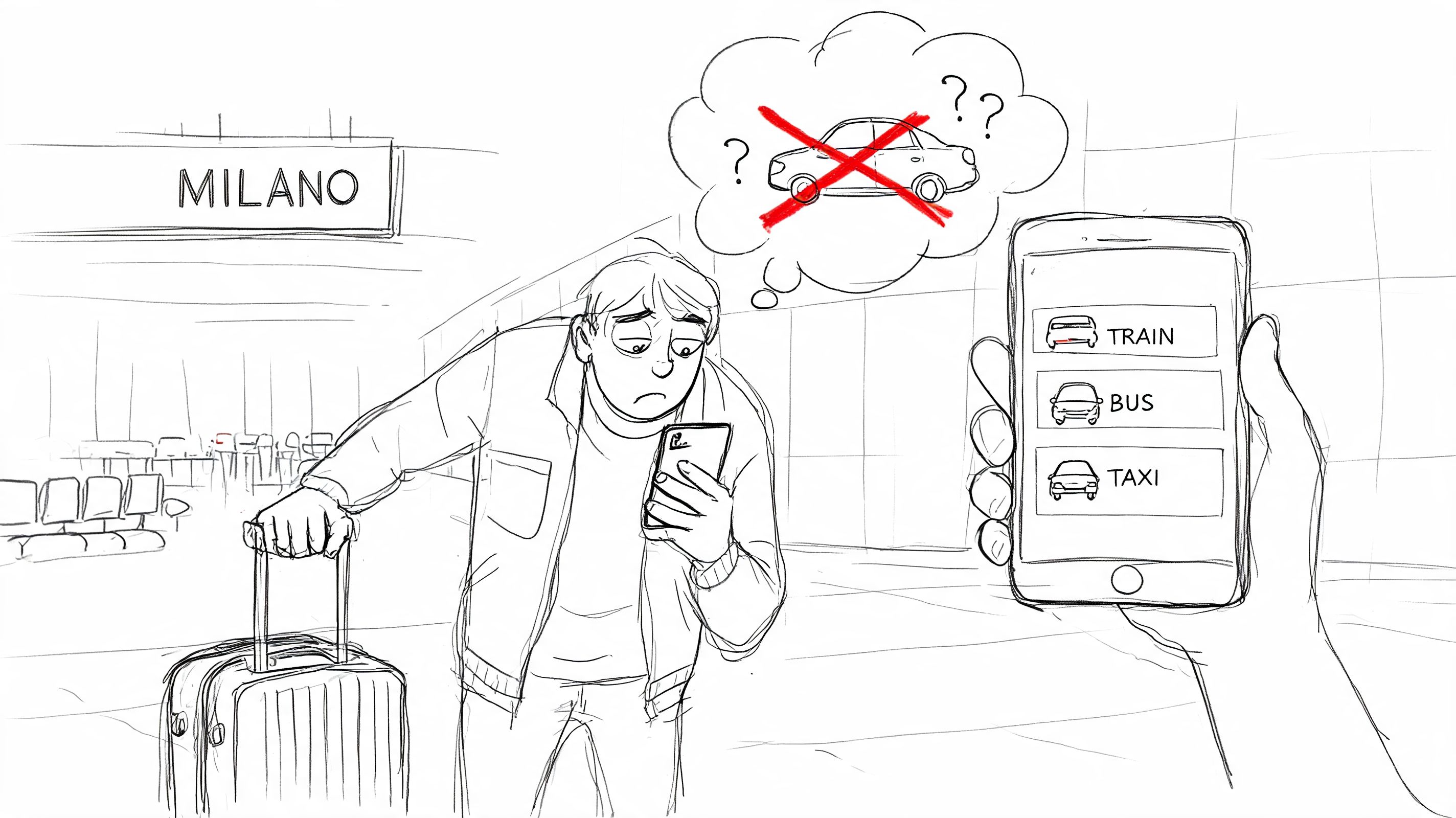
A familiar scene plays out every day at MXP, LIN, and BGY. A traveler lands after a long-haul flight, clears passport control, collects two large suitcases, and opens the Uber app expecting the same routine they use in London, Dubai, or New York. In Milan, that expectation often collides with local reality.
Globally, Uber is the market leader, completing over 11.27 billion trips in 2024, but that scale does not translate into the same user experience everywhere. In regulated markets like Italy, the app often means premium service rather than the lower-cost, broad-availability option many travelers expect, which is why Uber often feels limited to Uber Black rather than a true UberX-style fallback for airport arrivals, as noted in this rideshare market overview.
That difference catches visitors off guard.
What travelers expect versus what Milan offers
Most international travelers arrive looking for three things:
- Immediate pickup: They want a car soon after landing.
- Simple pricing: They don`t want to decode local transport rules while jet-lagged.
- Enough space: They need room for bags, strollers, shopping, or ski cases.
Uber-like convenience in Milan exists only in fragments. You may find app-based booking. You may find premium cars. You may find a taxi rank moving quickly. But you often won`t get the exact combination you are used to elsewhere.
In Milan, the mistake isn`t using the wrong app. It`s assuming the app controls the market.
Why this matters more at airports
Airport transport is where small uncertainty becomes expensive. If your destination is central Milan and you have one backpack, a train may be ideal. If you`re heading to a suburban hotel, arriving late, or continuing beyond the city, the trade-offs change immediately.
A family landing at Malpensa at night doesn`t need theoretical availability. They need one vehicle, one pickup point, and no discussion beside the curb. A business traveler headed to a meeting in Porta Nuova doesn`t need a transport experiment. They need a car that leaves on time.
That`s the lens to use for all services similar to uber in northern Italy. Not “Which app exists?” but “Which option fails least for my exact trip?”
Your Ground Transport Options in Milan and Northern Italy
When travelers compare services similar to uber, they often lump everything into one category. That creates bad decisions. Milan has four distinct transport lanes, and each suits a different kind of traveler.
Quick comparison table
| Option | Best for | Strengths | Trade-offs |
|---|---|---|---|
| App-based taxi platforms like FREE NOW or itTaxi | City rides, simple app booking, travelers who want digital dispatch | Familiar booking flow, useful inside Milan, easier than hailing on the street | Availability can vary by area and time, airport expectations are often higher than reality |
| Official taxis | Short urban rides, station transfers, travelers who want the regulated default | Clear, established system, easy from taxi ranks, practical for straightforward city trips | Not ideal for complex pickups, large groups, or long leisure routes |
| Public transport such as trains and buses | Solo travelers, light luggage, budget-conscious arrivals | Cost-effective, dependable on fixed routes, strong for station-to-station movement | Weak for door-to-door travel, awkward with bags, less comfortable after long flights |
| Pre-booked private transfer or chauffeur service | Airport pickups, families, business travel, groups, out-of-city routes | Fixed planning, direct service, luggage help, easier for complex itineraries | Usually not the cheapest option for a solo city-center ride |
How each option really works
App-based taxi platforms are the closest thing to the rideshare habit many visitors already know. In practice, they often function more like a digital front end for regulated cars than a true on-demand rideshare free-for-all. They can be convenient in central neighborhoods, especially if you want cashless booking and a visible pickup point.
Official taxis remain a solid Milan tool when your trip is simple. Centrale to Brera. Duomo to Navigli. Linate to a central hotel. If you walk to the rank, know your destination, and don`t need anything special, taxis are often the cleanest low-friction choice.
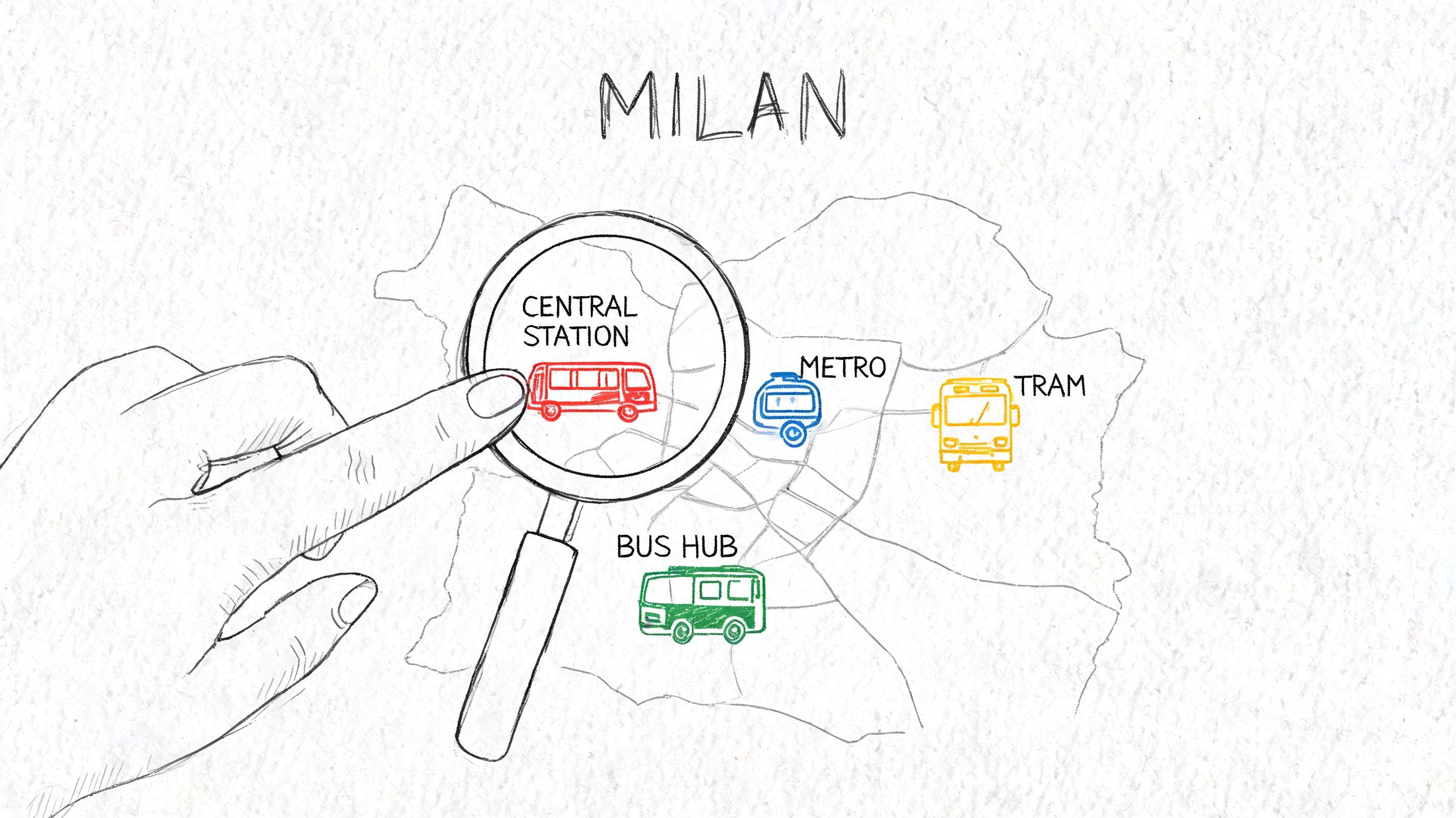
Public transport is excellent when your route matches the network. Malpensa Express is useful for rail-oriented arrivals. Airport buses can make sense for travelers heading toward major hubs. If your hotel is near Centrale, Cadorna, or another rail connection, this is often the most rational budget move. For travelers deciding whether to stay near a station specifically to simplify arrivals and departures, FlipMyStay`s Milan station hotel booking tips are a helpful planning reference.
Practical rule: In Milan, transport gets easier when your hotel matches your arrival method. Train traveler, stay near a station. Car traveler, don`t overvalue station proximity.
Pre-booked private transfers and chauffeur services cover the gaps the other options leave open. They are built for airport meets, family travel, trade fairs, shopping runs, lakeside hotels, and destinations outside the city grid. They also handle situations that standard apps rarely explain well, such as child seats, extra luggage, or a driver waiting after a delayed international arrival.
For a broader look at how chauffeured transport fits into Italy in practical terms, this 2026 comparison of car services and transfers in Italy is worth reviewing before you book.
What locals know that many guides miss
A transport option can be “good” and still be wrong for your trip.
Take these examples:
- A solo traveler to Centrale: Train often wins.
- A couple to a city-center hotel with cabin bags only: Taxi or app-based taxi platform is usually fine.
- A family with three checked bags to a suburban property: Pre-booked car becomes much safer operationally.
- A group heading to Como after landing: Public transport stops being convenient very quickly.
That is why comparing services similar to uber in Milan only by price misses the point. In this city, convenience is not one thing. It is route-specific.
Comparing Your Choices for Key Travel Scenarios
The true test isn`t which service sounds modern. It is which one behaves well when your trip gets messy.
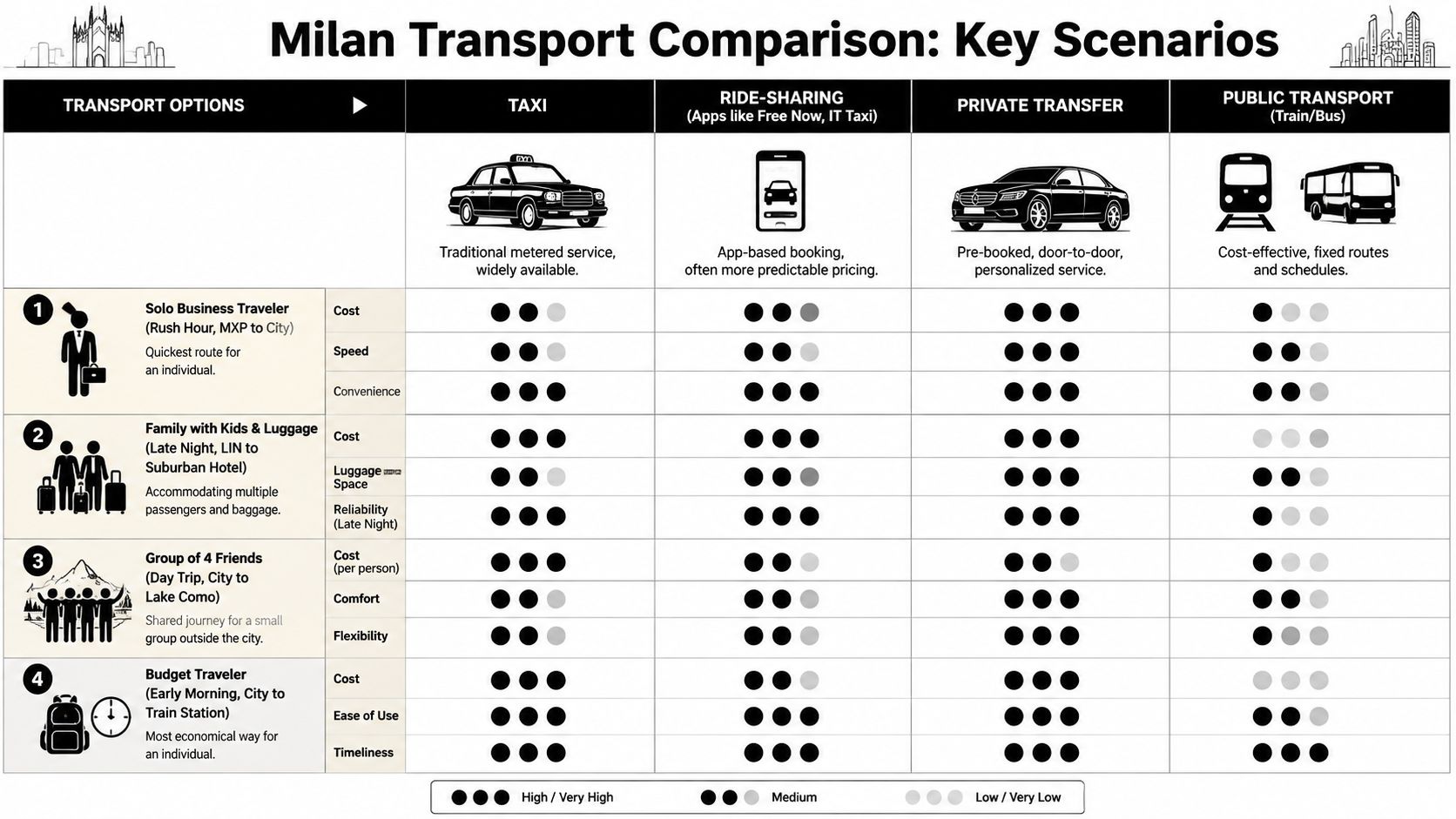
For airport transfers from MXP, LIN, and BGY, app-based ride options often fall short on reliability during busy periods, and local market conditions favor licensed or premium services. In that context, over 70% of international travelers prefer pre-booked, fixed-price airport transfers when guaranteed pickup and luggage help matter most, according to this analysis of ride-sharing apps in Italy.
Airport pickups
At the airport, certainty beats optionality.
A taxi rank works when the line is moving and your destination is ordinary. It works less well when you want a precise pickup process, help with several bags, or a route beyond central Milan. App-based platforms can feel convenient, but airport arrivals create exactly the conditions that expose their weak points: concentrated demand, unclear pickup logistics, and travelers with no patience left.
Private transfers win this scenario for one reason. They remove the curbside negotiation phase.
Best fit by option:
- Taxi: Good for straightforward city destinations when you want to leave immediately.
- App-based taxi platform: Reasonable if you know the pickup point and are traveling light.
- Private transfer: Best for fixed planning, delayed flights, family arrivals, and non-central destinations.
- Train or bus: Best only if your hotel aligns neatly with the route.
Business travel
Business travelers usually ask the wrong first question. They ask what is cheapest. They should ask what has the lowest chance of creating a late arrival.
Milan punishes small timing errors during major events, exhibitions, and rush-hour windows. If you are traveling to a meeting in the center, a taxi or app-booked car can be perfectly acceptable. If you are heading to a fairground, a client office outside the core, or a tight airport connection afterward, reliability becomes more valuable than small savings.
If your arrival time matters to someone else, don`t book transport that relies on good luck.
A serious advantage of private chauffeur-style transport is not luxury. It is process. You know who is meeting you, where the pickup is, and what vehicle class you booked. That matters when a missed meeting costs more than the ride.
For visitors also planning local sightseeing around business travel, this guide to Milan tourist areas, public transport, and airport transfers helps connect city movement with transfer planning.
Traveling with luggage
Many “Uber alternatives” guides lose their connection to reality at this point.
A couple with one rolling suitcase each can use nearly anything. A family with checked luggage, a stroller, shopping bags, and a tired child cannot. The same applies to travelers returning from ski trips, design fairs, outlet shopping, or multi-city tours.
Here is the practical hierarchy:
| Situation | Usually works | Often frustrating |
|---|---|---|
| One person, one small bag | Train, taxi, app-based platform | Overbooking a large vehicle |
| Two adults, moderate luggage | Taxi, app-based platform, pre-booked car | Late-night public transport with connections |
| Family with children and multiple bags | Pre-booked car or van | Standard sedan assumptions |
| Group with bulky luggage | Minivan or minibus booked in advance | Trying to split into multiple taxis |
A common mistake in Milan is assuming “four passengers” means one normal car is enough. It often isn`t once real luggage enters the picture.
Cost and pricing
Price comparisons become misleading unless you compare the whole trip, not just the headline fare.
Public transport has the lowest direct cost. It also asks you to carry everything yourself, follow schedules, and manage the final connection. For some travelers, that is efficient. For others, it is false economy.
Taxis are often fair value for urban rides when the route is short and uncomplicated. App-based platforms can offer convenience, but they don`t always improve the airport experience in the way travelers expect. Private transfers often look expensive if you compare them only to a solo train ticket. They often look sensible when you compare them to the combined cost of stress, lost time, extra local taxis, and poor luggage handling.
What works and what doesn`t
What works well in Milan
- Train for station-based itineraries: Strong when your hotel or onward rail trip lines up.
- Taxi rank for simple urban moves: Efficient when you land, know the route, and don`t need extras.
- Pre-booked transfer for critical arrivals: Best for early flights, late arrivals, families, and schedules that can`t slip.
What often disappoints
- Relying on an app for a complex airport pickup: Too many small points of failure.
- Using public transport with oversized luggage after a long flight: Manageable in theory, miserable in practice.
- Splitting groups across multiple cars: You save coordination on paper and lose it on the ground.
Insider Tips for Booking Transport in Milan for 2026
Most transport mistakes in Milan happen before the ride starts. The booking choice creates the problem, and the pickup only reveals it.
Booking habits that save trouble
Book airport transport early if your arrival is late at night, very early, or tied to an important event. Last-minute booking works best for ordinary city movement. It works worst for airport runs, family travel, or routes outside Milan proper.
If you need a child seat, write it into the booking, not into your hopes. The same goes for ski bags, golf bags, extra luggage, or a request for a larger vehicle. In Milan, assumptions create the most avoidable transport problems.
Use this checklist before confirming any ride:
- Confirm the pickup method: Meet inside, curbside, rank, or app-assigned point.
- State the luggage: Not “two bags” if you also have a stroller and shopping.
- Ask about payment: Card, prepayment, or pay-on-board.
- Save the contact channel: WhatsApp is often the fastest practical tool once you land.
Local details visitors often miss
Taxis in Milan are regulated, but travelers should still understand the difference between a metered urban ride and a pre-agreed transfer. One is flexible and immediate. The other is structured and predictable. Problems start when visitors expect one and get the other.
Language is rarely a disaster in Milan, but clear written details help. Send your hotel name, terminal, flight number, and destination in writing where possible. This avoids the classic airport exchange where one side says “near the station” and the other hears the wrong station entirely.
Write the destination exactly as it appears on the hotel booking. Street name alone is not enough if the property is outside central Milan.
Keep some cash on hand if you intend to use taxis, but ensure you have alternative payment methods ready. International travelers frequently expect that card acceptance will be easy and consistent in every location. While that is often the case, some conversations about payment only start after you reach your destination, which is the most difficult time to realize your expectations were too high.
Timing advice that matters in real life
A few local habits help:
- For early departures: Don`t rely on improvisation before dawn.
- For exhibition periods: Expect heavier pressure on cars around major venues and hotels.
- For suburban stays: Check the exact municipality, not just “Milan area.”
- For train connections: Build margin. Airports and stations are linked, but not friction-free.
Visitors who know Milan well often behave less spontaneously, not more. They improvise inside the city. They pre-arrange airport movement.
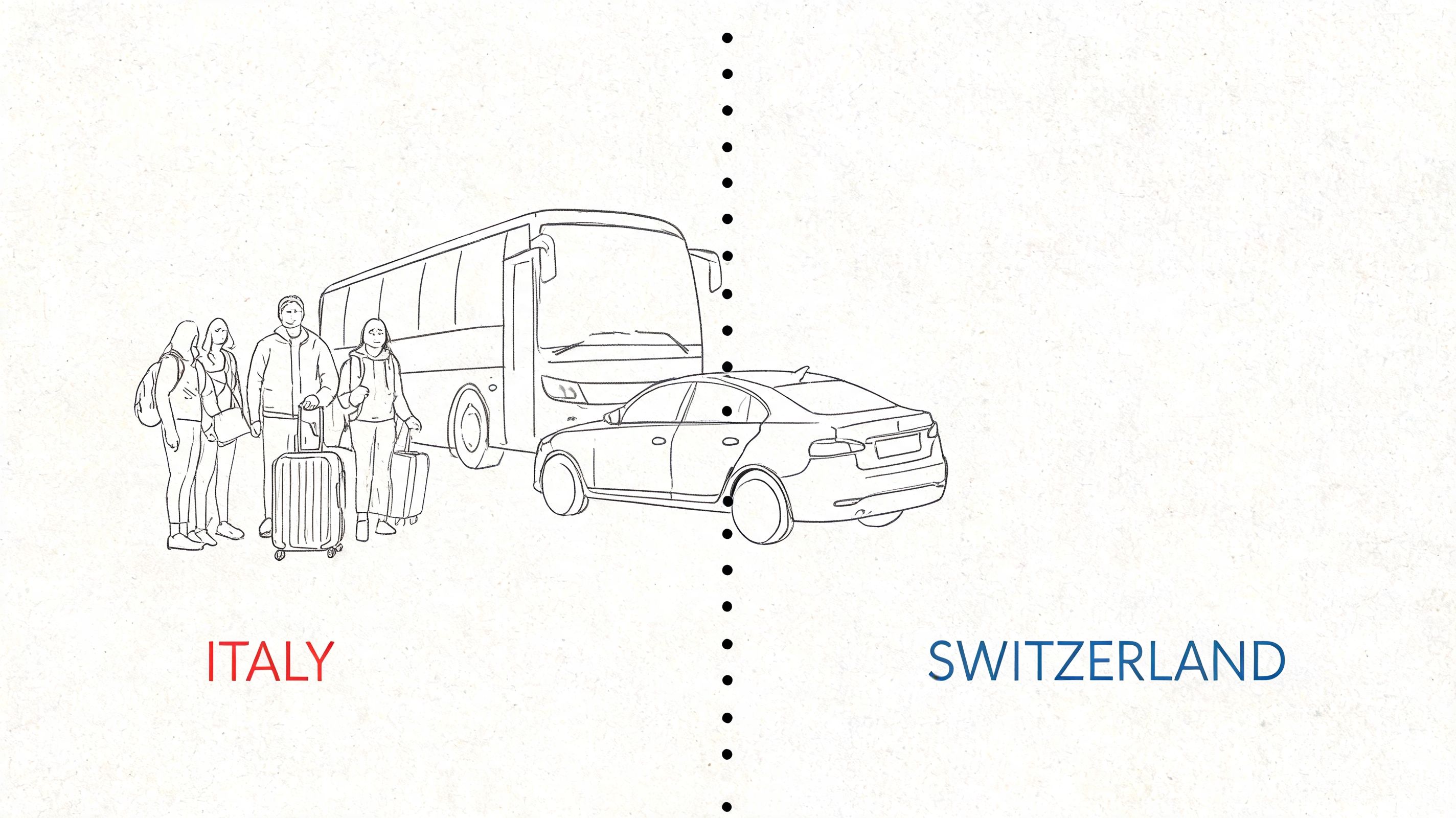
Navigating Group Travel and Cross-Border Trips
This is the point where standard ride-hailing logic usually breaks.
Why groups struggle with standard apps
For two people, almost any transport system can look functional. For five, seven, twelve, or forty, the cracks become obvious.
Multiple taxis sound simple until one car leaves first, another waits in the wrong pickup lane, and half the group arrives at the hotel while the rest are still calling the driver. App-based services are even less elegant for group movement because they are optimized for single-car trips, not coordinated arrivals.
Groups need three things standard apps don`t handle well:
- One booking owner
- One clear meeting point
- One vehicle plan matched to people and luggage
That applies to families, corporate teams, wedding guests, and friends going to the lakes for the day.
A useful parallel exists in premium air travel. When a group is large or the itinerary is sensitive, people stop thinking in terms of individual seats and start thinking in terms of logistics. The same logic appears in this guide to sourcing jets for groups. Ground transport in northern Italy follows the same principle. Once the party is large enough, coordination becomes the product.
Where cross-border planning breaks down
Cross-border travel is one of the biggest blind spots in articles about services similar to uber.
Apps are usually strongest inside dense urban zones. They are much weaker for routes that start at an airport and continue to Switzerland or France, or even to semi-rural destinations on the Italian side. Travelers heading to FoxTown, Lugano, Lake Como, ski areas, or wedding venues often discover that city-based transport logic does not travel well.
That gap has grown, not shrunk. Cross-border chauffeur demand on these routes has expanded, with private chauffeur services seeing 25% growth for such transfers post-2025, while standard apps remain city-limited and carpooling options are unreliable for airport pickup or groups, according to this overview of ride-sharing app gaps in France and nearby markets.
What actually works for these trips
For these journeys, the right solution is usually one of the following:
| Trip type | Best transport format |
|---|---|
| Family to Lake Como from MXP | Pre-booked van or spacious car |
| Corporate team to exhibition or hotel cluster | Minivan or minibus |
| Wedding guests from airport to venue | Coordinated multi-vehicle transfer or coach |
| Milan to Switzerland or France | Pre-booked chauffeur with route confirmed in advance |
| Shopping route with return and waiting time | Hourly hire or round-trip private service |
The main reason is not style. It is continuity.
A single operator handling the route means fewer handoffs, fewer misunderstandings, and less risk that the return leg becomes an afterthought. For international travelers, that is often the difference between a smooth day and a fragmented one.
When a Private Transfer Is Your Best Option
Not every traveler needs a private transfer. Many don`t.
But there are situations where it stops being a premium extra and becomes the most practical choice on the board.
Use this checklist
Book a private transfer if any of these apply:
- You are landing at MXP, LIN, or BGY with family and several bags. The airport phase is where confusion is most expensive.
- You have a meeting, event, or onward connection that cannot absorb delay. Precision matters more than experimentation.
- Your hotel is outside the core center or in a less obvious area. “Milan” covers many places that feel simple on a map and awkward on arrival.
- You need a child seat confirmed in advance. This is not something to leave to chance.
- Your group is five or more. At that point, coordinated transport usually beats multiple individual bookings.
- You are going beyond Milan. Lake Como, Serravalle, mountain resorts, Swiss destinations, and French routes all reward advance planning.
- You want one written price before travel begins. This matters more to international visitors than they often realize.
The more specific your trip becomes, the less useful generic transport becomes.
A pre-booked transfer is also the cleanest option when the ride itself is part of the travel experience. That includes older relatives, luxury leisure trips, wedding transport, or visitors arriving after an overnight intercontinental flight.
Where it clearly beats the alternatives
A taxi can be faster to board for a simple city ride. A train can be smarter for one traveler with a backpack. An app can be convenient inside central Milan.
A private transfer wins when your trip contains risk factors. Bags. Children. Time pressure. Group coordination. Border crossing. Rural destinations. Language friction. Delayed flights. The more of those you add, the stronger the case becomes.
That is the practical answer many generic “Uber alternatives” lists miss. They compare transport modes as if all rides are equal. They are not.
Frequently Asked Questions About Milan Transport
Can I request a child seat in a taxi or app-based ride in Milan?
You can ask, but you shouldn`t assume it will be available when you need it. For airport arrivals, family travel, or long rides, it is much safer to arrange a vehicle where the child seat is confirmed in advance.
Are Milan taxis safe at night?
Yes, official taxis are generally safe and widely used at night. The issue is usually not safety. It is convenience, availability, and whether the route is simple enough for a rank-based or on-demand ride to remain stress-free.
Is public transport from the airports good enough?
Often yes, if you are traveling alone, carrying light luggage, and staying near a major rail or bus connection. It becomes less appealing when you arrive late, travel with children, or need a direct suburban or out-of-town drop-off.
What is the best option for a group heading to Lake Como or Switzerland?
A pre-booked van, minibus, or chauffeur service is usually the most reliable answer. Standard apps are built for urban point-to-point trips, not coordinated group movement with luggage across longer routes.
If I don`t have euros in cash, will I have trouble?
Sometimes no. Sometimes yes. That uncertainty is exactly why many international travelers prefer pre-arranged transport with card payment or written booking confirmation before arrival.
If you`re arriving in Milan and want fixed-price, door-to-door transport with clear booking support, multilingual assistance, and vehicle options for solo travelers, families, and groups, TransferMilan LLC is a practical local choice for airport transfers and longer routes across northern Italy, Switzerland, and France.