0 Chauffeur Service Milan: The 2026 Insider's Guide
- Travel Tips
- by Tara Malone
- 15-07-2026
You land in Milan tired, slightly dehydrated, and already behind schedule. Maybe it’s Malpensa after an overnight flight, Linate before a same-day meeting, or Bergamo with two children, three suitcases, and no patience left for guesswork. That first transport decision shapes the rest of the trip more than most travelers expect.
A good chauffeur service milan booking isn’t just about riding in a nicer car. It’s about removing uncertainty at the exact moment when uncertainty is most expensive. You want to know who’s meeting you, where to walk, what the ride costs, how luggage is handled, and what happens if your flight arrives late.
In Milan, that matters because the city sits at the center of a busy airport system. Malpensa, Linate, and Bergamo together handle over 50 million passengers annually, and Malpensa alone processed about 28.5 million passengers in 2025, up 12% from pre-pandemic levels, according to Minivan Italy’s Milan airport overview. A high-volume gateway creates opportunity, but it also creates queues, bottlenecks, and moments when “I’ll figure it out on arrival” stops being a smart plan.
This guide is written from the operator’s side of the street. It focuses on what works in 2026, where travelers lose time, when taxis or trains still make sense, how to choose the right vehicle for groups, and how to build multi-day transport around one provider instead of improvising each leg.
Table of Contents
- Arriving in Milan and Your First Decision
- Why Choose a Chauffeur Over Other Options
- Navigating Milans Airports a Seamless Pickup Explained
- Understanding Your Fleet Options for Any Occasion
- Decoding Pricing Fixed Rates and Smart Itineraries
- Booking Your Chauffeur and Preparing for Your Trip
- Beyond the Transfer Trust Safety and Local Expertise
Arriving in Milan and Your First Decision
At arrival, clients think they’re choosing a vehicle. In reality, they’re choosing a level of control.
If you take public transport, you’re accepting fixed stops, walking, luggage handling, platform navigation, and the chance that your hotel or final address still requires another leg. If you join a taxi line, you’re depending on availability, local communication, and whatever happens at the curb. A chauffeur changes the sequence. You clear arrivals, meet your driver, hand over the luggage, and move directly to the address that matters.
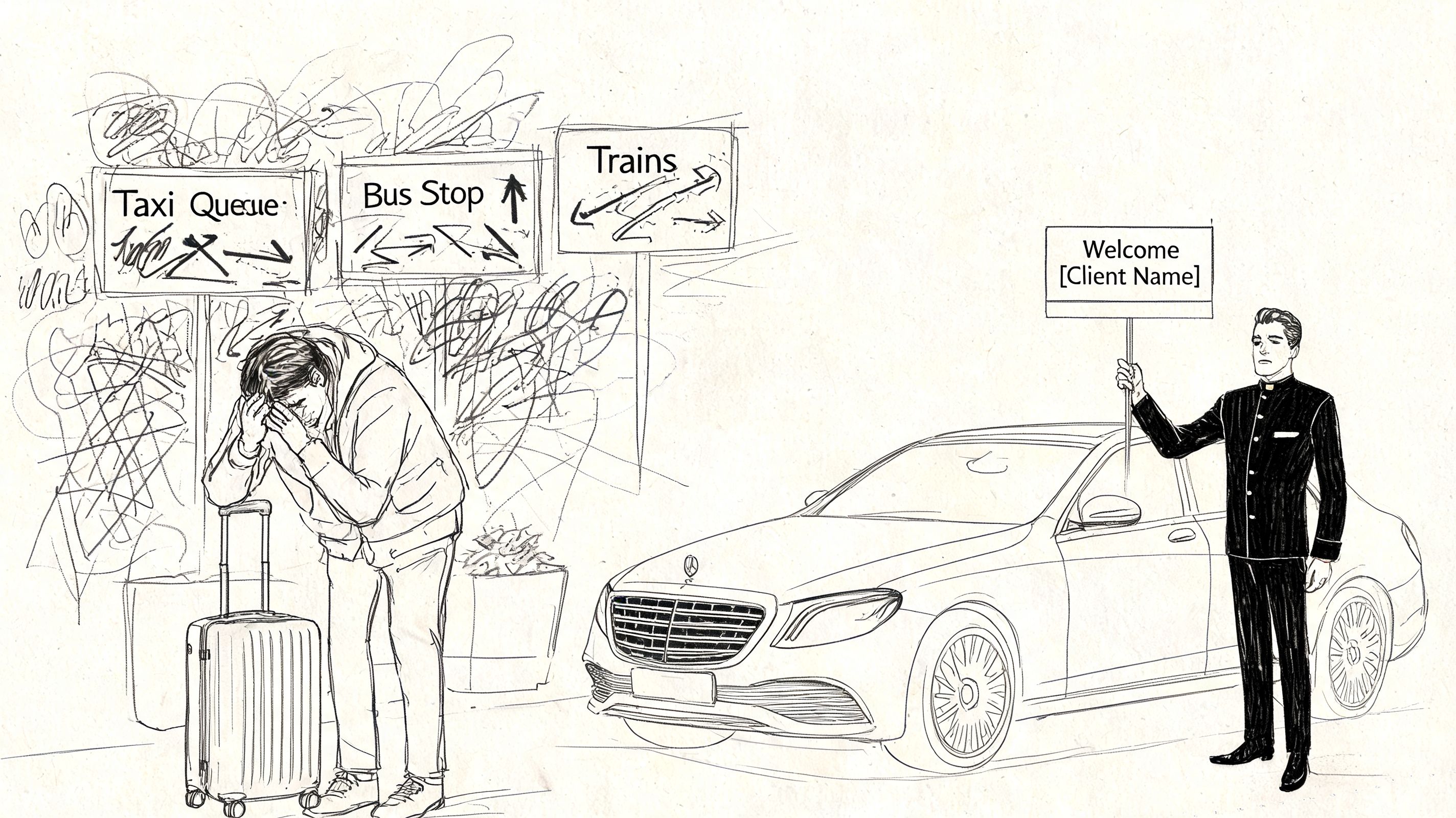
For business travelers, that means no wasted mental energy before a meeting. For families, it means no argument over escalators, ticket machines, or whether a stroller fits. For groups, it means everyone leaves together instead of splitting between cars, trains, and delayed arrivals.
The first mistake many travelers make
They optimize for the lowest visible price instead of the smoothest total journey.
That’s understandable. Airport transfers look simple online. But Milan trips rarely stay simple once you add luggage, rain, children, a late arrival, a hotel in a restricted area, or a next-day schedule outside the city. The right choice at the airport often saves more stress than any sightseeing upgrade later.
Practical rule: If your arrival day includes a meeting, children, elderly family members, heavy luggage, or a connection to another city, book certainty first and compare alternatives second.
A professional chauffeur service also starts the trip with useful information. A good driver can tell you which entrance your hotel uses, whether your address sits in a restricted traffic area, and where pickups are easiest the next morning. Those details don’t sound glamorous. They save time every day.
Why Choose a Chauffeur Over Other Options
The comparison isn’t luxury versus economy. It’s predictability versus friction.
Milan gives you three broad choices from the airport or around the city: chauffeur, taxi, or public transport. Each has a place. The problem is that travelers often compare them too narrowly. They look at headline fare first, then discover the hidden cost in time, luggage handling, queueing, confusion, or fragmented bookings.
What travelers actually compare
A chauffeur is strongest when you care about the whole door-to-door experience, not just the ride itself.
| Option | Best for | Main strength | Main drawback |
|---|---|---|---|
| Chauffeur service | Airport pickups, business trips, families, groups, multi-stop days | Fixed planning, meet-and-greet, direct routing, luggage help | Higher upfront cost |
| Taxi | Simple city rides when availability is easy | Fast to board if a taxi is waiting | Less predictable at busy moments |
| Public transport | Light luggage, solo travelers, flexible schedules | Lowest visible fare | Extra walking, transfers, and less comfort |
A chauffeur also fits how premium ground transport is evolving. The market is becoming more integrated and more digital. One clear sign is Uber’s announced acquisition of Blacklane on March 30, 2026, with Blacklane operating across 500+ cities in 60+ countries, as reported by Borsa Italiana’s finance coverage of the Uber-Blacklane deal. That matters because it confirms something travelers already feel on the ground. Premium chauffeur booking is no longer a niche workaround. It’s becoming a mainstream planning tool for international arrivals.
Where taxis and trains can go wrong
Taxis work fine when the trip is short, the queue is short, and you don’t need anything special. The problem is that Milan rarely stays calm during major fairs, evening arrival waves, and busy hotel check-in windows. You may still get a good ride. You may also start the trip with a line, rushed loading, and a conversation you’d rather not have after a long flight.
Public transport works best for travelers who know exactly where they’re going and can move easily with their bags. If you’re staying beside a station, arriving in daylight, and carrying one manageable suitcase, it can be perfectly sensible. But a lot of visitors underestimate the final stretch. Platforms, stairs, station exits, ticket validation, and that last walk to the hotel become much less charming when you’re tired.
The hidden cost of a cheap transfer is usually not the fare. It’s the first hour of your trip.
For groups, public transport becomes even less practical. Families often need room for luggage and child seats. Small corporate teams want to arrive together, not in fragments. Friends on a shopping or lake trip usually discover that one coordinated minivan is easier than trying to synchronize separate arrivals and separate returns.
A chauffeur also handles the awkward categories that generic guides skip: exhibition schedules, resort drop-offs, outlet runs, hotel entrances that confuse navigation apps, and addresses outside the center where buses are technically available but not realistically convenient.
Navigating Milans Airports a Seamless Pickup Explained
Airport pickup should feel simple from the passenger side. That simplicity only happens when the operator has done the work in advance.
What a proper airport pickup should look like
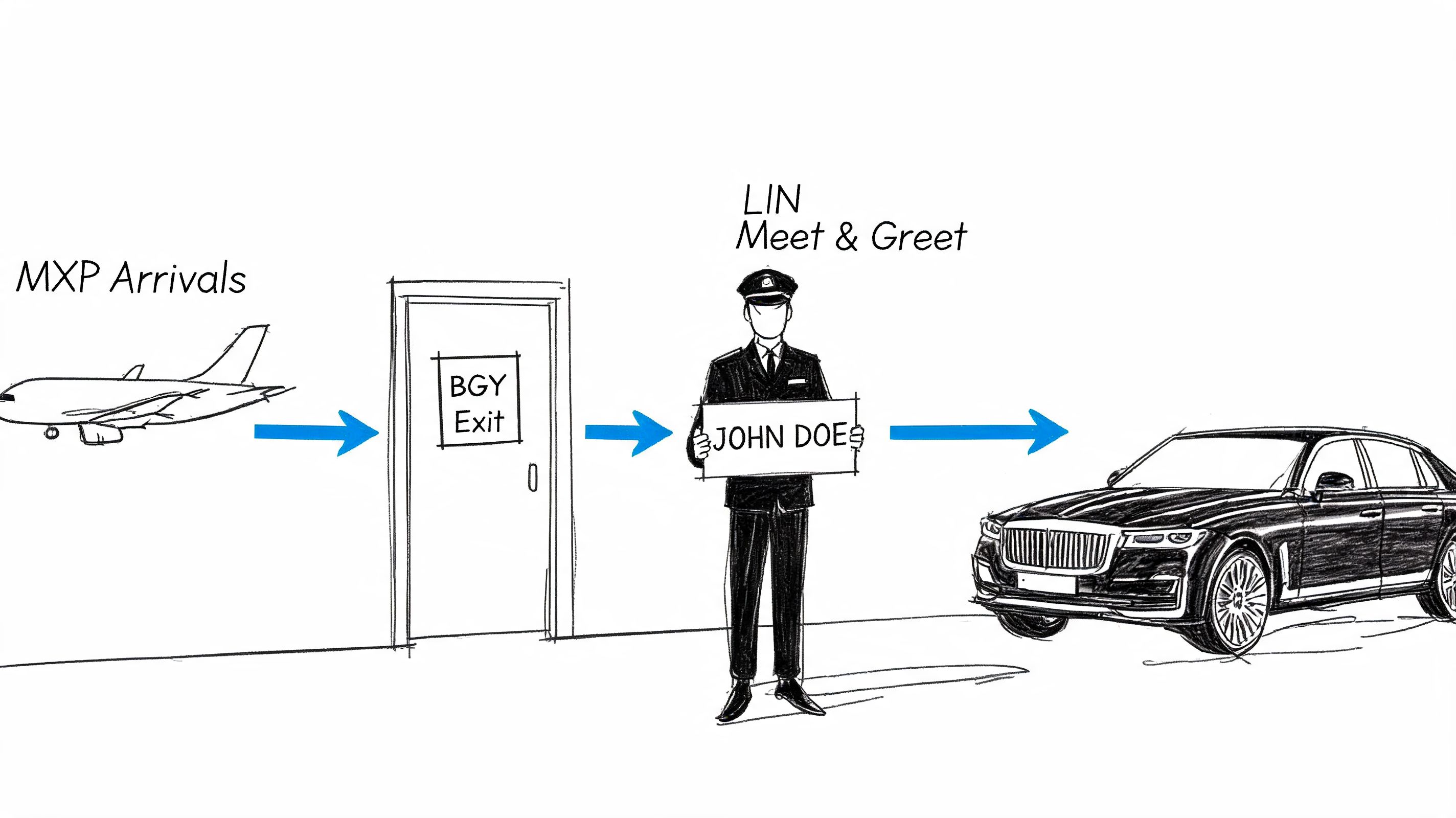
The sequence is straightforward. You land, taxi in, clear passport control if needed, collect baggage, and walk into arrivals. Your chauffeur or greeter waits at the agreed meeting point with your name. The driver already knows your flight details, tracks delays, and adjusts timing before you ever see a message.
That’s the standard you should expect at all three airports. If the booking feels vague before travel, it usually becomes stressful on arrival.
Use this checklist before departure:
- Flight number matters: It’s the only reliable way to track your actual arrival.
- Passenger count changes vehicle planning: Two adults with cabin bags is not the same job as four adults with ski cases.
- Name sign and contact number should be confirmed in writing: Don’t rely on memory.
- Special requests need to be pre-booked: Child seats, extra luggage room, or a second stop should not be improvised at the curb.
A practical local note. If you’re building a wider Milan stay around your arrival, this guide to Milan tourist places, public transport options, and airport transfers helps you match your transfer choice to where you’ll spend time.
Airport by airport local notes
Malpensa (MXP) is the airport where planning pays off most. It’s the biggest international gateway in the area, and passenger flow can feel long even when the process is efficient. Don’t rush straight out while checking messages. Finish baggage collection, step into the proper arrivals area, and look for the sign exactly where your confirmation says it will be. Most pickup confusion happens because passengers walk past the meeting zone while trying to call at the same time.
A short visual helps if it’s your first arrival in Milan:
Linate (LIN) is easier in layout and closer to the city, which makes it popular with business travelers. The common mistake here is assuming “small airport” means “I can decide transport after landing.” That works until several flights arrive close together and the curb gets busy. If you have a meeting or dinner reservation in Milan, pre-booking still removes the only unstable part of the day.
Bergamo Orio al Serio (BGY) serves many low-cost passengers and often creates the most mixed crowd profile. That means more variability on the ground. It’s a useful airport for groups, especially when you want a minivan and direct onward travel, but it’s not the place to arrive with an unclear plan and expect a calm exit.
If your group lands at Bergamo, agree on one meeting point before the doors open. The airport is easy enough to use, but scattered groups lose time fast.
Understanding Your Fleet Options for Any Occasion
The right vehicle depends less on status and more on the job you need it to do.
A lot of travelers book too small because they count seats, not people plus luggage plus comfort. Others book too large because they assume “premium” means the biggest available vehicle. Both mistakes create avoidable friction. In practice, Milan airport and intercity transfers usually come down to matching the vehicle to luggage profile, schedule intensity, and who needs to arrive in what state of mind.
Sedans for business and quiet comfort
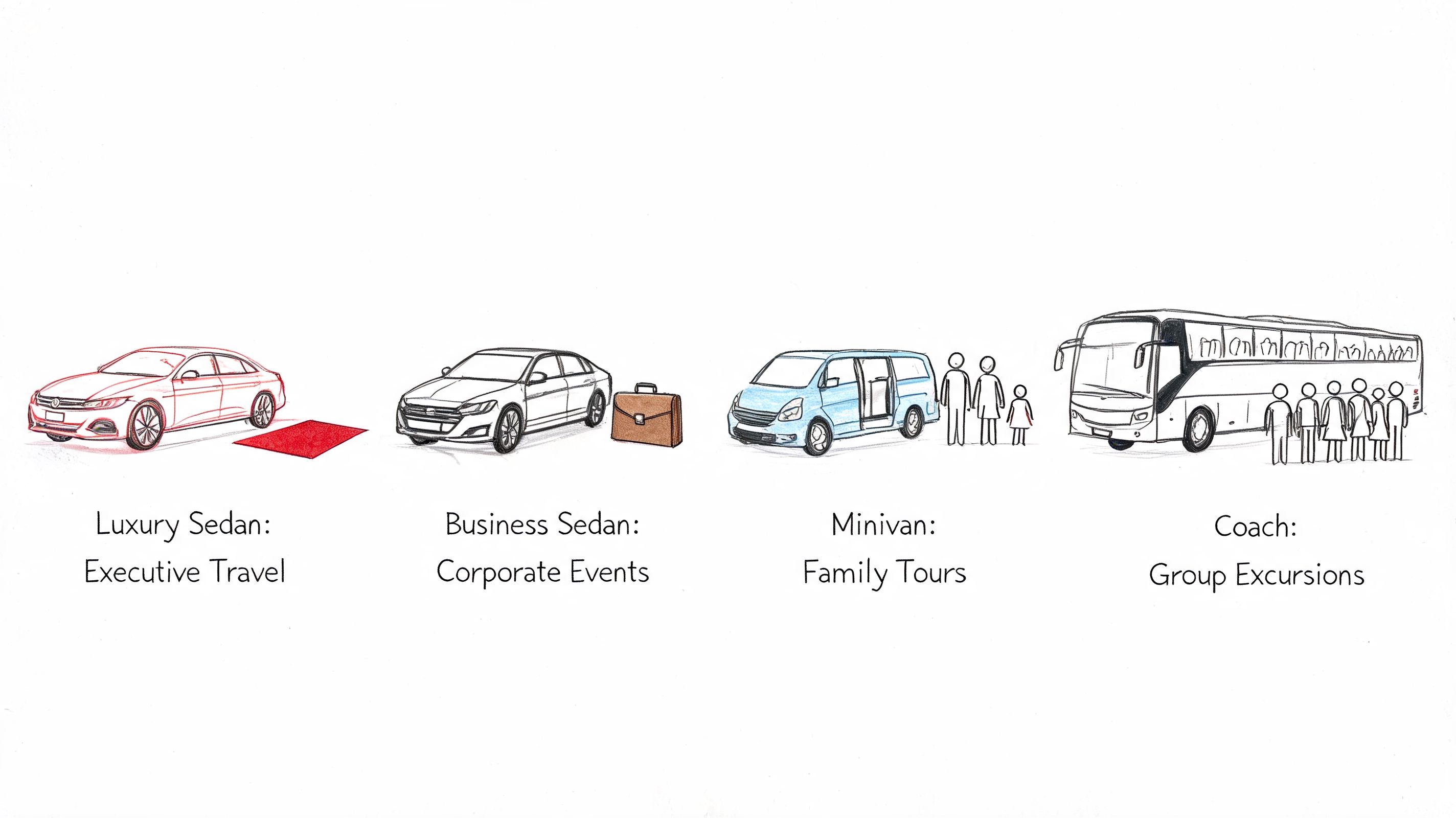
For many business travelers, the Mercedes-Benz E-Class is the practical sweet spot. It gives you a professional arrival, enough comfort for airport runs or regional transfers, and efficient movement through busy motorway corridors. According to Prestige Car Limousine’s discussion of Milan chauffeur vehicles, Milan chauffeur fleets commonly use the Mercedes-Benz E-Class and S-Class, and the E-Class uses real-time GPS routing that can shave 15 to 20 minutes off peak-hour trips through the A4 and A8 motorways.
The S-Class suits a different kind of day. It’s for senior executives, diplomatic movement, private clients who need discretion, or anyone treating the car as part of the working environment. If the ride is an extension of the meeting day, a larger luxury sedan often earns its place.
Minivans and larger vehicles for groups
For families and small groups, the Mercedes V-Class is usually the most useful vehicle in the fleet. It’s not just about adding seats. It changes the boarding process, the luggage process, and the mood inside the car. The verified fleet data notes that a V-Class accommodates 6 passengers plus 6 suitcases in typical transfer use, which is exactly why it works so well for airport runs, outlet trips, and Lake Como days.
A few good fits:
- Family with children: A V-Class handles strollers, child seats, soft bags, and the inevitable “one more carry-on” better than a sedan.
- Three or four adults on a lake or shopping trip: A minivan gives everyone room without splitting into two vehicles.
- Corporate team transfer: One vehicle keeps the team together and avoids staggered arrivals at a fairground or hotel.
- Wedding guest movement or event shuttles: Minibuses and coaches begin to make more sense than trying to coordinate many small cars.
For larger parties, the key question isn’t “How many seats?” It’s “How many coordinated movements?” A coach is useful when everyone follows the same schedule. Multiple vans are better when guests split between hotels, event venues, and return times.
Book for the most inconvenient bag, not the average bag. Garment bags, sample cases, strollers, and shopping luggage usually decide the vehicle, not passenger count alone.
Decoding Pricing Fixed Rates and Smart Itineraries
Fixed pricing sounds simple. It often isn’t.
One of the biggest trust problems in this market is that travelers hear “fixed price” and assume every road cost and operational detail is already included. But a 2025 survey found that 38% of travelers were confused about what was included in the fixed price for trips from Milan to Lake Como, while few suppliers clearly disclosed tolls, parking fees, or cross-border rules, according to TransferMilan LLC chauffeur service page. That confusion is real, especially once you move beyond a straightforward airport-to-hotel ride.
What fixed price should include
For a standard transfer, ask the supplier to state in writing what the quote covers. You’re looking for clarity on route, vehicle category, waiting policy, luggage handling, tolls where applicable, parking if relevant, and any border-related elements if the trip leaves Italy.
You should also separate two models that travelers often mix up:
- Point-to-point transfer: Best when you have one origin and one destination, with no meaningful stop in between.
- Hourly or daily disposal: Better when your day includes waiting time, several stops, uncertain timing, or a return leg.
That distinction matters because the cheapest quote for each leg can become the most inconvenient total plan.
The publisher’s own comparison guide on car service in Italy for 2026 is useful for understanding how transfer-style pricing and broader chauffeur hire differ once you add more than one destination.
When one provider is the smarter move
Many travelers book airport arrival first, then solve the rest later. That usually works for simple city stays. It works poorly for multi-day plans around northern Italy.
A better approach is to map the trip first. If you know you’ll need airport arrival, one city transfer, a lake day, and an airport departure, ask for the whole itinerary at the quote stage. That creates cleaner logistics and fewer mismatches in service level.
The underserved planning question is not “What is the cheapest ride?” It’s “At what point does one integrated provider become the easier and more economical choice?” The verified demand analysis provided for this topic notes that travelers who book airport arrivals and day trips through a single integrated provider report 1.5x more satisfaction in consistency and punctuality than those mixing operators.
Here’s a simple planning model.
| Destination | Distance | Estimated Time | Estimated Fixed Rate (2026) |
|---|---|---|---|
| Milan city center from MXP | Standard airport transfer distance | Varies by traffic and exact address | Ask for a written fixed quote |
| Lake Como from Milan | Regional transfer | Varies by town, hotel access, and parking | Ask whether parking and waiting are included |
| Serravalle outlet from Milan | Day trip or return transfer | Depends on one-way or round trip structure | Compare transfer pricing with hourly disposal |
| Switzerland or French Riviera | Cross-border transfer | Depends on route and border requirements | Ask for border, toll, and parking treatment in writing |
That table is deliberately qualitative. The exact number matters less than the quote structure.
A few practical rules help:
- Use point-to-point when the plan is direct and timed.
- Use hourly hire when the return time is flexible.
- Use one provider when the trip spans several days and regions.
- Ask for the final invoicing logic before booking if the itinerary includes hotels with parking charges, border crossings, or route changes.
For airport transfer plus day trip combinations, continuity often matters more than squeezing every leg. The same operations team already knows your luggage profile, passenger preferences, preferred language, and pickup style. That cuts down on repeat explanations and preventable mistakes.
Booking Your Chauffeur and Preparing for Your Trip
Good bookings are boring. That’s exactly what you want.
The smoother the ride, the more invisible the preparation looks. Most problems start before the wheels move, usually with incomplete details or assumptions that the operator can “figure it out on the day.” A serious booking process avoids that.
The booking details that matter
When requesting a quote, send the core facts in one message:
- Arrival or pickup point: Airport, hotel, apartment, fairground, station, or restaurant.
- Date and local time: Include arrival time for flights and desired pickup time for departures.
- Flight number or train detail: Essential for tracking and timing.
- Passengers and luggage: State both, especially if anyone carries bulky items.
- Vehicle preference: Sedan, luxury sedan, minivan, minibus, or coach.
- Special requirements: Child seat, elderly passenger support, multiple stops, shopping space, border crossing.
Multilingual support matters more than people think. If you’re coordinating from abroad, especially for family members or senior colleagues, clear written confirmation in English can prevent a lot of confusion. For practical planning ideas before travel, TransferMilan’s travel tips archive is a useful reference.
What to confirm before wheels move
After booking, confirm the operational details, not just the price.
Ask for these items in writing:
- Pickup instructions: Exact meeting point and who initiates contact.
- Vehicle category: Not just “car booked.”
- Cancellation or change handling: Especially important for changing flight plans.
- Payment method: Card, cash, advance payment, or pay-on-board.
- Special requests acknowledged: Child seat, extra stop, or large luggage should appear on the confirmation.
A final tip from the operator side. If your plans are even slightly complex, send one consolidated message rather than a long chain of fragmented updates. One clean booking summary helps dispatch, driver assignment, and vehicle matching. It also reduces the chance that one important note gets buried in chat history.
The best confirmation email is the one your driver can read in ten seconds and understand completely.
Beyond the Transfer Trust Safety and Local Expertise
The biggest difference between a random ride and a professional chauffeur service often appears in the moments the passenger never notices.
That includes licensing, insurance, route judgment, etiquette, and the discipline to handle delays without creating drama. In Italy, those aren’t small details. They are the foundations of a proper chauffeur operation.
Why NCC licensing matters
In Milan, licensed chauffeur operators work under Italian NCC regulations. According to TransferMilan’s explanation of chauffeur rules in Milan, those rules require professional driver certification, full vehicle insurance, and 20+ hours of annual training, and the same source states that licensed operations reduce risks compared with unlicensed ride-sharing by 40% to 50% in urban accident data.
For travelers, that translates into something very concrete. You know the service is regulated, insured, and professionally staffed. You aren’t stepping into an informal arrangement and hoping standards will hold when conditions get messy.
What local expertise changes in practice
A local operator doesn’t only drive. The operator understands how Milan moves.
That matters when your hotel entrance is not the same as the postal address, when your meeting venue has a better side for pickup, when your return transfer should avoid an awkward exhibition rush, or when your family needs a calmer loading area than the one the map suggests. Those adjustments don’t show up on glossy brochures. They make the trip feel easy.
This is also where a chauffeur service milan booking becomes more than an airport product. A reliable operator can support the full rhythm of the stay. Airport in, city meetings, shopping, Lake Como, wedding guests, station transfer, airport out. One standard, one contact flow, one written record of what was agreed.
If you value privacy, time discipline, and clean logistics, that consistency is worth paying for. Not because every trip needs a luxury badge. Because travel in northern Italy gets much better when someone competent is already thinking two steps ahead.
If you want one point of contact for airport transfers, city rides, and multi-day travel across northern Italy, TransferMilan LLC offers fixed-price chauffeur services from Malpensa, Linate, and Bergamo with sedans, luxury cars, minivans, minibuses, and coaches, plus booking support in English, Italian, and Russian. Request a written quote with your full itinerary, passenger count, and luggage details, and compare the transport plan before you land.