0 Transfer to Malpensa Airport: 2026 Guide
- Travel Tips
- by Tara Malone
- 13-07-2026
You're probably running the same calculation every first-time visitor runs. How early do I leave Milan, which terminal do I need, what happens if the train is crowded, and will a taxi be there when I need it? That small layer of uncertainty matters more at Malpensa than at many city airports because MXP sits 49 km northwest of Milan and handles very heavy traffic, with 28.5 million passengers in 2024, which ranks it among Europe's busiest airports, per Milan Malpensa Airport information.
A transfer to malpensa airport looks simple on paper. In real life, the right choice depends on luggage, flight time, terminal, children, mobility needs, and how much unpredictability you're willing to absorb before a flight. Travelers who like comparing airport experiences may also find it useful to look at how access planning differs at airports outside Italy, like this guide to Gerald R. Ford International Airport access and services from Splash Access.
This guide focuses on what works in 2026 for real travelers, not just what looks cheapest in a fare list. If you're combining your airport run with sightseeing, this overview of Milan tourist places, public transport options, and airport transfers is also useful for planning the days around your flight.
Table of Contents
- Planning Your Malpensa Airport Transfer for 2026
- Malpensa Transfer Options A Side-by-Side Comparison
- Beyond Price and Time The Hidden Costs of Each Option
- Strategic Booking and Timing for a Flawless Transfer
- Choosing the Right Transfer for Your Travel Style
- Your Malpensa Transfer Questions Answered FAQ
- Is Uber a better option than a pre-booked transfer?
- What's the safest option for very early departures?
- Is the train still worth it if I'm staying in central Milan?
- What does meet and greet usually mean?
- What if I need to compare companies before booking?
- Are private transfers good for groups?
- Should I book a transfer if I'm continuing beyond Milan?
Planning Your Malpensa Airport Transfer for 2026

It's 5:15 in the morning, the street outside your apartment is still dark and damp from the night, your flight leaves in a few hours, and the transfer choice you made two days ago suddenly matters a lot. The train that looked easy on paper feels different now, with two suitcases on the cobbles and a child half asleep against your hip. The taxi sounded simple until you found yourself standing under a doorway with no clear idea of pickup time or final fare, watching the occasional empty cab roll past without stopping. Malpensa rewards travelers who plan for friction, not just for distance.
That is the right way to approach a transfer to malpensa airport in 2026. The route from Milan is manageable, but the weak points are easy to underestimate: getting from your accommodation to the station, finding space for luggage, dealing with a bus stop in bad weather, or landing late and finding out your "cheap" option no longer feels practical.
Start with the four real choices
For most visitors, the choice is still one of four:
- Train if you want a direct rail connection and can handle the station side of the trip
- Bus if fare matters most and fixed pickup points are acceptable
- Taxi if you prefer on-demand door-to-door service and can accept some variability
- Private transfer if you want the car, driver, price, and pickup arranged in advance
The trade-off is rarely about transport alone. It's about how many moving parts you're willing to manage on travel day.
The train works well for a solo traveler staying near the right station. It becomes less attractive if your hotel is on a side street, you're carrying large cases, or you need to keep a family together through platforms, lifts, and crowded carriages. The bus is often cheaper, but its true cost shows up in extra waiting, limited personal space, and the final leg from stop to hotel or terminal entrance. Taxis can be useful, especially for simple city runs, though the experience depends heavily on timing, queue length, and traffic conditions. A pre-booked transfer usually costs more than public transport, but it removes the uncertainty that causes most airport-day stress.
Plan around friction first
I tell first-time Milan visitors to sort this out in a practical order:
-
Check your flight time
Early departures and late arrivals cut down your comfortable options fast. -
Check your exact starting point and terminal
A transfer that looks easy on a map can become awkward if you need another metro ride, a walk with luggage, or a terminal change. -
Count bags, children, and tired people One backpack is not the same trip as four cases, a stroller, and a grandparent.
-
Decide how much uncertainty you can tolerate
Some travelers are happy to piece the trip together. Others want one confirmed pickup and no surprises.
That last point matters more than many people expect.
If you're also mapping out how airport travel fits into your wider stay, this guide to exploring Milan with public transport and airport transfer options helps connect the airport run with the rest of your itinerary. Travelers comparing airport ground transport in other markets often use references like Splash Access for perspective, but Milan has its own rhythms, especially around early morning departures, fashion-week congestion, and the long walks from some apartments to the nearest practical pickup point.
A good transfer feels easy because the hard parts were handled before the day began. That's why fixed-price private service is often the smarter choice for families, business travelers, and anyone arriving late or leaving early. You're not only buying the ride. You're buying back time, certainty, and a calmer start or finish to the trip.
Malpensa Transfer Options A Side-by-Side Comparison
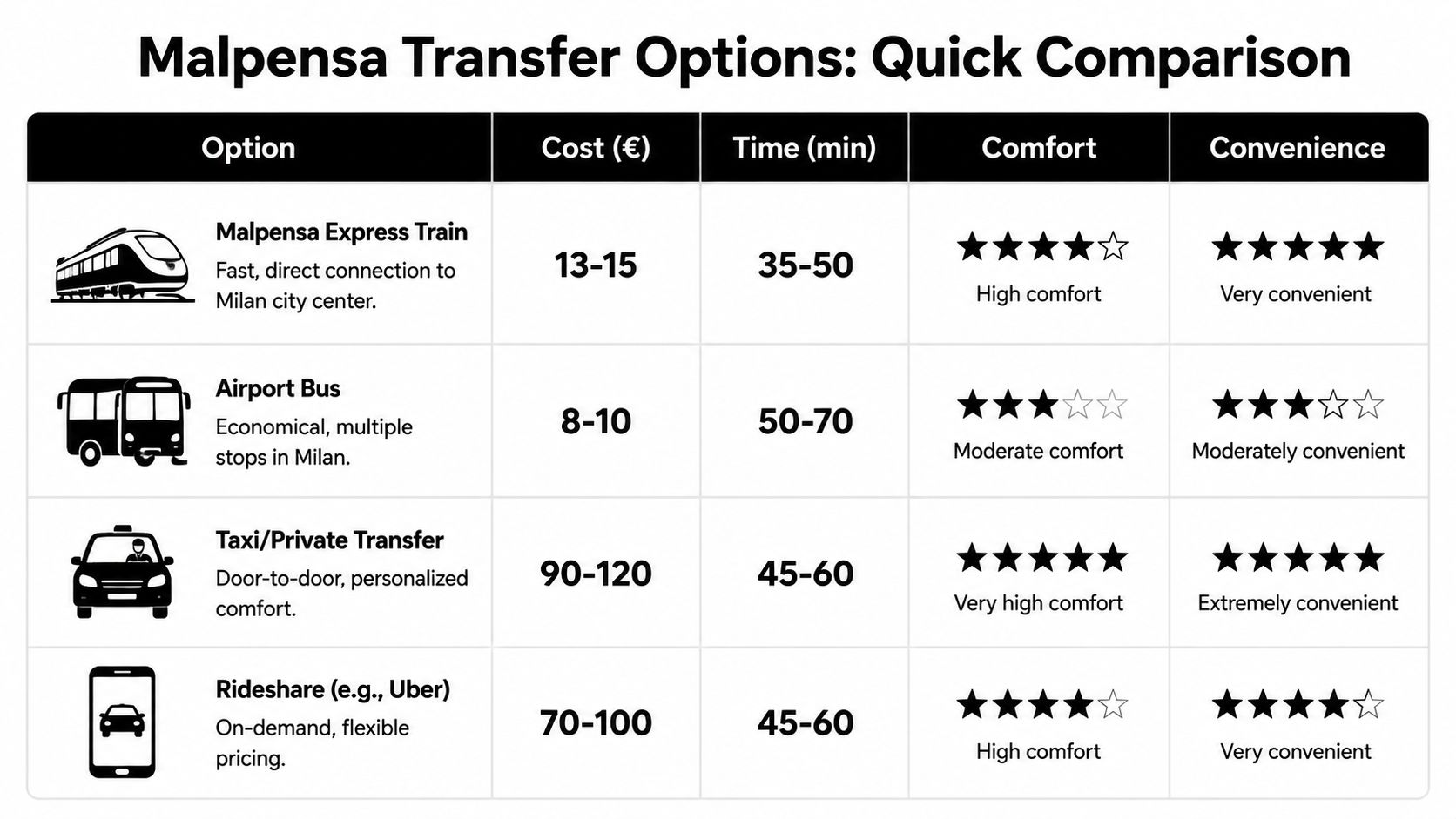
When clients ask me for the fastest summary, I give them a table first and the caveats second. A transfer to malpensa airport is one of those decisions where the headline answer is easy but the useful answer sits in the details.
Milan to Malpensa Transfer Options at a Glance 2026
| Transfer Option | Price Range (per person) | Travel Time | Best For |
|---|---|---|---|
| Malpensa Express train | Qualitatively lower than private car options | Usually direct city-airport travel | Solo travelers with light luggage |
| Airport bus | Qualitatively budget-friendly | Road-dependent | Travelers focused on price |
| Taxi | Qualitatively higher than bus or train | Door-to-door, traffic-dependent | Couples, late arrivals, simple hotel runs |
| Pre-booked private transfer | Qualitatively premium | Door-to-door, planned in advance | Families, groups, business travelers |
For a broader look at chauffeur and transfer categories across Italy, this comparison of car service options in Italy for 2026 is useful if you're deciding beyond just the airport run.
Train works best when your trip is simple
The Malpensa Express is the cleanest public option if your hotel is already well connected to the station you're using. It's especially sensible for one person carrying manageable luggage and traveling during normal daytime hours. There's a kind of pleasure to it, too, on a clear morning: the smell of espresso drifting from the bar at Centrale, the slow filling of the carriage with commuters and rolling suitcases, the city thinning out into farmland as the train picks up speed.
Where travelers get caught out is the part after the train. You still need to reach the station, work your way across platforms, and then handle the last stretch from your Milan stop to your hotel or apartment. If you're staying in a small street with cobbles, limited vehicle access, or a decent walk from the metro, the train can stop being convenient very quickly.
Bus is cheaper, but it asks for patience
Airport buses appeal to travelers who want the lowest transport bill. That makes sense, especially for solo leisure trips. The catch is that buses add layers of uncertainty visitors usually underestimate. Traffic leaving Milan in the morning rush. The queue that forms when a coach fills before you reach the front. Fixed drop-off points that may still leave you with another ride to organize. Add a rainy October morning, a fogged-up bus window, and a forty-minute wait at a crowded stop near Lampugnano, and the "saving" you imagined when you booked starts to look different.
If your accommodation isn't near the bus stop, your "cheap" airport transfer can turn into a bus ride plus a taxi plus a long drag with luggage.
For some travelers, that's acceptable. For others, it's the most tiring part of the day.
Taxi is convenient, but not always predictable
A taxi can be perfect when the queue is short and your destination is straightforward. You get direct service and avoid the station experience entirely.
The trade-off is predictability. You don't control which vehicle arrives, how much luggage space it has, or how easy communication will be if you're tired after a long flight. During busy moments, the waiting itself can become the issue. I've watched travelers stand for twenty minutes at a Milan taxi rank watching cabs go past with the roof lights off, while their flight check-in window shrinks in their phone.
Private transfer is strongest where public options weaken
A pre-booked car is rarely chosen only for comfort. It's usually chosen because it removes several small risks at once. The car is assigned, the pickup point is defined, and the route is built around your address rather than around a station.
This matters even more if terminals enter the equation. Transfers between Terminal 1 and Terminal 2 rely on a free landside shuttle bus, with a 7 to 15 minute daytime frequency and a 10 to 15 minute ride, but peak queues and traffic can stretch the effective transfer to 30 to 45 minutes, per this Malpensa terminal transfer guide.
The hidden weak spot at Malpensa
That inter-terminal shuttle catches many first-time visitors off guard. There's no airside connection between terminals, so if you land in one and need the other, you're dealing with a landside move and the timing that comes with it.
- Good fit for train: one traveler, light bags, central hotel, normal daytime schedule
- Good fit for bus: flexible budget traveler with time to spare
- Good fit for taxi: simple point-to-point ride when availability is strong
- Good fit for private transfer: groups, children, non-central stays, tight schedules, and terminal-sensitive itineraries
Beyond Price and Time The Hidden Costs of Each Option
A Malpensa transfer can look simple on paper, then become tiring fast. The friction usually shows up after landing, when bags are heavier than expected, everyone is tired, and the next decision has to be made in a crowded station, at a taxi rank, or outside the terminal under that flat grey Lombardy light that sometimes hangs over the airport for days.
Public transport often gets harder after the first easy step
Train and bus work well for some trips. I recommend them often for solo travelers with one bag and a hotel near a major stop. The problem is everything that happens before and after the ride itself.
At Malpensa, getting from baggage claim to the right platform or bus stand is usually manageable, but it still takes attention. Add children, older relatives, bulky luggage, or a rental stroller, and that simple transfer starts to feel like a chain of small tasks. Then you reach Milan and the trip may still not be over. A station arrival is not a hotel arrival, especially if your apartment is on a side street, your accommodation has stairs, or your final destination is outside the center. Picture pulling two cases over Milanese cobbles at eleven at night, looking for the right doorway, while the rest of the family waits under a streetlamp with the dog and the snacks.
That last stretch catches first-time visitors all the time.
Taxis solve one problem and create another
A taxi removes the station change and gets you door to door. That's the main advantage. The trade-off is uncertainty.
At busy arrival times, the true expense isn't only the fare. It's the queue, the lack of clarity on wait time, and the question of whether the next car will fit your group and luggage comfortably. Late at night or very early in the morning, availability can also feel less predictable than visitors expect. If you have a meeting, a dinner reservation, or tired children already close to meltdown, that uncertainty matters.
Time pressure changes what "good enough" means
Some trips leave room for improvisation. Others do not.
For travelers arriving at Terminal 1, official Minimum Connecting Times can reach 90 minutes for high-risk flights, per the official Malpensa technical annexes. That doesn't mean every city transfer is urgent. It does mean Malpensa is an airport where buffers disappear faster than people expect, especially if the journey includes a terminal change, a family group, or a destination that isn't right beside a rail stop.
I've seen travelers save a little on paper, then spend that saving back in stress.
A transfer starts to look expensive only when compared in isolation. Put back the queue time, the extra local ride, the luggage handling, and the risk of delay, and the math changes.
What fixed-price planning actually gives you
A key benefit of a pre-booked car is fewer variables on a day that already has enough of them.
- A defined pickup point cuts out the guesswork after arrival.
- Luggage support makes a difference after a long-haul flight or with family travel.
- The right vehicle size avoids the common problem of fitting the people but not the bags.
- A fixed price helps you budget without second-guessing the route or traffic.
One local example is TransferMilan LLC, which offers fixed-price airport and long-distance transfers with sedans, minivans, minibuses, and meet-and-greet support. That setup is often the cleaner choice for families, groups, early departures, late arrivals, and stays outside central Milan where public transport usually turns into a two-step or three-step journey.
Strategic Booking and Timing for a Flawless Transfer
Timing is where good transfer decisions become bad ones. The same train, bus, or car that works perfectly at midday can become awkward at the edges of the day, during fair periods, or when your departure leaves no room for recovery.
The first rule is to book around your flight, not around a generic estimate
Travelers often ask for a single recommended departure time from Milan. There isn't one. A transfer to malpensa airport should be timed backward from check-in needs, airline habits, terminal, and your tolerance for stress.
If you're the kind of traveler who likes backup options, daytime public transport gives you that flexibility. If your departure is time-critical, certainty matters more than optionality.
Early and late hours narrow the field fast
For flights before 05:00 or arrivals after 02:00, public transport options like the Malpensa Express and most bus services aren't running, which creates a service gap where pre-booked taxis or private transfers become the only reliable 24/7 option, per this Malpensa airport transfer timing guide.
That matters in real life because off-hours mistakes are harder to fix. If a daytime bus is full, another one will follow. At the edges of the night, you may be out of alternatives, watching your phone light up the inside of an empty bus shelter while the minutes you can't spare go by.
A booking approach that works
I usually recommend choosing by trip type rather than by habit.
-
Book public transport only when the route is simple
Central hotel, daytime departure, light bags, no children, no mobility concerns. -
Pre-book a car when the flight is awkward
Very early, very late, or tied to a schedule you can't miss. -
Lock in group transport sooner rather than later
Groups are harder to improvise than solo rides, especially when everyone lands tired and wants one vehicle.
Local note: During busy fair and event periods in Milan, the issue often isn't only traffic. It's the extra time spent coordinating people, bags, and pickups while the city is already under strain.
Build buffer where visitors usually don't
Travelers who know Milan well usually leave more margin than first-time visitors expect. Not because the route is impossible, but because city logistics punish optimism. Apartment checkouts run late. Elevators are slow, the older ones in the centro storico move with a wheeze that feels personal. Porters aren't always available. Streets can be awkward for loading, especially the narrower ones around Brera and Navigli where double-parked delivery vans turn a five-minute pickup into a fifteen-minute one.
A simple checklist helps:
- Confirm terminal the day before
- Leave extra time if you're traveling as a group
- Keep the driver contact or booking details easy to reach
- Don't assume all public options run through the night
- Treat airport day as a logistics day, not a sightseeing day
That final point saves more missed flights than any clever routing trick.
Choosing the Right Transfer for Your Travel Style
The best transfer to malpensa airport isn't universal. It depends on who's traveling and what the airport day needs to feel like. A solo consultant flying out for a Tuesday meeting, a family of five with a connection in Frankfurt, and a couple heading to Lake Como after a week of sightseeing shouldn't choose the same way.
Families and small groups
Families usually start by looking at price per person. Then they remember the children, the jackets, the snacks, the cabin bags, and the one adult who's already running on too little sleep before the journey begins.
For them, the friction of public transport is cumulative. One staircase isn't the problem. One platform change isn't the problem. The problem is everything happening at once while you're trying to keep the group moving and a six-year-old from sitting down on the floor of Centrale.
- Train can work if the children are older and luggage is minimal.
- Bus can work if the stop is close and nobody minds waiting.
- Private minivan usually works better when the trip needs to stay calm from door to terminal.
Business travelers and event attendees
Business travelers usually value control over price. They need the pickup to happen when expected, the vehicle to be quiet enough to work in, and the route to remove unnecessary decisions. The ideal version is the one where you close the laptop in the hotel lobby, open it again in the car, and finish the deck somewhere between Cascina Merlata and the airport without breaking concentration.
This is also the group most affected by transfer uncertainty. If you're heading to a meeting, an exhibition, or a client dinner straight from the airport, you don't want to start by negotiating stairs, queues, or missing space for luggage samples and presentation materials.
Here's a quick visual if you're comparing airport transfer styles and expectations:
Luxury leisure travelers and long-distance onward trips
This group often isn't going to Milan city center at all. They're heading onward to a villa, a resort, the lakes, the coast, or a shopping stop before check-in. In those cases, public transport may be technically possible and practically annoying. Picture stepping off a long-haul flight at Malpensa and asking yourself whether you really want to drag four suitcases through Centrale to make a regional train connection while what you actually want is to be on a terrace by the lake with a Negroni before sunset.
A chauffeured transfer is often less about luxury in the flashy sense and more about continuity. You leave arrivals, meet the driver, load the bags once, and continue directly to your final destination.
The longer the onward journey, the more valuable it becomes to avoid breaking the trip into airport train, city transfer, and second connection.
Travelers with reduced mobility
This is the category public transport serves least gracefully. Malpensa does provide free assistance for passengers with reduced mobility within the airport, but public transport from Milan city presents accessibility challenges, while private transfer services can offer door-to-door service with accessible vehicles like minibuses, as noted in this guide to getting to Milan from Malpensa.
That difference matters because accessibility isn't only about the airport building. It's about the whole route from accommodation to terminal. A service that can pick up directly and handle the vehicle fit in advance removes a lot of uncertainty for travelers and families alike.
Your Malpensa Transfer Questions Answered FAQ
Is Uber a better option than a pre-booked transfer?
Sometimes, but not automatically. App-based rides can be convenient when demand is low and your route is simple. A pre-booked transfer is usually better when you want a defined pickup, a known vehicle category, and less uncertainty on airport day.
What's the safest option for very early departures?
A pre-booked car. Public transport doesn't cover every off-hour need, and a pre-dawn flight is the worst possible moment to discover that your backup plan isn't running.
Is the train still worth it if I'm staying in central Milan?
Yes, if your hotel is close to the station you need and you're traveling light. If you still need a taxi at the end, the convenience gap narrows quickly.
What does meet and greet usually mean?
It usually means the driver waits at an agreed arrival point, helps you spot the vehicle quickly, and assists with luggage. That's especially useful after a long-haul flight, when the hardest part of the transfer is often finding the right person fast in a crowded arrivals hall full of people holding identical white signs.
What if I need to compare companies before booking?
That's smart. Look beyond star ratings and check the details that affect the day itself: pickup instructions, vehicle type, waiting policy, support response, and whether pricing is clearly written. This guide on how to evaluate transfer reviews in 2026 gives a practical way to compare providers without getting distracted by vague praise.
Are private transfers good for groups?
Usually, yes. Groups benefit from staying together, loading once, and arriving together. That matters for families, wedding guests, trade fair teams, and anyone carrying more than hand luggage.
Should I book a transfer if I'm continuing beyond Milan?
If you're heading straight to Lake Como, a resort, an outlet, or another city, a direct transfer often makes more sense than stitching together airport transport plus onward rail or taxi segments.
If you want a fixed-price, door-to-door option for your transfer to malpensa airport, TransferMilan LLC handles airport pickups, hotel transfers, business travel, and group transport across Milan, the lakes, and onward destinations in Italy, Switzerland, and France. It's a practical fit when you'd rather confirm the ride in advance and keep the airport day simple.